
AI Next Stop: Launchpad Enters the "Institutionalized Era", MCP Counters with "Decentralized Distribution from VCs"


Original Title: "Crypto AI Second Half: Launchpad War, Tokenomics Shift Towards Ecosystem, Rising Star of MCP"
Original Author: Zolo, Deep Tide TechFlow
It has been just over 4 months since the last assessment of AI projects. The once-promising AI narrative has been hit hard by Trump's Meme, the sudden emergence of deepseek, and various setbacks such as tariffs, leading to a gradual depletion of on-chain liquidity. A series of "unexpected" events have caused the AI bubble to burst prematurely.
After assessing those projects last year, I have been following up on basically all of them. It is evident that some have gradually died out, some are still storytelling, some are continuing to work on new things, and some have experienced unexpected rebounds due to the arrival of "whales."
On April 6, the MCP project Dark launched;
On April 17, Virtuals' Genesis Launchpad went live;
On April 20, ai16z's auto.fun Launchpad went live.
Is there a second wave for AI? My answer is yes. Is AI still the same as before? My answer is no.
After experiencing the burst of the bubble over the past few months, can AI achieve reconstruction from ruins? As we enter the second half, how will AI play? Here are my thoughts.
Launchpad Outbreak, Meme Launchpad and AI Launchpad Will Each Occupy Half of the Territory
This year, we have seen too many Launchpads. The outbreak of Four.Meme at the beginning of the year, myshell's AI Launchpad went live; and recently, Launchlab. In addition to these Launchpads, in different ecosystems, each is building its own Launchpad.
The competition of Meme Launchpad is fundamentally about ecosystem + creator competition. The ecosystem determines that each public chain can have its Meme Launchpad, and almost only one Meme Launchpad can become the role that wins it all.
The creator competition includes:
1- Providing token issuers with a better revenue-sharing model
2- Attracting those with creative (angle-seeing) minds to issue tokens on your platform
Known as the flagship of Launchpads, "$TIME" only reached a peak of 9M, and there hasn't been a successful Meme that emerged from it. News of Pump.fun releases one or two tokens a day, with only a handful successfully graduating, while other platforms have none.
What affects one, affects all. However, most of the above are focused on "Meme" Launchpads. The key here is the perspective and ongoing dissemination. Memes lack utility, and whether you like it or not, an AI Agent must have utility to be taken seriously.
Therefore, you will see AI projects launching on dedicated AI Launchpads, as Meme Launchpads are not suitable for AI Agents.
According to incomplete statistics, compared to Meme Launchpads, there are already at least 5-10 AI Launchpads.
· Meme Launchpad: Pumpfun, Launchlab, FourMeme, Clanker, Apeswin, etc.;
· AI Launchpad: autofun, Virtual Genesis, Creatorbid, Arc Ryzome, Myshell, Spectral, etc.
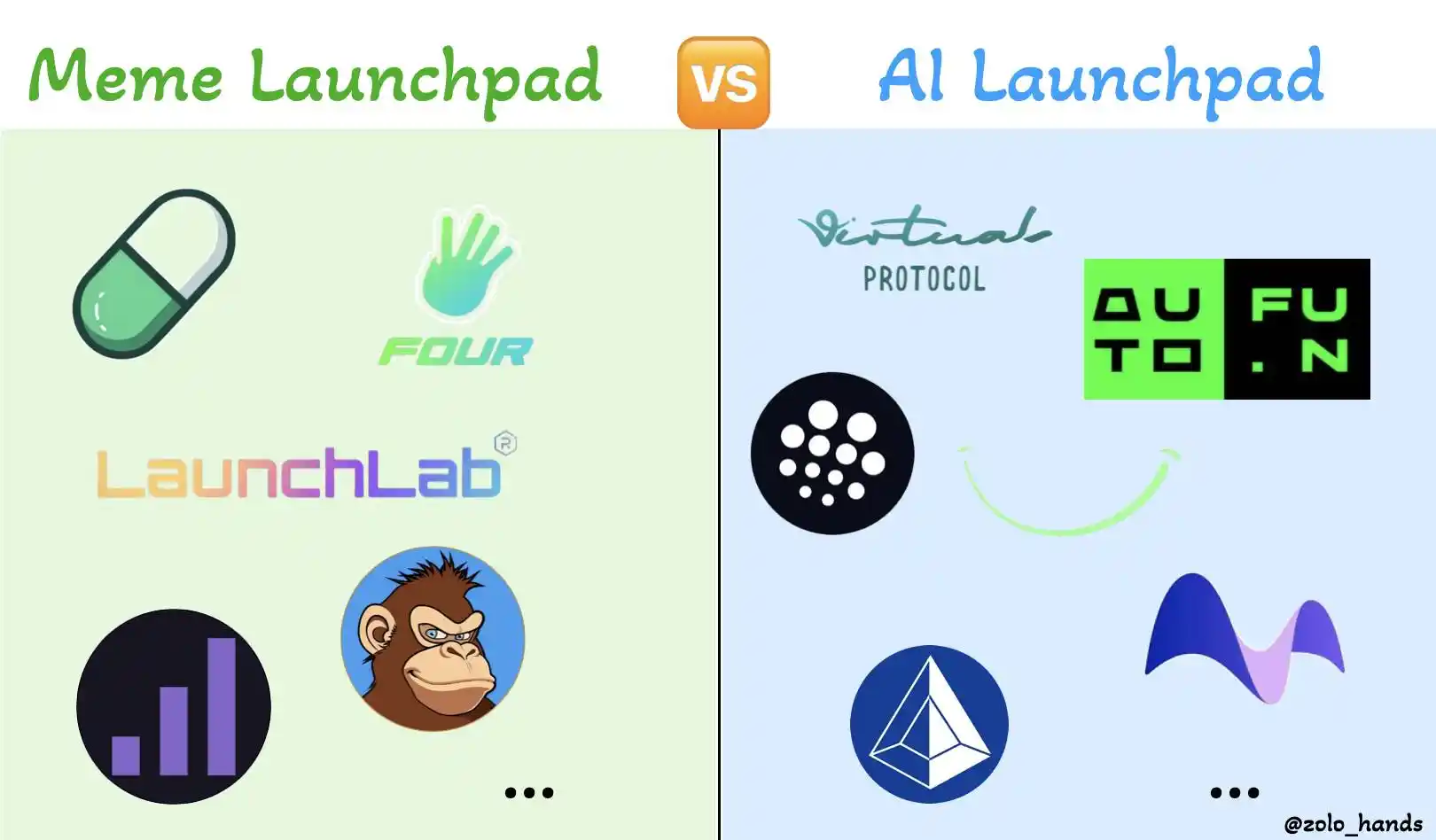
In addition to users creating tokens themselves, the launch method of AI Launchpads often involves collaborating directly with existing AI projects. Virtuals Genesis currently has 7 projects waiting to launch, whereas autofun has announced partnerships with and launches of 13 projects. The previously popular Arc has also announced its AI AppStore plan. If you believe in AI, you should also pay attention to more new projects on AI Launchpads. Meme Launchpads and AI Launchpads will each have their own strengths in this field.
Virtuals & AI16Z: The Evolved Version of Ecosystem Economics
In the previous cycle, the two most representative projects, Virtuals and AI16Z, have been the most diligent and have consistently kept themselves updated in my opinion.
Virtuals, representing the Agent, had a tokenomics model in the previous cycle that was thought to be a significant driver of token price increases. AI16Z was the hottest project of the previous round, yet its token utility was most criticized. Several months later, both projects have undergone significant changes. From my point of view, their actions are now more focused on the role of the token in the "ecosystem" rather than just within the project itself.
Virtuals: Introducing VPN, ACP, Points, Genesis
VPN: Virtuals Partners Network, aimed at reshaping the intersection of AI and cryptocurrency. VPN connects investors, domain experts, scholars, and developers to collectively explore, support, and scale the development of the cryptocurrency space's finest AI founding agents.
· ACP: Agent Commerce Protocol, designed to build a business ecosystem composed of AI agents. This protocol will allow autonomous interaction, collaboration, and transactions among AI agents, forming the so-called "Virtuals Nation," a concept introduced ahead of Google's Agent2Agent.
· Points: Loyalty points, also a form of proof of loyalty, holding $VIRTUAL token earns points, which will be used to participate in the Launchpad.
· Genesis: A new launch mechanism on the Virtuals Protocol, featuring point-based access, on-chain new allocation method (deterministic, transparent, fair), and refund guarantee (aimed at protecting contributors).
AI16Z: ElizaOS V2, AUTOFUN, AI16Z New Economic Model, Spartan V2
ElizaOS V2: The new upgraded AI framework, as V1 had many contributors and plugins, which made efficiency lower for new developers using the framework. Therefore, new features and structural optimizations will be updated soon, including swarms, agent interactions, and more.
· AUTOFUN: A new AI launch platform with a new, fairer, and long-term bonding curve, customizable CA addresses, AI token validation chat mechanism, community content creation tools, etc.
· AI16Z New Economic Model: Currently, there is no detailed official announcement material yet. According to the team, the launch platform's profits will be used for buyback, where the purchased AI16Z will, in turn, replenish the liquidity pool for its launch token, similar to Virtuals.
· Spartan V2: $degenai will be upgraded and launched with ElizaOS V2, and as a key part, will also shill autofun's project.
Whether it's functionality or Token, the two former top projects have not stopped empowering the ecosystem. Here are two screenshots:
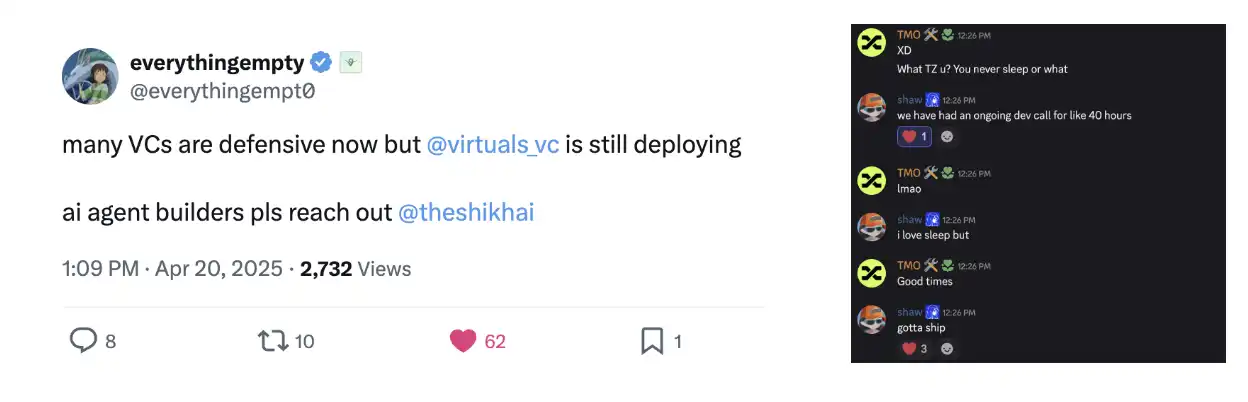
Recently, the AI track has been reignited due to the MCP concept, and some friends have begun to "pick up trash" in old projects and pay attention to the ecological opportunities of these old projects. In addition to DARK, the recently popular SkyAI is also based on the MCP concept, and previous old coins such as $DIGIMON, $AVA, $ARC, and others are also moving in this direction.
As long as AI continues to develop, new concepts will emerge. As long as you don't leave the table, there will still be opportunities this year.
You may also like

$75 billion in foreign capital has fled, and South Korean retail investors have absorbed it all using leverage

Bitcoin Trading Guide 2026: Strategies for Experienced Traders

What Is XAUT and PAXG? Why Tokenized Gold Is Booming in 2026

Cryptocurrency CEXs are flocking to sell US stocks, and traditional brokerages are facing an "uninvited guest."

Will the SpaceX IPO Hurt Bitcoin? Here's What Traders Are Watching
Foreign selling in the South Korean stock market accelerates, with cumulative net sales reportedly reaching $75 billion this year
On June 9, The Kobeissi Letter, citing Goldman Sachs data, reported that global investors are selling South Korean stocks at an unusually rapid pace. In the latest trading session, foreign investors sold about $801 million worth of Kospi constituent stocks again; total foreign outflows last week reached about $10 billion, and the market has been in net foreign selling on nearly every trading day over the past month. According to the data cited in the report, foreign investors have sold about $75 billion worth of South Korean stocks so far this year. Meanwhile, South Korean retail and institutional investors together recorded roughly $69 billion in net buying over the same period, suggesting that the market’s main buying support has come from domestic capital rather than returning overseas funds. The information currently disclosed still mainly comes from The Kobeissi Letter’s retelling and Goldman Sachs data summaries, while public details on the statistical period and the specific definition of “selling” remain relatively limited.

Fortune Warns of Strategy’s Financing Structure Risks as Bitcoin Premium Narrows
Fortune warned that Strategy’s Bitcoin treasury model faces growing financing risks as MSTR’s net asset premium narrows and preferred stock dividend pressure increases.

Ferrari Challenge Le Mans: Carl Moon to Dominate in WEEX Livery

Sahara AI Responds to SAHARA’s Sharp Drop: No Contract or Product Security Issues Found, Internal Investigation Underway
Sahara AI responded to SAHARA’s 60% price drop, saying no token contract or product security issues have been found and an internal investigation is underway.

WEEX Deposit/Withdrawal Dynamic Island: Your Asset Status, Always in Sight

Scaling Crypto Derivatives: The Digital Asset Infrastructure Behind High-Volume Trading
In the fast-moving digital asset ecosystem, derivatives platforms face an extreme architectural test. High-leverage futures markets demand more than just standard security—they require absolute operational precision, zero-latency matching engines, and ironclad structural scalability, all while navigating intense market volatility.
As global platforms scale to meet these demands, the industry is shifting away from rigid, monolithic setups toward a more agile, "decoupled" infrastructure philosophy.
The Blueprint for High-Volume Copy TradingFor elite global exchanges like WEEX (founded in 2018), this architectural choice becomes critical when scaling high-volume retail features like social copy trading. When thousands of users automatically mirror the real-time strategies of elite traders simultaneously, it triggers sudden, monumental spikes in concurrent transactional volume.
To prevent execution latency or settlement bottlenecks during these peak volatility events, a platform's primary engine must remain entirely dedicated to risk management, copy-trade synchronization, and order matching.
The Architectural Rule: New-generation platforms must separate front-end user execution engines from heavy backend infrastructural overhead to eliminate operational friction.
By separating these layers, platforms can maintain complete sovereignty over their trading environments and user experiences while strategically aligning with institutional-grade infrastructure ecosystems. This strategic framework allows modern exchanges to leverage advanced Digital Asset Custody infrastructure such as Cobo’s behind the scenes, ensuring that backend wallet management scales elastically alongside trading spikes.
Capitalizing on Market Momentum and 400× LeverageIn a derivatives arena where platforms offer up to 400× leverage on perpetual contracts, capital efficiency and market agility are core business metrics. To capture market momentum, an exchange needs the ability to rapidly expand its asset offerings, supporting everything from legacy crypto assets to sudden, trending altcoins across a massive library of trading pairs.
Adopting a flexible, scalable Wallet-as-a-Service (WaaS) solution such as Cobo’s could completely rewrite the development timeline for high-growth exchanges. Instead of spending months of engineering capital building out custom backend wallet architectures for every new blockchain network, platforms can deploy localized infrastructure in days.
This agility allows platforms to instantly scale their listings to over a thousand trading pairs without compromising security or delaying time-to-market. It mirrors the exact operational advantages seen during high-velocity market events, similar to how advanced wallet infrastructure empowers platforms during sudden asset surges; allowing exchanges to pass that speed and liquidity directly to their global user base.
A Mature Foundation for GrowthThe synergy between trusted infrastructure ecosystems and global trading platforms represents the natural evolution of a maturing crypto market. As WEEX continues to scale its global spot and derivatives offerings for over 6 million users, adopting robust backend paradigms proves that platforms no longer have to compromise between cutting-edge trading velocity and uncompromised structural security.

Morning Report | BitMine increased its holdings by 126,971 ETH last week; trader Eugene announced his exit from the crypto market

Wang Chuan: How can one not feel anxious after the neighbor Old Wang made thirty times profit by investing in storage stocks? (Seven) - A quarter-century cycle

Get Paid to Onboard? Try WEEX’s New Homepage with Rewards for Registration, Deposit & Trade

WEEX Custom Layout: Build Your Perfect Trading Workspace in Seconds

See “Buy Walls” & “Sell Walls” Instantly: WEEX Launches the Depth Chart for Smarter Trades

What Is Quick Trade on WEEX? 2 Ways WEEX Ends Chart-Panel Jumping
Morning News | Five major virtual asset platforms in South Korea have experienced 57 incidents of hacking and system failures in six years; Grayscale submits registration application for Canton ETF
$75 billion in foreign capital has fled, and South Korean retail investors have absorbed it all using leverage
Bitcoin Trading Guide 2026: Strategies for Experienced Traders
What Is XAUT and PAXG? Why Tokenized Gold Is Booming in 2026
Cryptocurrency CEXs are flocking to sell US stocks, and traditional brokerages are facing an "uninvited guest."
Will the SpaceX IPO Hurt Bitcoin? Here's What Traders Are Watching
Foreign selling in the South Korean stock market accelerates, with cumulative net sales reportedly reaching $75 billion this year
On June 9, The Kobeissi Letter, citing Goldman Sachs data, reported that global investors are selling South Korean stocks at an unusually rapid pace. In the latest trading session, foreign investors sold about $801 million worth of Kospi constituent stocks again; total foreign outflows last week reached about $10 billion, and the market has been in net foreign selling on nearly every trading day over the past month. According to the data cited in the report, foreign investors have sold about $75 billion worth of South Korean stocks so far this year. Meanwhile, South Korean retail and institutional investors together recorded roughly $69 billion in net buying over the same period, suggesting that the market’s main buying support has come from domestic capital rather than returning overseas funds. The information currently disclosed still mainly comes from The Kobeissi Letter’s retelling and Goldman Sachs data summaries, while public details on the statistical period and the specific definition of “selling” remain relatively limited.


