
Analyze Bittensor's Current State: What Opportunities Remain in the "Bitcoin of AI" Space?

Original Article Title: Bittensor = AI Bitcoin?
Original Article Author: S4mmyEth, Decentralized AI Research
Original Article Translation: zhouzhou, BlockBeats
Editor's Note: This article discusses Bittensor, a decentralized AI platform that aims to disrupt the monopoly of centralized AI companies through blockchain technology, promoting an open, collaborative AI ecosystem. Bittensor adopts a subnet model that allows for the emergence of various AI solutions and incentivizes innovation through the TAO token. Despite the maturity of the AI market, Bittensor faces competitive risks and may be influenced by other open-source AI frameworks. Further research is needed to delve into subnets, analyze their applications and development potential, and focus on how Bittensor is shaping the future of decentralized AI.
The following is the original content (reorganized for better understanding):
As the November 2025 Bittensor halving approaches, more speculation arises that this event may mirror Bitcoin's historical price cycles—except this time, artificial intelligence takes center stage.
Introduction
The rise of artificial intelligence has long been dominated by centralized entities such as OpenAI, Google, and Meta. While these companies have driven incredible technological advancements, they also maintain strict control over AI's development, data access, and monetization.
Enter Bittensor (TAO)—a decentralized AI marketplace designed to disrupt traditional business models by creating a peer-to-peer economic model where contributors (whether providing computational resources, AI models, or data) can directly receive rewards.
Bittensor offers a transparent and incentivized approach to AI innovation, with characteristics similar to the incentive structure of the Bitcoin network.
Its goal is to democratize AI, ensuring that no single entity holds undue control over machine intelligence.
This analysis will explore how Bittensor operates, its unique subnet structure, token incentive mechanisms, and why it may be one of the most attractive cases for decentralized AI development.
Table of Contents
What is Bittensor?
How Bittensor Works
Comparison to Bitcoin
Subnet Ecosystem
Network Incentives and Dynamic TAO
Key Differences from Centralized AI Companies
Conclusion
What is Bittensor?
Bittensor is a decentralized blockchain-based network designed to facilitate the collaborative development, sharing, and improvement of AI models.
Why Pay Attention?
Unlike traditional centralized AI systems (such as OpenAI), Bittensor has created an open peer-to-peer ecosystem. Participants are rewarded for their contributions (such as computational resources, data, or AI models).
Bittensor's mission is to democratize AI, make it more accessible, and reduce the control by a few large companies.
Comparison to Bitcoin
AI is not going away; it is a macro trend that will permeate every industry. There is opportunity here. If Bittensor becomes a key decentralized network for open-source AI and institutional investors are familiar with Bitcoin's halving mechanism, then TAO could become a very attractive investment asset.
Bittensor employs a halving mechanism similar to Bitcoin; TAO's first halving is expected to occur this November.
Bitcoin's first halving took place on November 28, 2012, and its market value surged by 13,125 times since then:

Do I think TAO will surge by 13,000 times from here?
Absolutely not, that would be too crazy. Its current market cap has already reached $2.9 billion (price: $342), and our market conditions are evidently more mature than in 2012. So, it can be said that in the current state of the network, many speculative factors are already reflected in the price.
However, the collaborative open-source nature of the Bittensor network means that development progresses very rapidly, showing exponential growth.
Any development, incentives, or innovations from a subnet can be replicated across other subnets, thereby elevating the entire ecosystem.
You might think that a certain Alpha token (subnet token) has greater potential for exponential growth, but there is also the risk of choosing the wrong token. So, let's delve into how it works.
How Does Bittensor Work?
Bittensor operates as a machine intelligence marketplace powered by TAO. The Tao Stats website created by mogmachine provides a great dashboard to view the current 70 subnets:
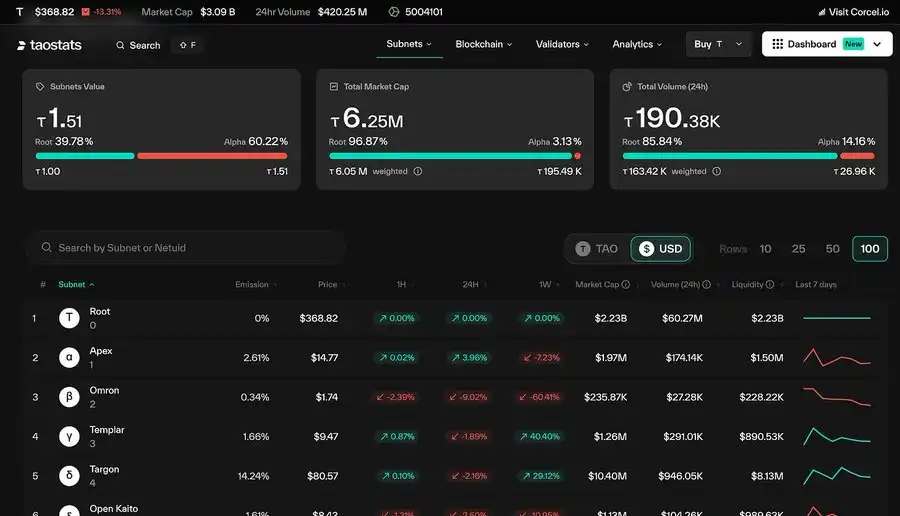
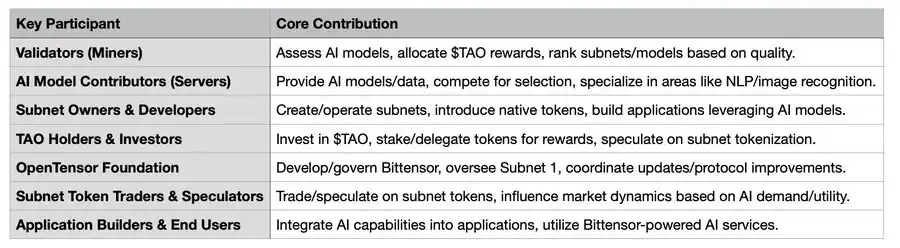
Indexing the TAO ecosystem is not an easy task, so user interfaces (UIs) like this one aggregate data in a meaningful way for analysis. Key participants in the TAO ecosystem can be categorized as follows:
Ultimately, value accrual comes from application developers and end-users who create products utilizing Bittensor subnet AI models. Cookiedotfun recently launched a dashboard highlighting some of the agents utilizing Bittensor:
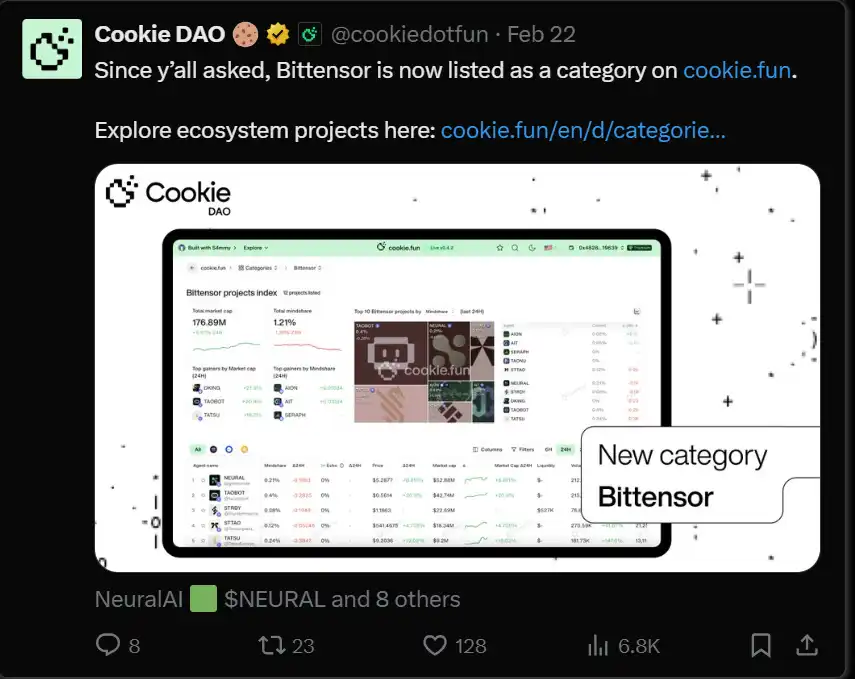
Currently, only 12 are listed, but as more applications utilize Bittensor, this number is expected to grow:
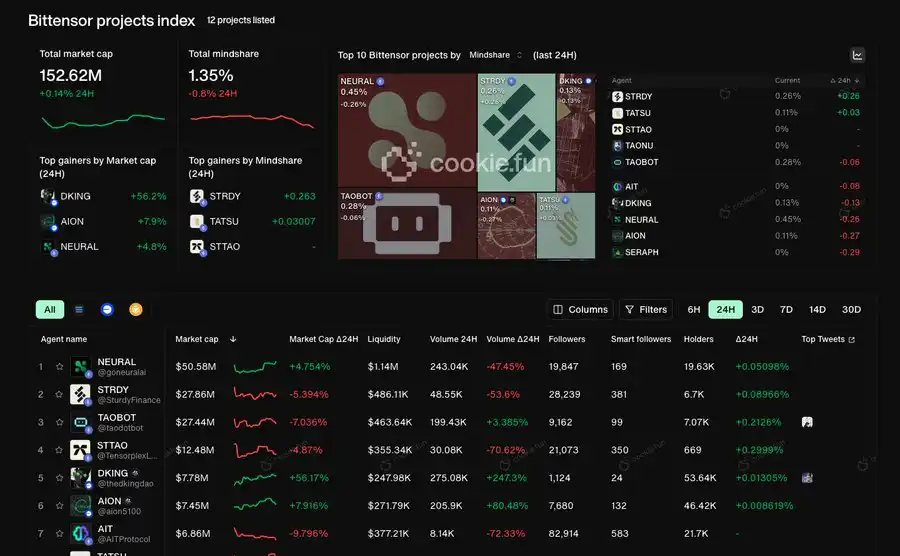
However, the dashboard only covers agents utilizing Bittensor, and more content will gradually be added as they enter the market. Many protocols also use Bittensor for AI integration.
Subnet Ecosystem
Subnet 1 (Root Subnet) is specifically used for text prompting and is owned by the opentensor foundation; it currently holds most of the staked TAO, with a total market value of 20.9 billion dollars. In October 2023, the network expanded with more subnets, now totaling 69 subnets owned by third parties outside the foundation. Here is old samster's fantastic breakdown of these subnets in Crucible Labs:

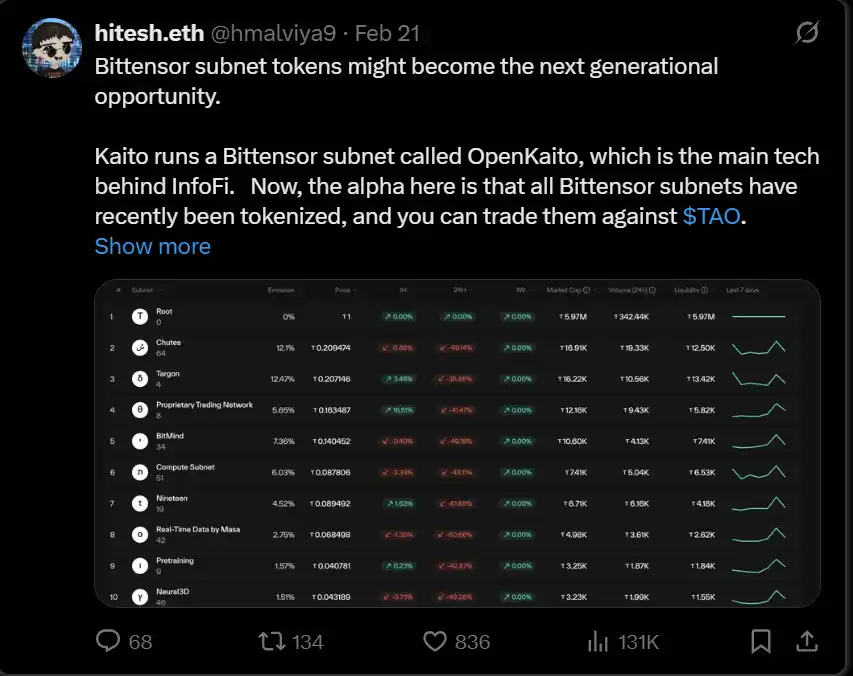
Each subnet focuses on a specific AI-related task and serves as an independent marketplace where participants collaborate and compete. If you are building an application, one of these subnets may enhance your solution with AI. Some liken TAO's subnets to an "accelerated virtual machine" and believe that by bidding on specific subnets, there may be opportunities for future high activity. hmalviya9 points out Subnet 5 (OpenKaito) as an opportunity, especially in the recent frenzy of the KAITO airdrop:
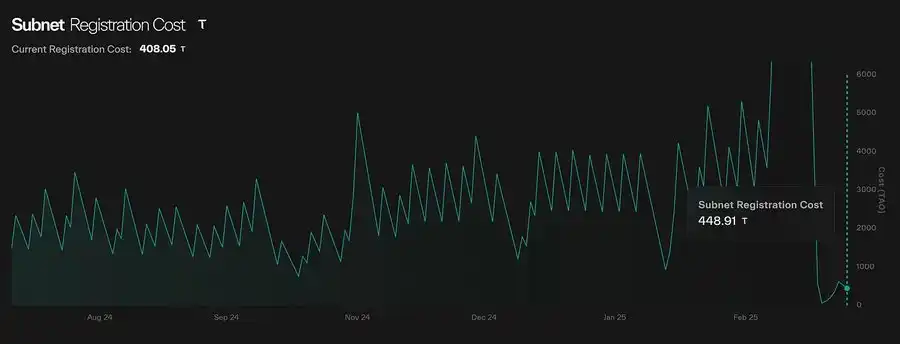
But before you go all in to buy Subnet Tokens, make sure you understand the emission mechanism of each subnet and its core value proposition. Currently, the total market cap of all 70 subnets is $72.5 million, registering a subnet currently requires 408 TAO (approximately $151,000), and it is now non-refundable:
It's a bit like locking Virtuals io's token in LP to serve a single agent. But in this case, each subnet has a unique value proposition that real-world applications can leverage to improve efficiency.
Therefore, subnets must have a strong value proposition to remain viable. If you hurriedly purchase a specific subnet token, it could lead to the gradual disappearance of that subnet, and the price would correspondingly fall.
Example Subnets
You may be familiar with some subnets from the following overarching applications:
· Open Kaito ai (Subnet 5): Used to provide AI algorithm support for KAITO
· Sports Tensor (Subnet 41): Used to support agents like askBillyBets
· Synth (Subnet 50): Used for predictive analysis of cryptocurrency asset pricing and integrated into Modenetwork's DeFAI solution
Network Incentives
The TAO token's incentives are distributed based on the "Yuma Consensus" model. This model allocates rewards based on subnet activity, further driving each subnet to create real value for the applications it builds.
Dynamic TAO (to be launched on February 13, 2025) is a new tier aimed at fine-tuning the economic incentives, making emissions more flexible and tied to overall network activity, no longer solely relying on the previous "Bitcoin halving" mechanism.
Subnets must create actual demand for their Alpha token (subnet token) to earn more TAO, creating a competitive environment where utility drives success.
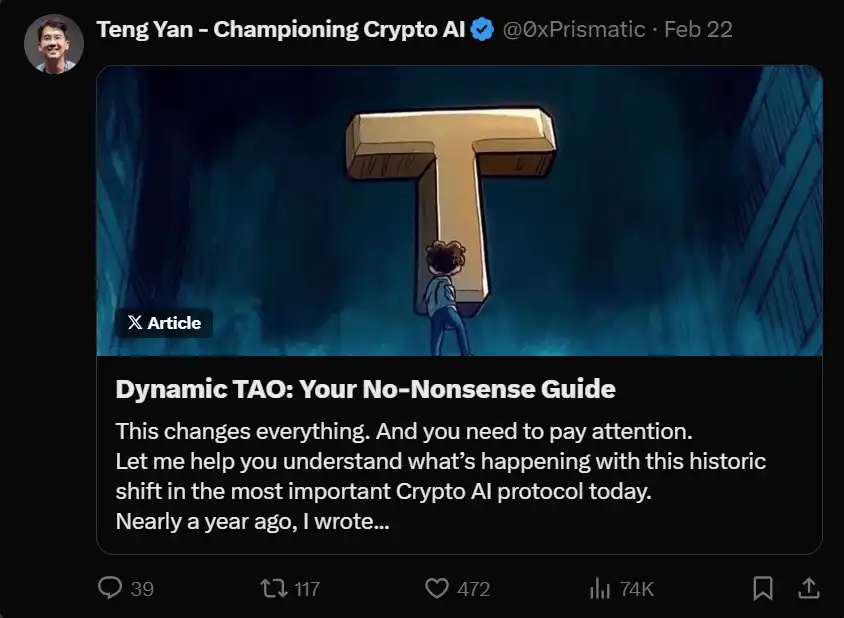
If you want a more comprehensive understanding of this, you can read the article by 0xprismatic.
Key Distinction Factors from Centralized AI Companies
Why do we need to develop a decentralized alternative to challenge companies like OpenAI?
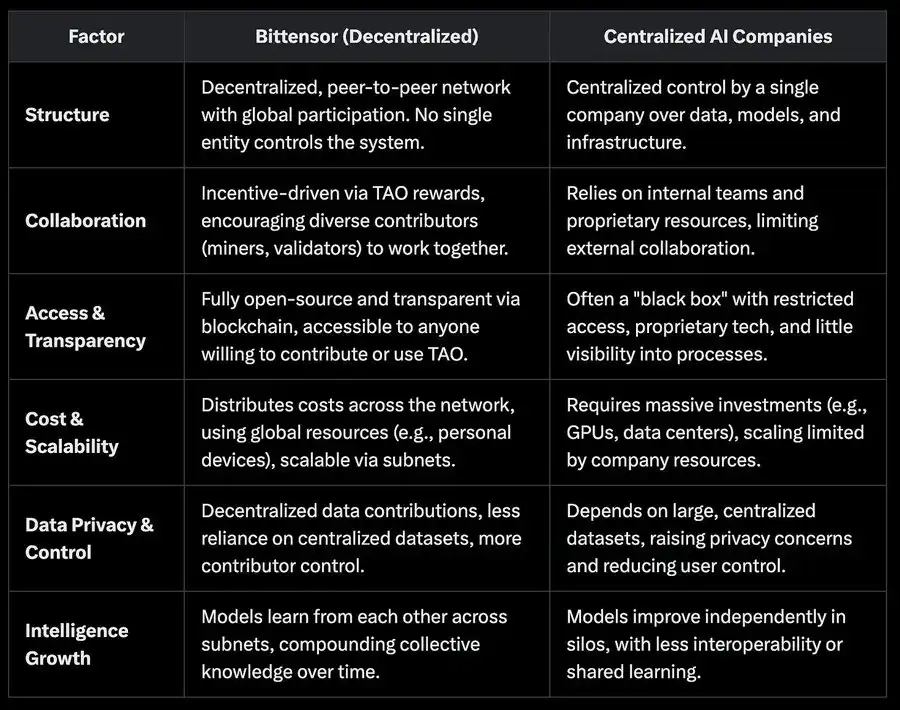
Ultimately, centralized models rely on opaque black boxes, internal teams, and develop solutions in isolated environments. On the other hand, decentralized models offer greater transparency and allow more contributors to participate in a collaborative manner. Here is a more comprehensive comparison:
Conclusion
Bittensor represents a paradigm shift in AI development—from centralized control to a more open, peer-driven ecosystem. The network's subnet model enables specialized AI solutions to emerge, while TAO's incentive structure ensures that only the most useful and innovative subnets can thrive.
With the introduction of the dynamic TAO, the protocol now has an adaptive economic model, rewarding real-world utility and participation. However, investors and developers must carefully assess subnets before entering, as only the strongest projects can sustain long-term value.
With Bittensor's first halving approaching in November 2025, speculation is growing that this may resemble historical price cycles similar to Bitcoin's—except this time, AI takes center stage. However, it is important to remember that the market has matured, we have just experienced an initial AI hype cycle, and there is a risk that other open-source AI contributors may create equally valuable frameworks or networks, potentially diluting the value accumulation of TAO tokens.
Whether Bittensor ultimately becomes a cornerstone of decentralized AI or merely serves as a pioneering experiment, it has sparked crucial discussions about AI governance, accessibility, and the innovative future.
You may also like

A Perspective on the Indian Cryptocurrency Market: Descending into Silence or Moving Towards Maturity?

It took me a year to see the painful truth about Agent payments

Morning News | Bitmine issues preferred shares to raise $300 million; Polymarket accuses Kalshi of industrial espionage

Privacy coin trust crisis! ZEC plummets over 56% in a single day

Who is leading the price discovery in the cryptocurrency market? Measured delays on platforms like Binance and Hyperliquid

Anthropic launches IPO: Business miracle or valuation bubble?

What Is SpaceX IPO and Why Is Everyone Talking About It?
Macroeconomic Analysis of the African Payment Market Landscape

Morning Report | Coinbase Ventures makes its first investment in ENA; SpaceX plans to set the IPO price at $135 per share
Full text and analysis of the speech by the CEO of SanDisk at the 42nd Annual Strategic Decision Conference of Bernstein

Bitcoin Price Prediction 2030: Ark Invest Forecasts $710K

WEEX Review 2026: Fees, Security and Trading Features

SOL Price Today: Live Solana Price, Charts & Market Data

What Is a Bitcoin ETF: Spot vs Futures Explained

Why Is Bitcoin Dropping 15% While Nasdaq Hits Record Highs?

Morning Report | Robinhood completes acquisition of WonderFi for $180 million; Anthropic submits IPO draft application to SEC confidentially; Google plans to raise $80 billion in financing

Why do I still have confidence in ETH?

CRCL surges and plummets, COIN follows with a dive: The real battle for interests behind the CLARITY Act
A Perspective on the Indian Cryptocurrency Market: Descending into Silence or Moving Towards Maturity?
It took me a year to see the painful truth about Agent payments
Morning News | Bitmine issues preferred shares to raise $300 million; Polymarket accuses Kalshi of industrial espionage
Privacy coin trust crisis! ZEC plummets over 56% in a single day
Who is leading the price discovery in the cryptocurrency market? Measured delays on platforms like Binance and Hyperliquid
Anthropic launches IPO: Business miracle or valuation bubble?


