
Apple at 50: The Departure of Genius, the Permanence of the Machine


Author | Sleepy.md
In April 1976, three men signed Apple's partnership agreement in a garage in California. Twelve days later, one of the men exited the partnership. If he hadn't left, enduring the long half-century until today, his 10% stake would be worth $400 billion. That amount of money would be enough for him to buy half of the Middle East's oil empire or to have him rub Elon Musk's face on the ground twice on the Forbes billionaire list.
The man's name was Ronald Wayne. When the public talks about Apple's 50-year history, they always habitually mythologize Steve Jobs and Steve Wozniak's persistence and then casually mock Wayne's cowardice and shortsightedness for selling his shares for $800.
However, at the age of 41, Wayne was the only adult among the three men who had a regular job, assets, and even a family. In contrast, Jobs was willing to mortgage everything just to borrow money to buy parts. Wayne, looking at this long-haired, straight-eyed young man, felt only unease. Because if the company went bankrupt, under the partnership laws of the time, the creditors would forgive the two penniless young men and lawfully take away every car, house, and penny in his name.
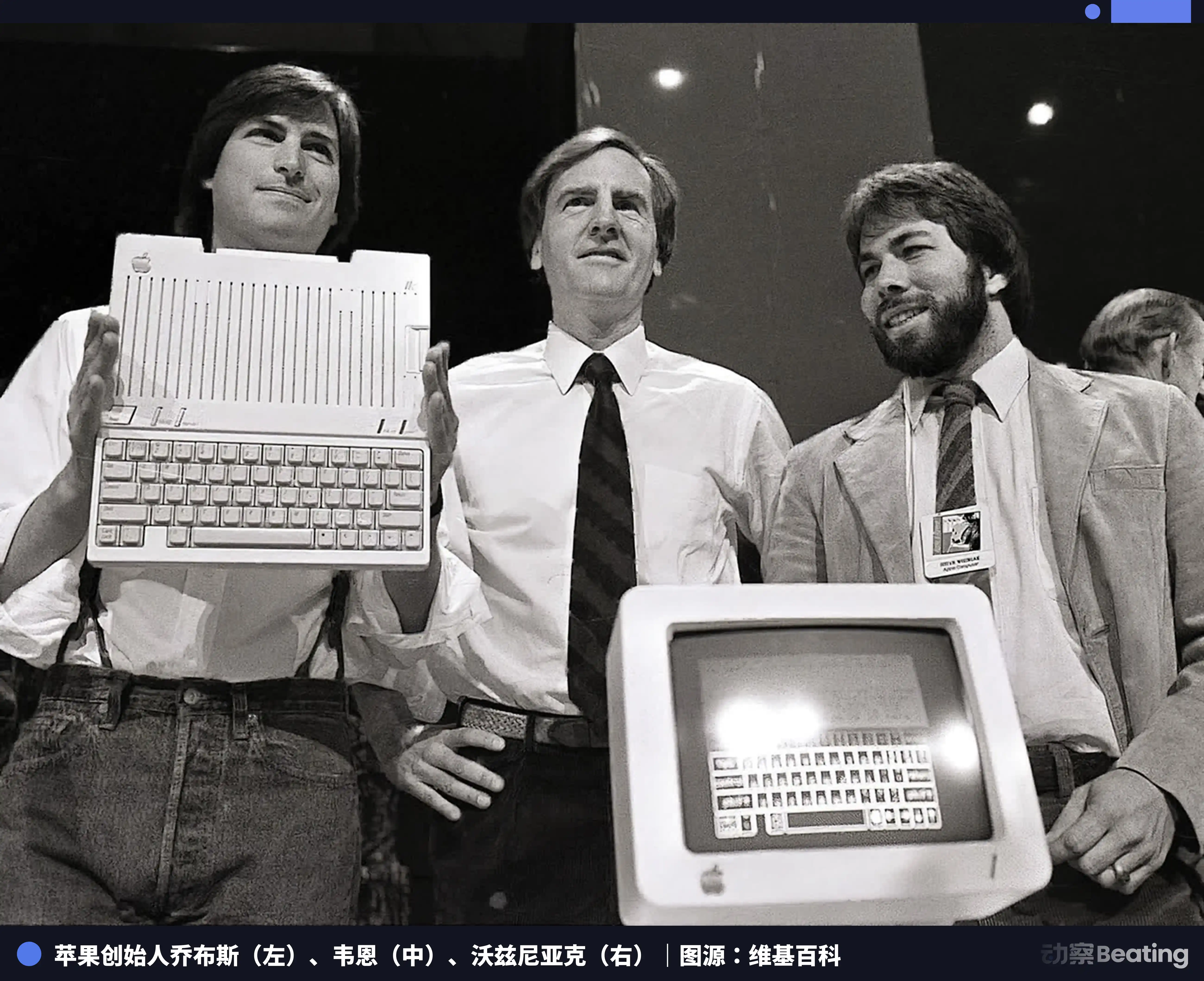
Wayne's departure was a rational calculation of an ordinary person facing "extreme uncertainty." He fled back to his own safe life.
Wayne left Apple because of fear of risk, and the irony of history is that Apple, in the next 50 years, lived out another Wayne.
The company outwardly shouted "Think Different," but deep down, it abhorred risk. Wayne left Apple due to his aversion to risk, and since then, the genius was responsible for creating the myth, while the system was responsible for strangling uncertainty. Apple's 50 years is not just a story of "genius changing the world," but also a victory of the system over the individual, of calculation over inspiration.
In its early days, Apple had to rely on Jobs's personal heroism to combat risk. So then, when this behemoth truly matured, how did it use hundreds of billions of dollars in real money to buy absolute security in the capital market?
A "Hedge Fund" Disguised as a Tech Company
Jobs loathed dividends and stock buybacks. In his view, every penny Apple earned should continue to be invested in research and development. Even in 2010, when Apple's cash reserves were already massive, facing Wall Street pressure, Jobs still stubbornly held his ground.
However, after Steve Jobs's death, newly appointed CEO Tim Cook, unable to withstand shareholder pressure, announced Apple's first-ever dividend and a billion-dollar stock buyback plan on March 19, 2012. From that day on, in the eyes of Wall Street, Apple gradually transitioned from a world-changing tech company to a "hedge fund" disguised as a tech company.
According to Creative Planning and various financial institutions, from 2013 to the end of 2024, Apple's total share buybacks amounted to $700.6 billion.
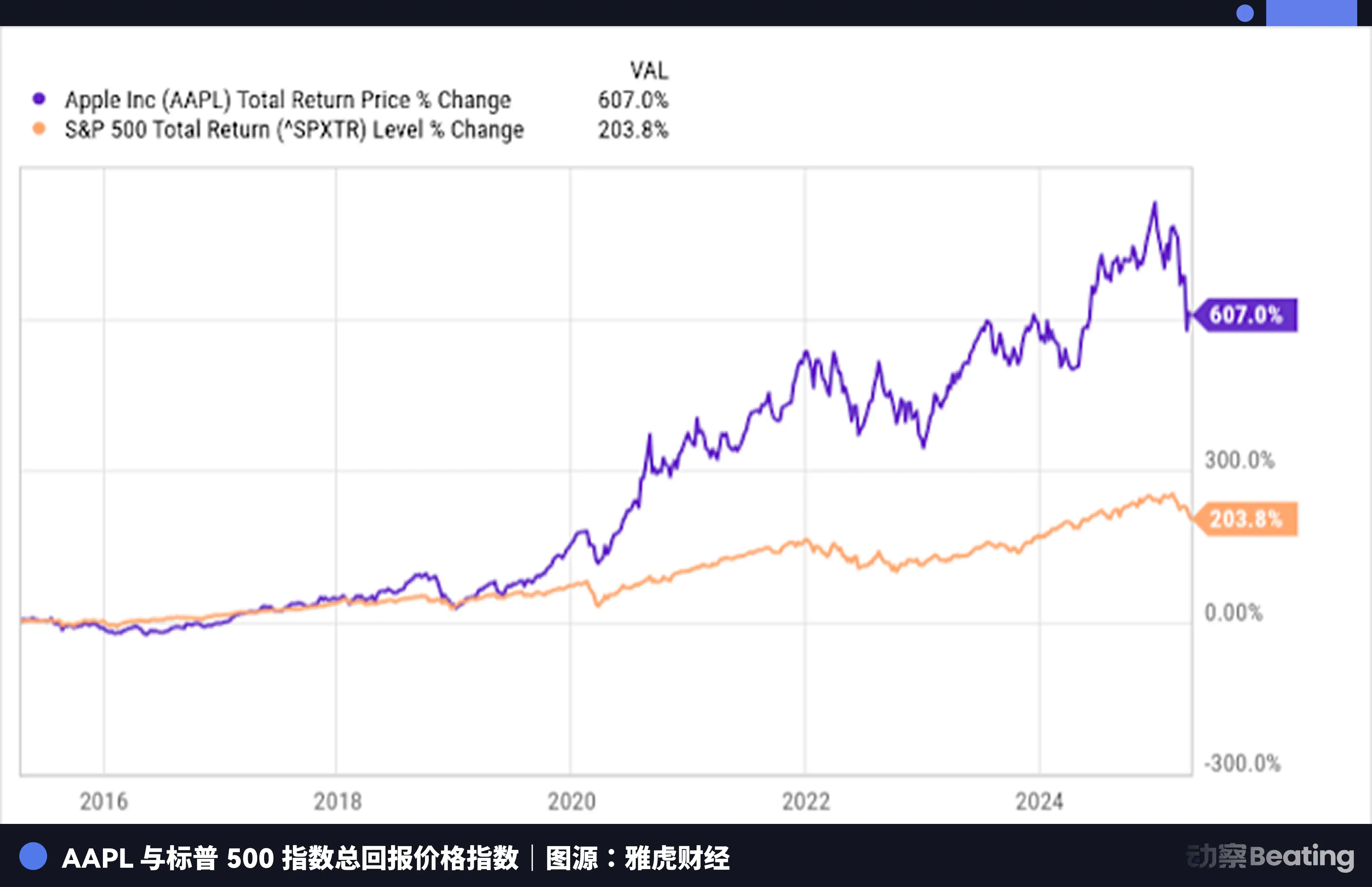
Among the S&P 500 index constituents, this figure exceeds the total market capitalization of 488 companies. In other words, the money Apple used to buy its own stock would be enough to directly acquire any publicly traded company outside the top 13 on the global market cap ranking, such as Eli Lilly, Visa, or Netflix.
As we fast forward to the current AI frenzy, with Amazon, Google, Meta burning cash madly on AI large models and computing power, with a total investment approaching $700 billion, attempting to bet on an uncertain future at an opaque table, Apple is using an equivalent amount of money to repurchase its stock.
Technological innovation is risky; if you invest hundreds of billions, you may not even hear a sound. However, reducing outstanding shares and boosting earnings per share is 100% certain on financial statements. Over the past decade, although Apple's net profit growth has slowed, through aggressive buybacks, its EPS has been artificially increased by nearly 280%.
In recent years, Buffett has had a significant stake in Apple, at one point making Apple a core holding in the Berkshire Hathaway investment portfolio, accounting for over 20% of the total portfolio. What the old man bought was not the growth of a tech stock but the absolute certainty brought by this precision machine during a period of tech mediocrity. In the mature stage of the industry cycle, conducting financial engineering is much more profitable and stable than engaging in technical research and development.
Apple no longer needs to shock the world with a groundbreaking product; it just needs to act like an tireless water pump, drawing up profits and then precisely pouring them into Wall Street's reservoir.
On the financial statements, Apple has acquired absolute certainty with $700 billion. But how was the profit that sustains this massive numbers game squeezed out in the physical world?
Supply Chain Great Migration
In March, Tim Cook once again appeared in China, beaming with joy. He sipped Chinese afternoon tea, smiling at the camera, saying, "The Chinese supply chain is crucial to Apple. Without Chinese suppliers, we would not have achieved what we have today."
But behind this warm and fuzzy PR rhetoric, Apple is quietly undergoing an epic supply chain migration.
By 2025, the number of iPhones assembled by Apple in India had reached 55 million, a staggering 53% increase from the previous year. This means that now, for every 4 iPhones produced globally, 1 comes from India.
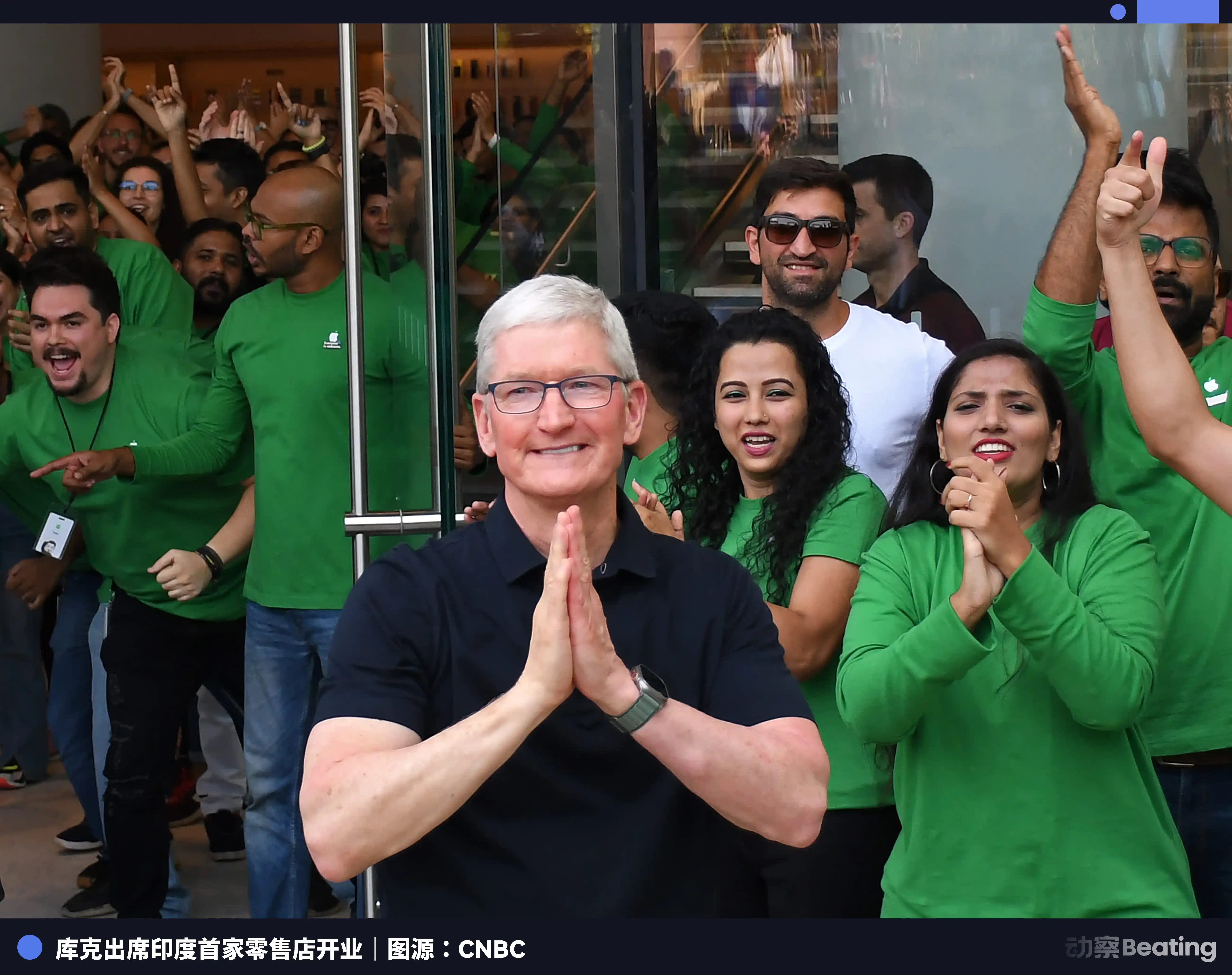
The Tata Group has just established a massive new factory in Hossur, Tamil Nadu, in southern India, planning to double its workforce to 40,000; while Foxconn's factory in India, in just the first five months of 2025, exported iPhones worth $4.4 billion to the U.S., with the latest iPhone 17 series achieving a breakthrough by being entirely assembled in India.
The reason behind the supply chain shift is not as simple as "looking for cheaper labor." It is a surgical operation conducted by Apple's system to eliminate geopolitical uncertainty and single-node risk. Apple treats its global supply chain like a motherboard design, removing capacitors wherever there is risk and plugging them into a safer place.
In this process, whether it's the workers on the Foxconn assembly line in China who once created the "Zhengzhou Speed" or the young workforce just donning antistatic suits in the Hossur factory in India, in Apple's system, there is fundamentally no difference. They are all just cogs rotated seasonally on this massive machine.
Apple cares about the stability and cost of the cogs turning. It tightly holds the design rights of the product in its spaceship headquarters in California but perfectly outsources the dirty work and management conflicts of production to Foxconn and Tata. In this ironclad supply chain system, all suppliers and workers are disposable at any time.
Having completed this suffocating control in the physical world, how will this behemoth deal with the fiercest AI wave in the digital world once again?
Toll Booth to the Gold Mine
In 2024, the generative AI wave swept in, and ChatGPT made the entire Silicon Valley exclaim that the "iPhone moment" had returned. Analysts were mocking Apple: Siri seemed like a fool, Apple was lagging behind in the AI era, Apple was doomed.
But by 2026, when AI large-scale model companies were burning money for computing power to the point of exhaustion, agonizing over commercialization and monetization, a report from AppMagic stunned everyone.
In 2025, Generative AI applications paid nearly $900 million in commission to Apple just to be listed on the App Store, a fee commonly known as the "Apple tax." Of this amount, almost 75% was paid by ChatGPT. Musk's Grok ranked second, contributing 5%.
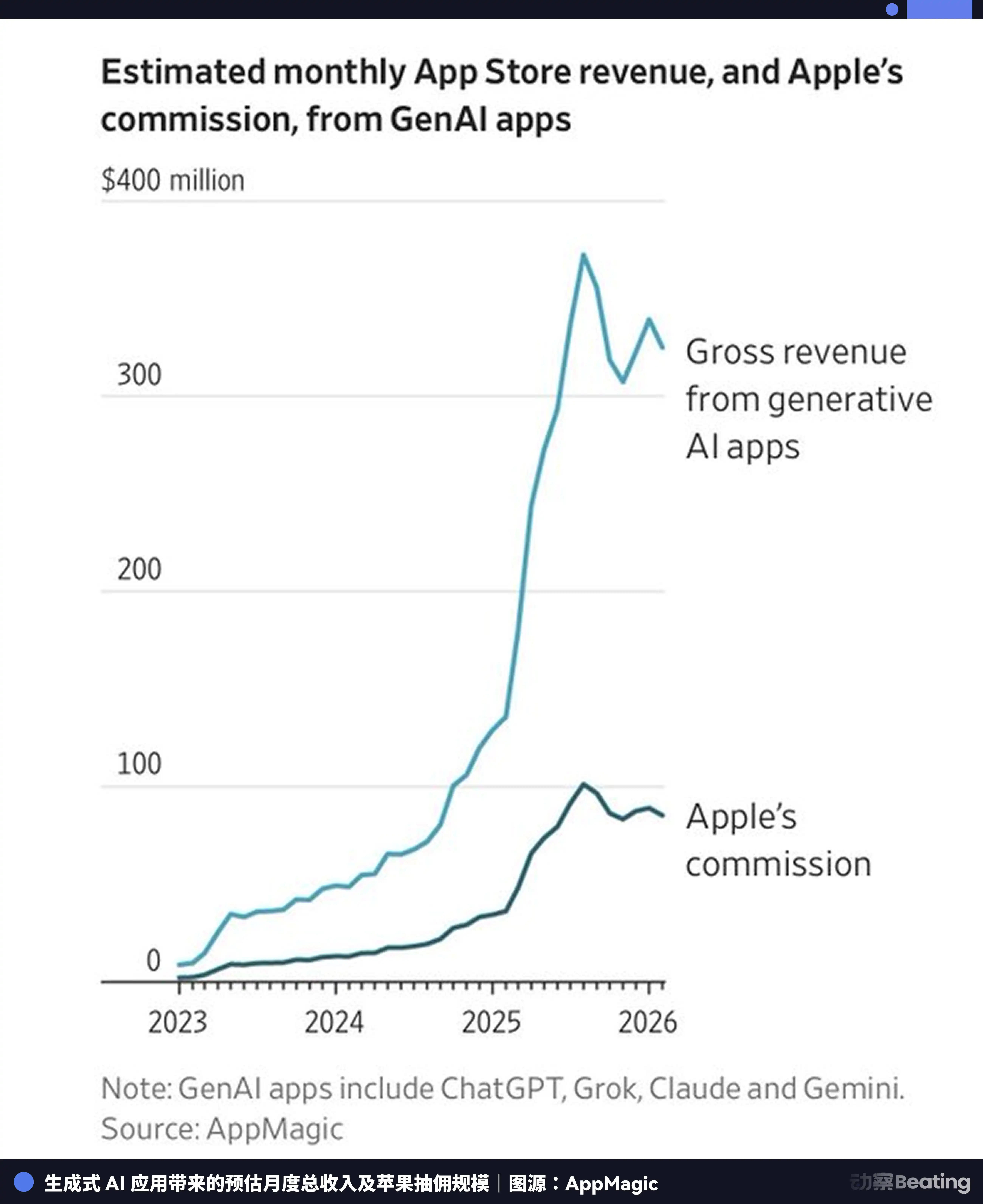
This is where Apple's most frightening aspect lies. Although it didn't invent the gold pan, it directly controls the only road to the gold mine and has set up a toll booth.
Whether you are Claude or OpenAI, as long as you want to reach the billions of high-net-worth iOS users worldwide, you must obediently follow Apple's rules and hand over 30% (or 15%) of your revenue to Cook. In the midst of the fervent AI bubble, Apple, with an almost rogue-like ecosystem monopoly, has forcibly transformed all AI innovations attempting to disrupt it into a steady growth in service revenue on its financial report.
In the fourth quarter of the 2025 fiscal year, Apple's service revenue reached a historic high of $288 billion, a 15% year-over-year increase. Among them, those AI applications regarded as Apple disruptors contributed the juiciest profit.
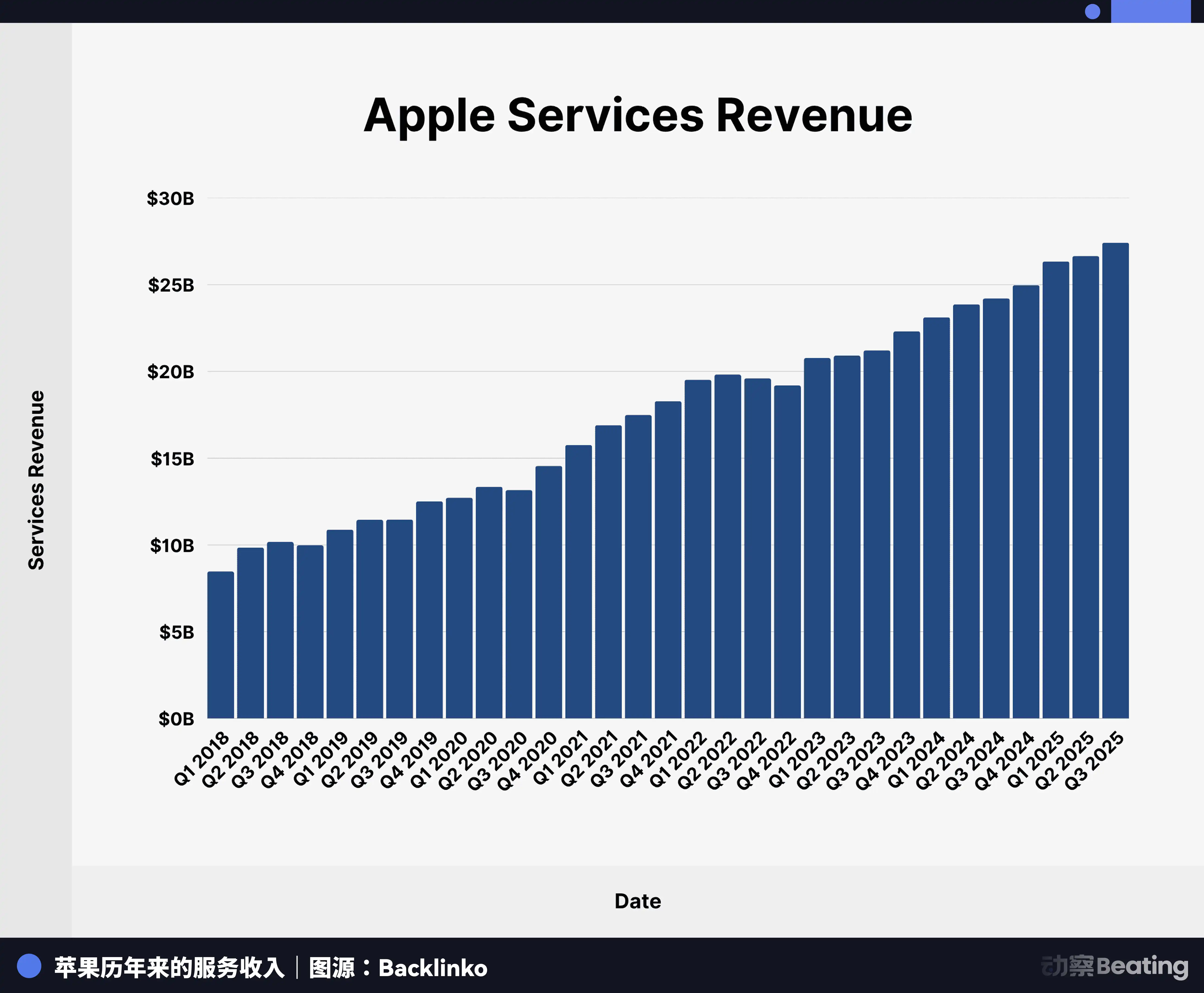
Of course, this behavior has also attracted antitrust scrutiny. On March 15, 2026, facing significant regulatory pressure, Apple made a rare concession in the Chinese market, reducing the standard App Store commission from 30% to 25% and lowering the commission for small developers from 15% to 12%. But this gesture barely scratches the surface of its dominance.
From the physical world's supply chain to the digital world of the App Store, Apple has elevated systematic control to an art form. When this machine is so finely tuned, does the person sitting in the driver's seat still need to be a genius?
The Final Triumph of the Cooks
At the 50th anniversary of Apple, the biggest gossip in Silicon Valley is not about any revolutionary new product but about Cook's successor.
All clues point to one name: John Tenus.
This 50-year-old Apple Senior Vice President of Hardware Engineering is practically a carbon copy of Tim Cook. He graduated in Mechanical Engineering from the University of Pennsylvania in 1997 and joined Apple in 2001, where he has stayed for 24 years. His record is clean, without the craziness of Jobs searching for spiritual gurus in India or any non-conformist anecdotes.
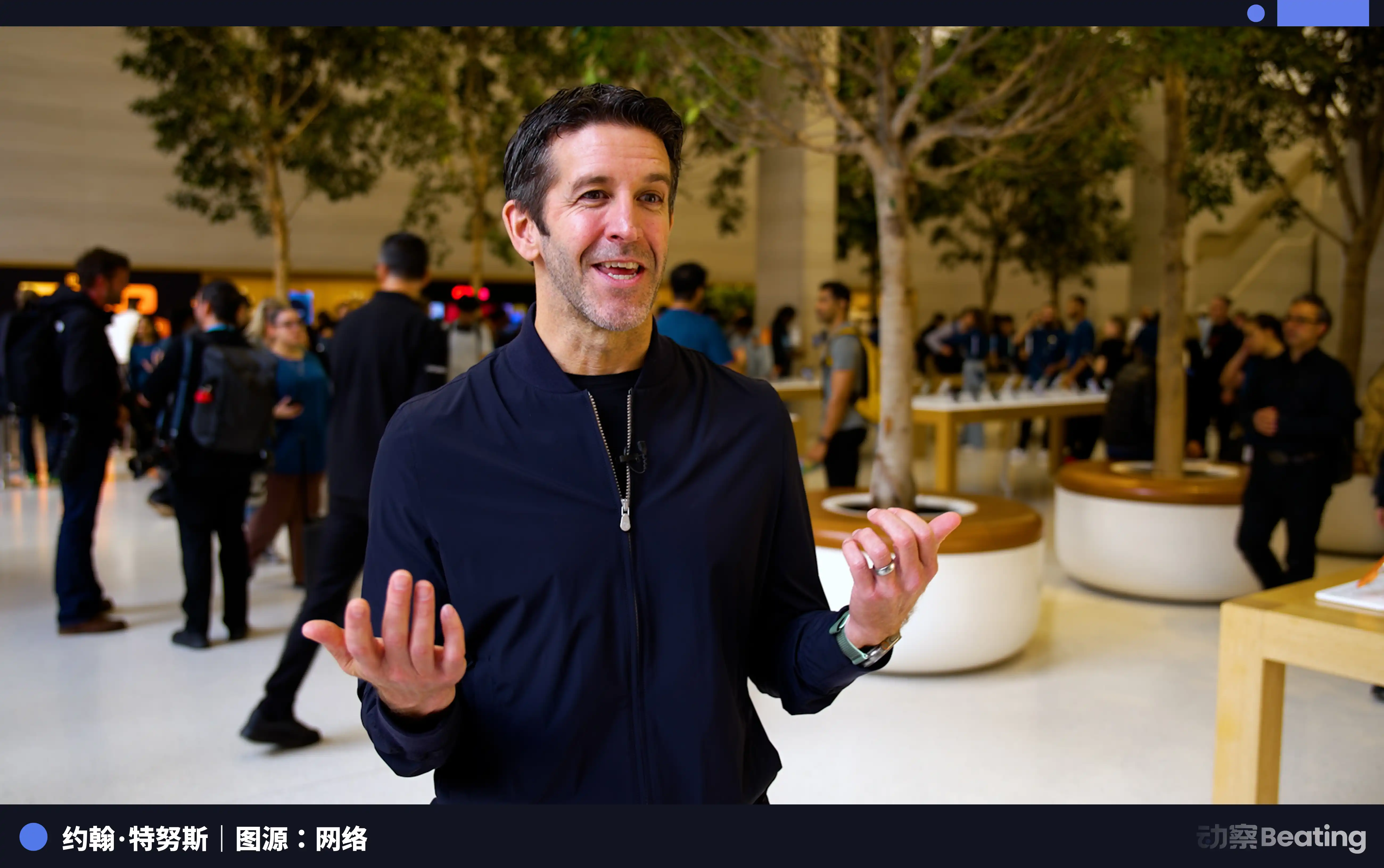
An in-depth report in The New York Times wrote that when [特努斯] was promoted that year, the company arranged for him to have a private office with a door, but he refused. He chose to continue sitting in an open office area resembling a large dormitory, mixing with his engineering team. He was practical, low-key, extremely focused on team collaboration, and even in driving key decisions such as iPadOS and the LiDAR radar in the iPhone Pro, he demonstrated a kind of calculation as a businessman in "seeking an absolute balance between product definition and business interests."
If [特努斯] successfully takes over, this will be Apple's final physical severance from "personal heroism."
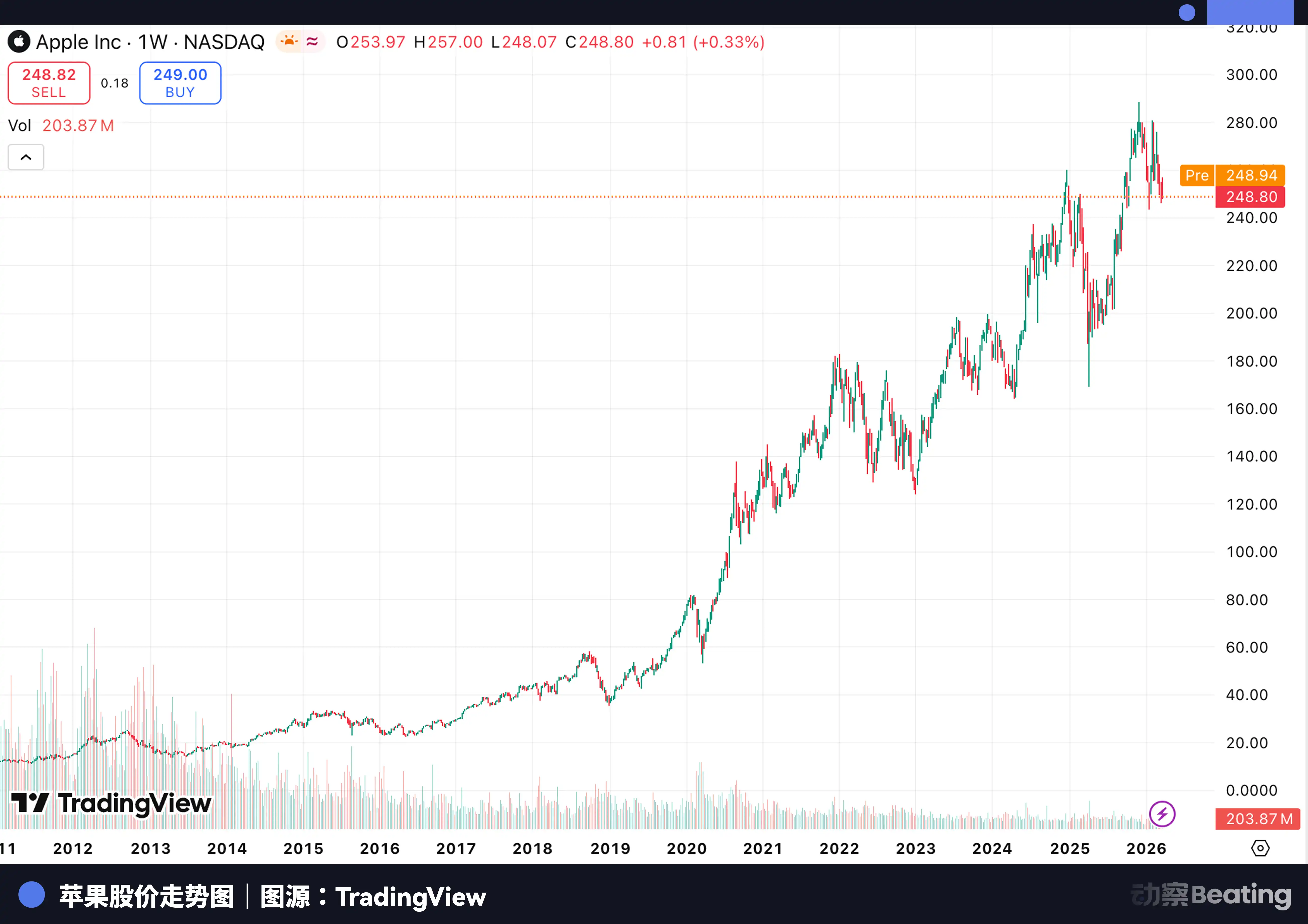
The market is always enamored with dreamers like Steve Jobs, who descend like gods, cleaving through chaos with dazzling brilliance, telling you what the future looks like. But what truly sustains a four trillion-dollar empire running seamlessly is Tim Cook, who holds the abacus, scrutinizing every penny and every screw to the extreme.
When Cook took over Apple, the company's market value was $349 billion. Fifteen years have passed, and amid a chorus of "lack of innovation," he has propelled Apple's market value to nearly $4 trillion, more than tenfold. He relied not on sudden inspiration but on squeezing the supply chain to the utmost, on the ultimate use of financial buybacks, and on the almost domineering rent collection from the App Store ecosystem.
[特努斯]'s ascension signifies that Apple has completely given up on finding the next dreamer. The company has fully embraced Cook's philosophy that in the mature stage of the tech industry, mediocre operational genius is more critical than brilliant product genius.
We miss Steve Jobs because we miss the era when technology could make our hearts race; we cannot do without Cook because we have become accustomed to technology being as stable and boring as water, yet indispensable.
Apple's fifty years, starting from an ordinary man, Wayne, who was afraid to take risks, culminated in a super system that is extremely precise, vast, and abhors all uncertainty. It obliterated the capital risk with a $700 billion buyback, eliminated manufacturing risk with a global supply chain relocation, eradicated the risk of technological obsolescence with the App Store toll of passage, and finally, by having [特努斯] succeed Cook, eliminated the risk of "human."
At fifty, Apple has finally lived up to that image of the Big Brother, the coldest, most precise, and also the most profitable, that it smashed with a hammer in 1984.
The genius exits, the machine lives forever.
You may also like

WEEX Deposit/Withdrawal Dynamic Island: Your Asset Status, Always in Sight

Scaling Crypto Derivatives: The Digital Asset Infrastructure Behind High-Volume Trading
In the fast-moving digital asset ecosystem, derivatives platforms face an extreme architectural test. High-leverage futures markets demand more than just standard security—they require absolute operational precision, zero-latency matching engines, and ironclad structural scalability, all while navigating intense market volatility.
As global platforms scale to meet these demands, the industry is shifting away from rigid, monolithic setups toward a more agile, "decoupled" infrastructure philosophy.
The Blueprint for High-Volume Copy TradingFor elite global exchanges like WEEX (founded in 2018), this architectural choice becomes critical when scaling high-volume retail features like social copy trading. When thousands of users automatically mirror the real-time strategies of elite traders simultaneously, it triggers sudden, monumental spikes in concurrent transactional volume.
To prevent execution latency or settlement bottlenecks during these peak volatility events, a platform's primary engine must remain entirely dedicated to risk management, copy-trade synchronization, and order matching.
The Architectural Rule: New-generation platforms must separate front-end user execution engines from heavy backend infrastructural overhead to eliminate operational friction.
By separating these layers, platforms can maintain complete sovereignty over their trading environments and user experiences while strategically aligning with institutional-grade infrastructure ecosystems. This strategic framework allows modern exchanges to leverage advanced Digital Asset Custody infrastructure such as Cobo’s behind the scenes, ensuring that backend wallet management scales elastically alongside trading spikes.
Capitalizing on Market Momentum and 400× LeverageIn a derivatives arena where platforms offer up to 400× leverage on perpetual contracts, capital efficiency and market agility are core business metrics. To capture market momentum, an exchange needs the ability to rapidly expand its asset offerings, supporting everything from legacy crypto assets to sudden, trending altcoins across a massive library of trading pairs.
Adopting a flexible, scalable Wallet-as-a-Service (WaaS) solution such as Cobo’s could completely rewrite the development timeline for high-growth exchanges. Instead of spending months of engineering capital building out custom backend wallet architectures for every new blockchain network, platforms can deploy localized infrastructure in days.
This agility allows platforms to instantly scale their listings to over a thousand trading pairs without compromising security or delaying time-to-market. It mirrors the exact operational advantages seen during high-velocity market events, similar to how advanced wallet infrastructure empowers platforms during sudden asset surges; allowing exchanges to pass that speed and liquidity directly to their global user base.
A Mature Foundation for GrowthThe synergy between trusted infrastructure ecosystems and global trading platforms represents the natural evolution of a maturing crypto market. As WEEX continues to scale its global spot and derivatives offerings for over 6 million users, adopting robust backend paradigms proves that platforms no longer have to compromise between cutting-edge trading velocity and uncompromised structural security.

Morning Report | BitMine increased its holdings by 126,971 ETH last week; trader Eugene announced his exit from the crypto market

Wang Chuan: How can one not feel anxious after the neighbor Old Wang made thirty times profit by investing in storage stocks? (Seven) - A quarter-century cycle

Get Paid to Onboard? Try WEEX’s New Homepage with Rewards for Registration, Deposit & Trade

WEEX Custom Layout: Build Your Perfect Trading Workspace in Seconds

See “Buy Walls” & “Sell Walls” Instantly: WEEX Launches the Depth Chart for Smarter Trades

What Is Quick Trade on WEEX? 2 Ways WEEX Ends Chart-Panel Jumping
Morning News | Five major virtual asset platforms in South Korea have experienced 57 incidents of hacking and system failures in six years; Grayscale submits registration application for Canton ETF

Should we escape the peak? The principle of the tail-end market in the stock market

RootData: May 2026 Cryptocurrency Exchange Transparency Research Report

Founder of Baixing.com: My Experience with Claude Code in Fourteen Points

Yang Ge Gary: Agent Economics and AI Microeconomics
When reasoning becomes a scarce resource, who captures its value?

Jensen Huang dramatically "rescues" the South Korean stock market

Stablecoins vs Deposit Tokens: On the surface, they seem like opposing sides, but in reality, they are interconnected

Bitcoin Crash to $50,000 or Bear Trap Before $100,000? Deep Dive for WEEX Traders
How Could the SpaceX IPO Affect Bitcoin, Altcoins season, and Crypto Liquidity?
WEEX Deposit/Withdrawal Dynamic Island: Your Asset Status, Always in Sight
Scaling Crypto Derivatives: The Digital Asset Infrastructure Behind High-Volume Trading
In the fast-moving digital asset ecosystem, derivatives platforms face an extreme architectural test. High-leverage futures markets demand more than just standard security—they require absolute operational precision, zero-latency matching engines, and ironclad structural scalability, all while navigating intense market volatility.
As global platforms scale to meet these demands, the industry is shifting away from rigid, monolithic setups toward a more agile, "decoupled" infrastructure philosophy.
The Blueprint for High-Volume Copy TradingFor elite global exchanges like WEEX (founded in 2018), this architectural choice becomes critical when scaling high-volume retail features like social copy trading. When thousands of users automatically mirror the real-time strategies of elite traders simultaneously, it triggers sudden, monumental spikes in concurrent transactional volume.
To prevent execution latency or settlement bottlenecks during these peak volatility events, a platform's primary engine must remain entirely dedicated to risk management, copy-trade synchronization, and order matching.
The Architectural Rule: New-generation platforms must separate front-end user execution engines from heavy backend infrastructural overhead to eliminate operational friction.
By separating these layers, platforms can maintain complete sovereignty over their trading environments and user experiences while strategically aligning with institutional-grade infrastructure ecosystems. This strategic framework allows modern exchanges to leverage advanced Digital Asset Custody infrastructure such as Cobo’s behind the scenes, ensuring that backend wallet management scales elastically alongside trading spikes.
Capitalizing on Market Momentum and 400× LeverageIn a derivatives arena where platforms offer up to 400× leverage on perpetual contracts, capital efficiency and market agility are core business metrics. To capture market momentum, an exchange needs the ability to rapidly expand its asset offerings, supporting everything from legacy crypto assets to sudden, trending altcoins across a massive library of trading pairs.
Adopting a flexible, scalable Wallet-as-a-Service (WaaS) solution such as Cobo’s could completely rewrite the development timeline for high-growth exchanges. Instead of spending months of engineering capital building out custom backend wallet architectures for every new blockchain network, platforms can deploy localized infrastructure in days.
This agility allows platforms to instantly scale their listings to over a thousand trading pairs without compromising security or delaying time-to-market. It mirrors the exact operational advantages seen during high-velocity market events, similar to how advanced wallet infrastructure empowers platforms during sudden asset surges; allowing exchanges to pass that speed and liquidity directly to their global user base.
A Mature Foundation for GrowthThe synergy between trusted infrastructure ecosystems and global trading platforms represents the natural evolution of a maturing crypto market. As WEEX continues to scale its global spot and derivatives offerings for over 6 million users, adopting robust backend paradigms proves that platforms no longer have to compromise between cutting-edge trading velocity and uncompromised structural security.
Morning Report | BitMine increased its holdings by 126,971 ETH last week; trader Eugene announced his exit from the crypto market
Wang Chuan: How can one not feel anxious after the neighbor Old Wang made thirty times profit by investing in storage stocks? (Seven) - A quarter-century cycle
Get Paid to Onboard? Try WEEX’s New Homepage with Rewards for Registration, Deposit & Trade
WEEX Custom Layout: Build Your Perfect Trading Workspace in Seconds


