
CME Basis Collapse + Pectra Upgrade: Is Ethereum's Rally to $3000 Imminent?


Original Article Title: "Ethereum Sees Short Squeeze: Will CME Basis Collapse, Rate Cut, and Pectra Upgrade Drive ETH Above $3000?"
Original Article Author: Alvis
Section 1: Market Phenomenon and Data Retrospect: Price Surge from $1385 to $1750
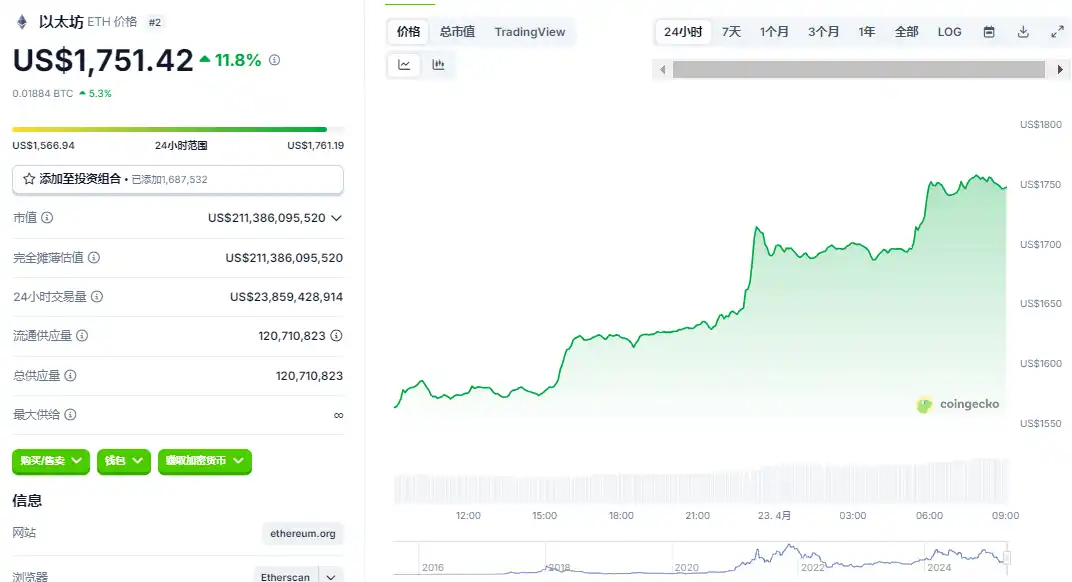
On April 23, 2025, Ethereum (ETH) staged a thrilling price resurgence. Its price climbed from the yearly low of $1385 on April 6 to break through the $1750 mark on April 23, with a cumulative gain of 26.3% in two weeks. The single-day highest surge exceeded 10%. Coinglass data shows that in the past 24 hours, Ethereum's liquidation amount exceeded $120 million.
Behind this round of rally lies not only the liquidity release from the closure of short-term market arbitrage positions but also the reshaping of risk appetite under the expectation of a macroeconomic policy shift. Moreover, it is necessary to seek long-term value support from the endogenous driving force of the blockchain ecosystem.
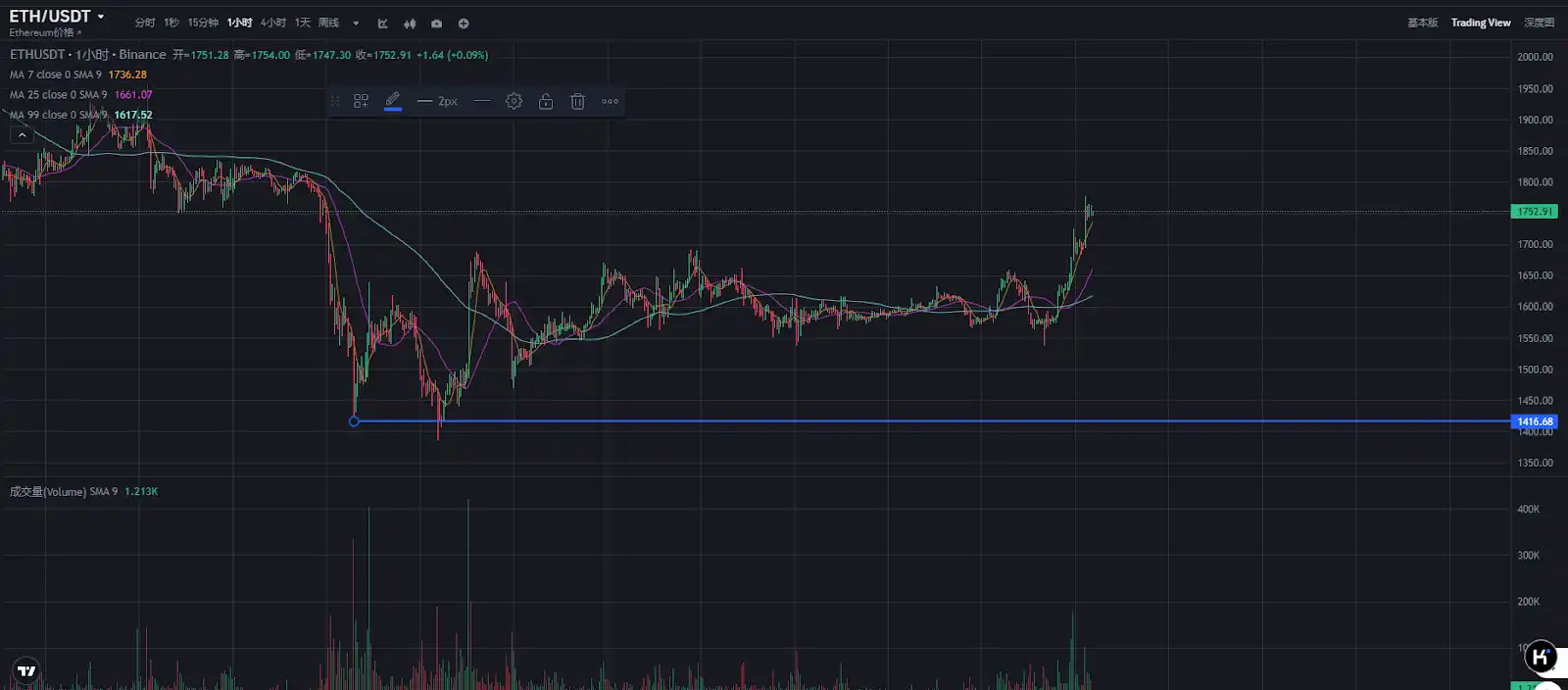
From a technical perspective, after breaking through $1600 on April 9, ETH continuously pierced through the key resistance levels of $1688 and $1700. The daily MACD indicator formed a golden cross above the zero axis, confirming a short-term bullish trend with a three red soldiers pattern.
The weekly level is more noteworthy: the Bollinger Band midline (around $1720) was powerfully surpassed.
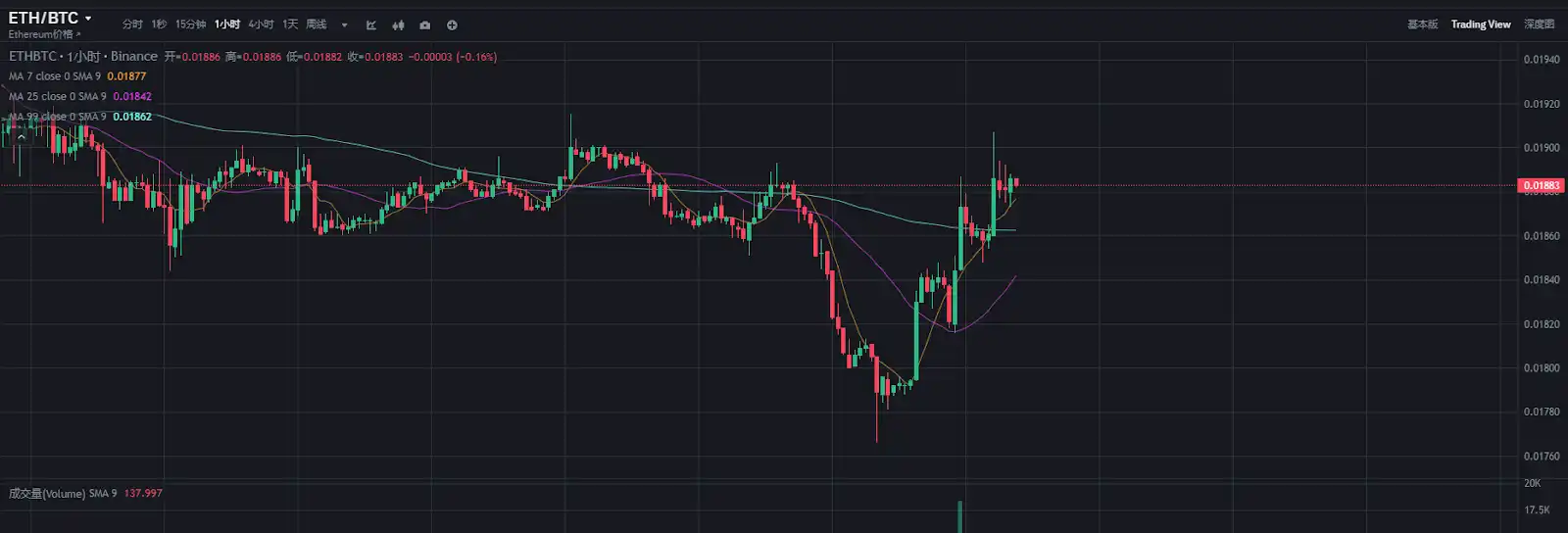
The ETH/BTC exchange rate rebounded from a historical low of 0.01765 to 0.0191, showing the market's restored confidence in the Ethereum ecosystem.
During this process, the Chicago Mercantile Exchange (CME) ETH basis collapsed from 20% in November 2024 to 5% in April 2025, marking the exhaustion of bearish momentum dominated by arbitrage capital and clearing the way for a price rebound.
Section 2: Deconstructing the Surge Factors: Arbitrage Closure, Macro Shift, and Ecosystem Recovery's Triple Drive
1. Arbitrage Capital Clearance Triggered by Futures Basis Convergence
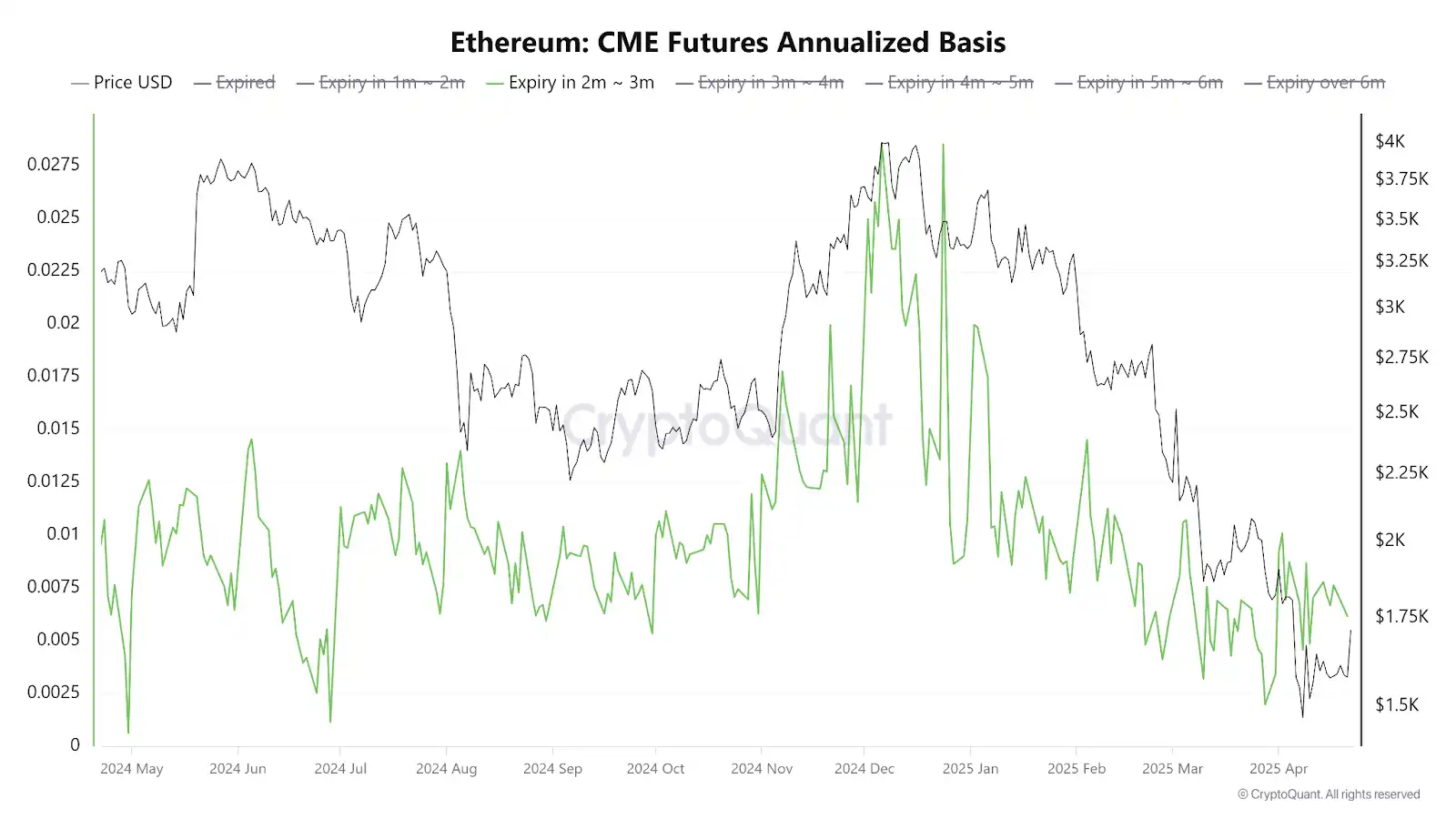
ETH CME Futures Annualized Basis
The essence of CME Basis (price difference between futures price and spot price) is the market's pricing of future liquidity.
In the fourth quarter of 2024, the 20% Basis level far exceeded the concurrent U.S. Treasury bond yield, attracting hedge funds to construct an arbitrage portfolio of "buy spot ETF + short futures." The sustainability of this strategy relies on two premises: first, maintaining a high Basis to cover funding costs, and second, market liquidity sufficient to support position rolling. However, the risk asset sell-off triggered by Trump's tariff policy (April 6th ETH plummeted to $1385) rapidly narrowed the Basis to 5%. After the arbitrage profit space disappeared, institutions were forced to sell off spot ETF positions, further exacerbating the price decline.
After the arbitrage capital exited, ETH pricing power returned to the spot market supply-demand relationship. According to Glassnode on-chain data, the 824,000 ETH accumulated around $1546 became a key support level, and whale addresses' accumulation behavior in this area (such as a single withdrawal of 6528 ETH from Bitfinex) indicates that value investors are starting to enter the market.
2. Macro Policy Shift and Risk Appetite Restoration
The dramatic shift in market expectations for the Fed's monetary policy constitutes another core variable. After Trump pressured Powell to "cut interest rates immediately" on April 17th, the market's probability of a rate cut in June surged from 32.8% to 61.8%.
This change led to a new annual low for the U.S. Dollar Index at 98.2790, while gold and cryptocurrencies strengthened as safe-haven assets outside the dollar. It is worth noting that ETH's rally resonated with the three major U.S. stock indexes (Dow Jones +2.66%, Nasdaq +2.7%), reflecting a global capital reallocation trend from a "cash is king" strategy to risk assets.
The easing of geopolitical risks further catalyzed the upward trend. U.S. Treasury Secretary Benson's statement about the "possible easing of U.S.-China trade tensions" reduced market concerns about supply chain disruptions. From a behavioral finance perspective, this expectation correction reduced ETH's beta coefficient (relative to market volatility) from 1.2 to 0.9, lowering the risk premium requirement and driving the valuation center of gravity upward.
3. Ethereum Ecosystem's Endogenous Value Restructuring
Technological upgrades and ecosystem expansion constitute long-term value support. The Pectra upgrade, launching on April 25th, introduces EIP-7732 (account abstraction optimization) and a Layer2 scaling solution, reducing the cost of a single transaction to below $0.001 and increasing TPS (transactions per second) to 20,000.
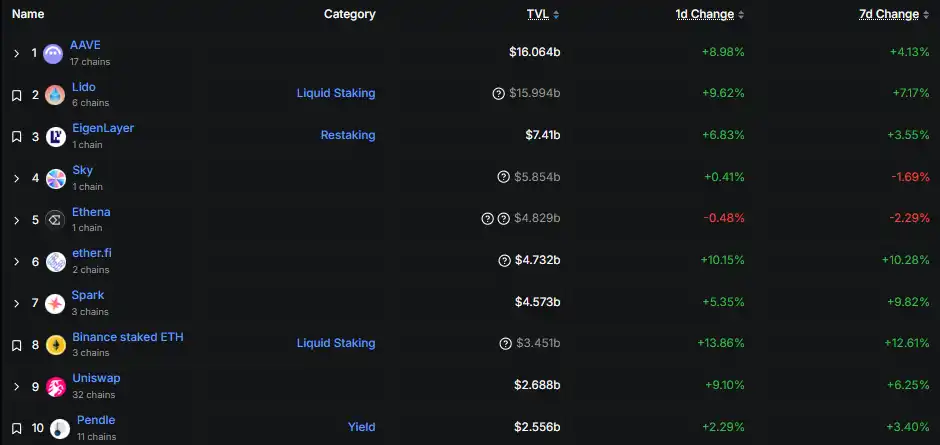
This directly stimulated the recovery of the DeFi Total Value Locked (TVL): as of April 23, the Ethereum DeFi protocol TVL reached $467 billion, an 18% increase from the March low point, with top protocols such as MakerDAO and Aave contributing 60% of the increment.
The structural inflow of institutional funds is equally crucial. In the $500 million RWA (Real World Assets) tokenization fund issued by BlackRock, 47% of the underlying assets are settled through the Ethereum network, demonstrating traditional finance's recognition of the Ethereum settlement layer.
Furthermore, the expected approval of an Ethereum spot ETF by the US SEC through staking may trigger a fund's syphoning effect similar to the 2024 Bitcoin ETF. According to the 10x Research model, if approved, this will bring in at least $5 billion in net inflows.
Future Trend Extrapolation: Path Selection from Resistance Breakout to Trend Reversal
Short-term (1-3 months) price trend depends on the effectiveness of the $1688 support level.
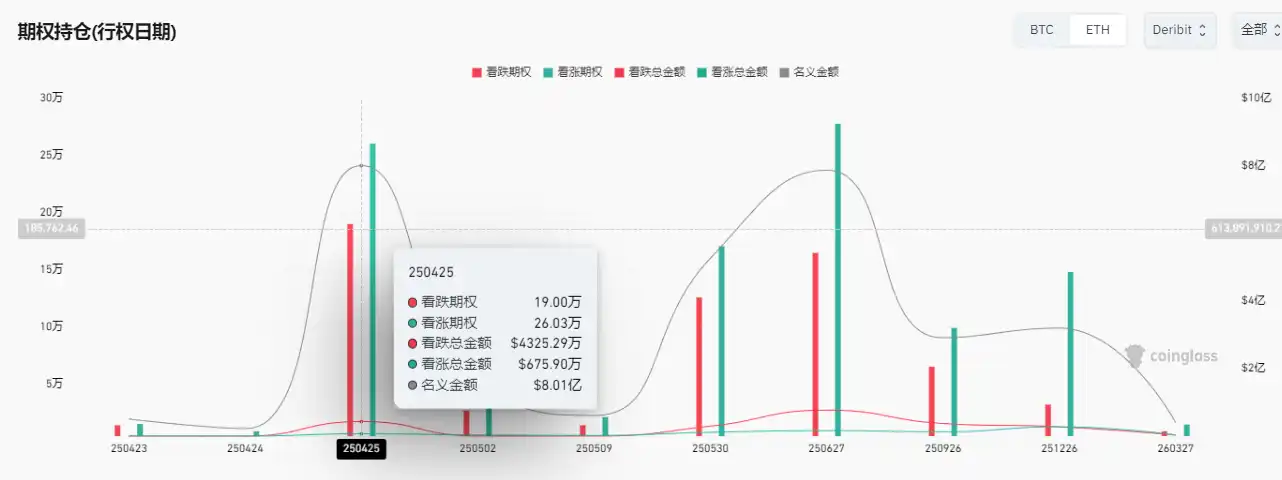
According to options market data, in the ETH contracts expiring on April 25, the open interest of put options with a strike price of $1700 amounts to 12,000 contracts. Caution is required against bearish pressure tactics before the CPI data is released on April 25. If the support holds, the upward targets could be seen at $1830 (weekly Bollinger Bands upper band) and $1930 (Fibonacci 61.8% retracement level).
Medium-term (6-12 months) attention should focus on two major catalysts:
1. Initiation of the Fed Rate Cut Cycle: If a 25 basis point rate cut occurs in June, based on the Capital Asset Pricing Model (CAPM), ETH's expected return will increase from the current 12% to 18%, attracting approximately $20 billion in allocation-oriented funds.
2. ETF Staking Approval and RWA Expansion: If the Ethereum spot ETF is approved through staking, referencing Bitcoin ETF history, the scale of first week inflows may reach $8-12 billion.
Long-term (2-3 years) value pivot will depend on the full implementation of Ethereum's upgrade. After the sharding technology is fully deployed, network throughput is expected to reach 100,000 TPS, with Gas fees approaching zero, positioning Ethereum for absolute advantage in the Web3.0 infrastructure competition.
Epilogue: Seeking Certainty in Uncertainty
The recent surge of Ethereum is not merely a technical rebound but a result of multiple cyclical resonances: arbitrage capital liquidating to release short-term liquidity, monetary policy shifting to reshape risk premium, and technical upgrades solidifying long-term value foundation. Within the key range of 1688-1800 US dollars, investors need to be cautious of increased volatility adding to risk, but more importantly, they should focus on whether the ETH/BTC exchange rate can break through the strong-weak boundary of 0.03 - this will be a core signal confirming the revaluation of the Ethereum ecosystem's value.
As Austrian School economist Hayek said: "The denationalization of money process inevitably accompanies the diversification of the unit of account." Ethereum, as the infrastructure for decentralized finance, its price volatility is fundamentally a consensus evolutionary process of humanity towards a new type of value storage medium. In this historic process, rational investors need to identify signals in the noise, capture trends in the volatility, in order to stand undefeated in the wave of the digital economy.
You may also like

Japan’s Three Megabanks Plan Joint Stablecoin Issuance in Fiscal 2026
MUFG, SMBC, and Mizuho reportedly plan to jointly issue fiat-pegged stablecoins in fiscal 2026, signaling Japan’s growing push into bank-led digital payment infrastructure.

Humanity Discloses H Token Dual-Chain Attack Details, With Losses on Ethereum and BSC Exceeding $36 Million
Humanity said the H token attack across Ethereum and BSC caused more than $36 million in losses after leaked ProxyAdmin keys enabled malicious contract upgrades and token minting.

White House Discusses CLARITY Act With Law Enforcement Ahead of Senate Vote
The White House discussed the CLARITY Act with law enforcement ahead of a Senate vote, focusing on illicit finance risks and developer protections.

$75 billion in foreign capital has fled, and South Korean retail investors have absorbed it all using leverage

Bitcoin Trading Guide 2026: Strategies for Experienced Traders

What Is XAUT and PAXG? Why Tokenized Gold Is Booming in 2026

Cryptocurrency CEXs are flocking to sell US stocks, and traditional brokerages are facing an "uninvited guest."

Will the SpaceX IPO Hurt Bitcoin? Here's What Traders Are Watching
Foreign selling in the South Korean stock market accelerates, with cumulative net sales reportedly reaching $75 billion this year
On June 9, The Kobeissi Letter, citing Goldman Sachs data, reported that global investors are selling South Korean stocks at an unusually rapid pace. In the latest trading session, foreign investors sold about $801 million worth of Kospi constituent stocks again; total foreign outflows last week reached about $10 billion, and the market has been in net foreign selling on nearly every trading day over the past month. According to the data cited in the report, foreign investors have sold about $75 billion worth of South Korean stocks so far this year. Meanwhile, South Korean retail and institutional investors together recorded roughly $69 billion in net buying over the same period, suggesting that the market’s main buying support has come from domestic capital rather than returning overseas funds. The information currently disclosed still mainly comes from The Kobeissi Letter’s retelling and Goldman Sachs data summaries, while public details on the statistical period and the specific definition of “selling” remain relatively limited.

Fortune Warns of Strategy’s Financing Structure Risks as Bitcoin Premium Narrows
Fortune warned that Strategy’s Bitcoin treasury model faces growing financing risks as MSTR’s net asset premium narrows and preferred stock dividend pressure increases.

Ferrari Challenge Le Mans: Carl Moon to Dominate in WEEX Livery

Sahara AI Responds to SAHARA’s Sharp Drop: No Contract or Product Security Issues Found, Internal Investigation Underway
Sahara AI responded to SAHARA’s 60% price drop, saying no token contract or product security issues have been found and an internal investigation is underway.

WEEX Deposit/Withdrawal Dynamic Island: Your Asset Status, Always in Sight
Scaling Crypto Derivatives: The Digital Asset Infrastructure Behind High-Volume Trading
In the fast-moving digital asset ecosystem, derivatives platforms face an extreme architectural test. High-leverage futures markets demand more than just standard security—they require absolute operational precision, zero-latency matching engines, and ironclad structural scalability, all while navigating intense market volatility.
As global platforms scale to meet these demands, the industry is shifting away from rigid, monolithic setups toward a more agile, "decoupled" infrastructure philosophy.
The Blueprint for High-Volume Copy TradingFor elite global exchanges like WEEX (founded in 2018), this architectural choice becomes critical when scaling high-volume retail features like social copy trading. When thousands of users automatically mirror the real-time strategies of elite traders simultaneously, it triggers sudden, monumental spikes in concurrent transactional volume.
To prevent execution latency or settlement bottlenecks during these peak volatility events, a platform's primary engine must remain entirely dedicated to risk management, copy-trade synchronization, and order matching.
The Architectural Rule: New-generation platforms must separate front-end user execution engines from heavy backend infrastructural overhead to eliminate operational friction.
By separating these layers, platforms can maintain complete sovereignty over their trading environments and user experiences while strategically aligning with institutional-grade infrastructure ecosystems. This strategic framework allows modern exchanges to leverage advanced Digital Asset Custody infrastructure such as Cobo’s behind the scenes, ensuring that backend wallet management scales elastically alongside trading spikes.
Capitalizing on Market Momentum and 400× LeverageIn a derivatives arena where platforms offer up to 400× leverage on perpetual contracts, capital efficiency and market agility are core business metrics. To capture market momentum, an exchange needs the ability to rapidly expand its asset offerings, supporting everything from legacy crypto assets to sudden, trending altcoins across a massive library of trading pairs.
Adopting a flexible, scalable Wallet-as-a-Service (WaaS) solution such as Cobo’s could completely rewrite the development timeline for high-growth exchanges. Instead of spending months of engineering capital building out custom backend wallet architectures for every new blockchain network, platforms can deploy localized infrastructure in days.
This agility allows platforms to instantly scale their listings to over a thousand trading pairs without compromising security or delaying time-to-market. It mirrors the exact operational advantages seen during high-velocity market events, similar to how advanced wallet infrastructure empowers platforms during sudden asset surges; allowing exchanges to pass that speed and liquidity directly to their global user base.
A Mature Foundation for GrowthThe synergy between trusted infrastructure ecosystems and global trading platforms represents the natural evolution of a maturing crypto market. As WEEX continues to scale its global spot and derivatives offerings for over 6 million users, adopting robust backend paradigms proves that platforms no longer have to compromise between cutting-edge trading velocity and uncompromised structural security.

Morning Report | BitMine increased its holdings by 126,971 ETH last week; trader Eugene announced his exit from the crypto market

Wang Chuan: How can one not feel anxious after the neighbor Old Wang made thirty times profit by investing in storage stocks? (Seven) - A quarter-century cycle

Get Paid to Onboard? Try WEEX’s New Homepage with Rewards for Registration, Deposit & Trade
WEEX Custom Layout: Build Your Perfect Trading Workspace in Seconds
Japan’s Three Megabanks Plan Joint Stablecoin Issuance in Fiscal 2026
MUFG, SMBC, and Mizuho reportedly plan to jointly issue fiat-pegged stablecoins in fiscal 2026, signaling Japan’s growing push into bank-led digital payment infrastructure.
Humanity Discloses H Token Dual-Chain Attack Details, With Losses on Ethereum and BSC Exceeding $36 Million
Humanity said the H token attack across Ethereum and BSC caused more than $36 million in losses after leaked ProxyAdmin keys enabled malicious contract upgrades and token minting.
White House Discusses CLARITY Act With Law Enforcement Ahead of Senate Vote
The White House discussed the CLARITY Act with law enforcement ahead of a Senate vote, focusing on illicit finance risks and developer protections.
$75 billion in foreign capital has fled, and South Korean retail investors have absorbed it all using leverage
Bitcoin Trading Guide 2026: Strategies for Experienced Traders
What Is XAUT and PAXG? Why Tokenized Gold Is Booming in 2026


