
Ethereum Narrative Crisis: Why Has Seven Years of Ecosystem Development Struggled to Overcome Market Indifference?


Original Article Title: ETH needs a new narrative
Original Article Author: Richard Chen
Original Article Translation: DeepTech TechFlow
Last week, the price of Ethereum (ETH) fell to the level of its initial coin offering (ICO) in 2017. Back then, Ethereum was just a whitepaper and a token, and compared to today's many real-world applications, the market seems indifferent to the 7.5 years of progress in the Ethereum developer ecosystem.
The bigger issue is that ETH needs a new narrative, a clear reason to attract people to buy the token. Let's analyze the common narratives of ETH and discuss why they are no longer effective.
1. "ETH is Bitcoin's leveraged beta."
In past bull market cycles, this statement held true, as altcoins usually outperformed BTC, with blue-chip altcoins being leveraged beta. Whenever BTC performed well, investors increased their risk exposure to gain better returns in altcoins.
This time it's different. In January 2024, the launch of a Bitcoin ETF brought a new paradigm shift. Nearly $100 billion flowed into Bitcoin ETFs, which now collectively hold 5.7% of the BTC supply. In contrast, Ethereum ETFs only attracted $5 billion in inflows. Unlike past cycles, a significant inflow of funds into the cryptocurrency market, especially from large institutions, is now only flowing into BTC and not diversifying to other parts of the market. While BTC will always have a natural demand for new funds looking to enter the cryptocurrency space, it is unclear if other assets have a similar demand.
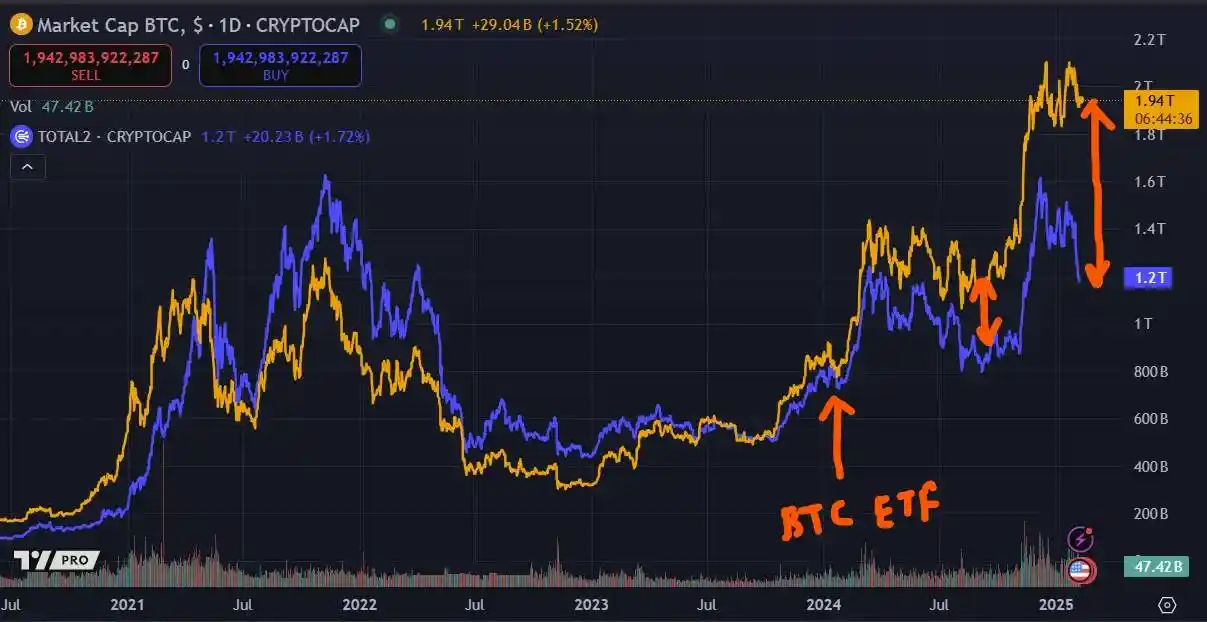
Bitcoin (BTC) is at an independent tier and differentiated from other parts of the market.
The lack of new funds flowing into altcoins leads us to a second-order effect of a zero-sum game speculative fund pool that rotates between different "casinos." This rotation has been evident in price trends over the months post-election, with speculative funds moving from Solana's AI Agent coin to Hyperliquid, then back to $TRUMP and $MELANIA. Without economic growth, the competitive zero-sum attention economy of the crypto tribes accelerates this rotation.
Another second-order effect of funds not flowing into altcoins is that it has harmed the venture capital market. The ideal scenario for a Token Generation Event (TGE) is for the infrastructure project's funding cap to be in the tens of billions of dollars, with the total addressable market (TAM) for other project categories being smaller in comparison. Due to an oversupply of capital relative to founder talent, valuations in private funding rounds have not decreased. As a result, returns in crypto venture capital are being squeezed.
2. "ETH Is Ultrasound Money."
This is no longer the case. In April 2024, the ETH supply started reversing and increasing again. In February 2025, ETH became inflationary since the merge. Therefore, the argument that ETH is a harder money than BTC is no longer valid.
The argument for ultrasound money is also somewhat nuanced. Those newly entering the crypto space would accept the scarcity narrative of "BTC as digital gold" without delving into the technical details of EIP-1559 and which of BTC or ETH is more deflationary.
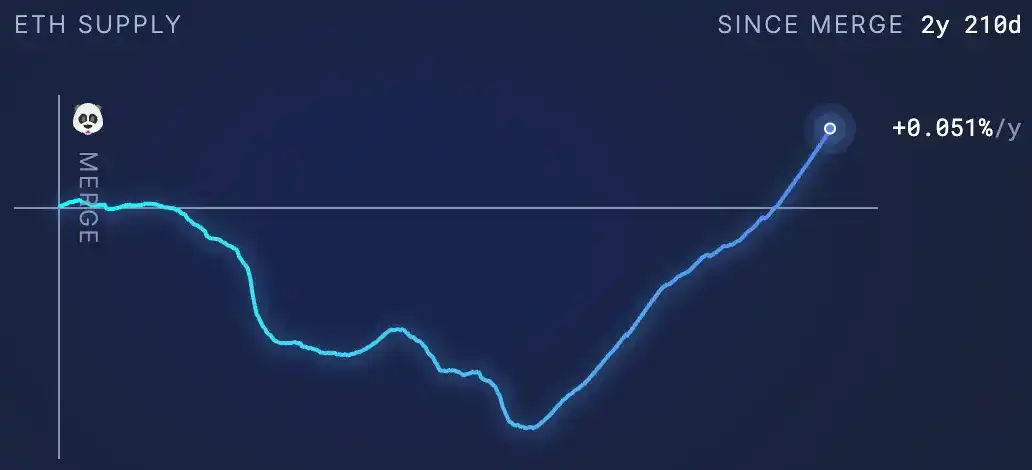
Source: ultrasound.money
3. "ETH Is Digital Oil."
The issue with this framework is that ETH would thus trade like a commodity, exhibiting sideways and range-bound movements. The value of a commodity is based on market supply and demand dynamics, rather than being a growth asset held for the long term. To illustrate this point, there are two charts below comparing the performance of oil and the S&P 500 Index over the past decade.
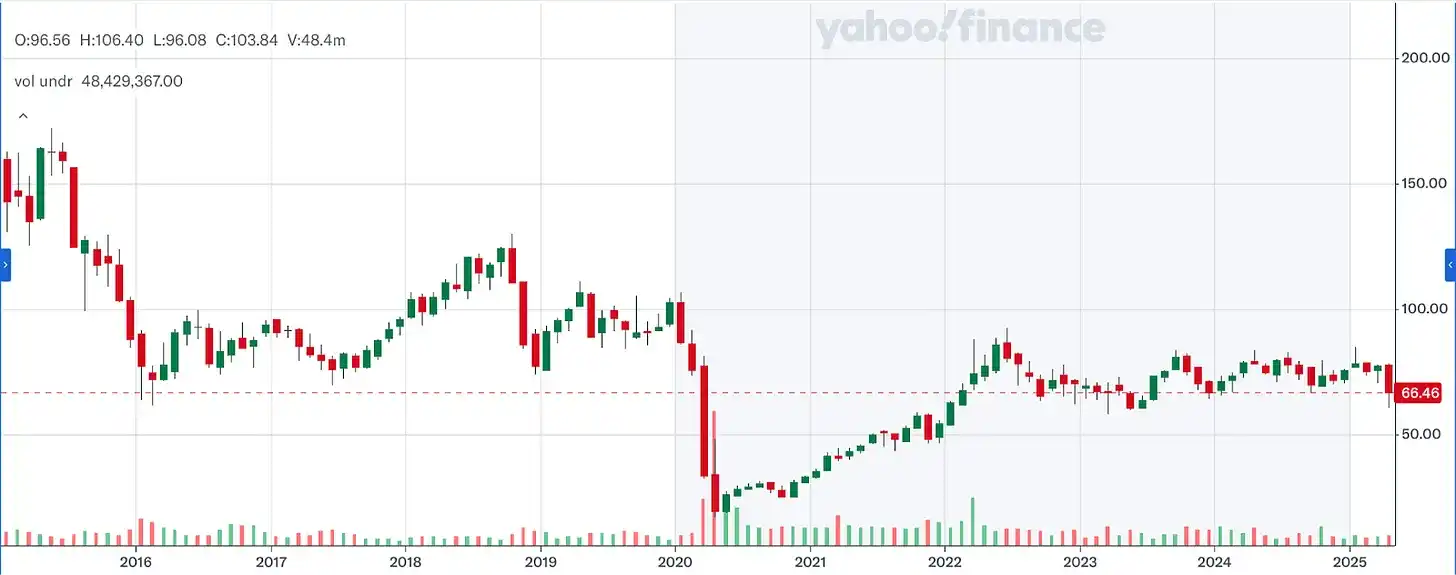
USO
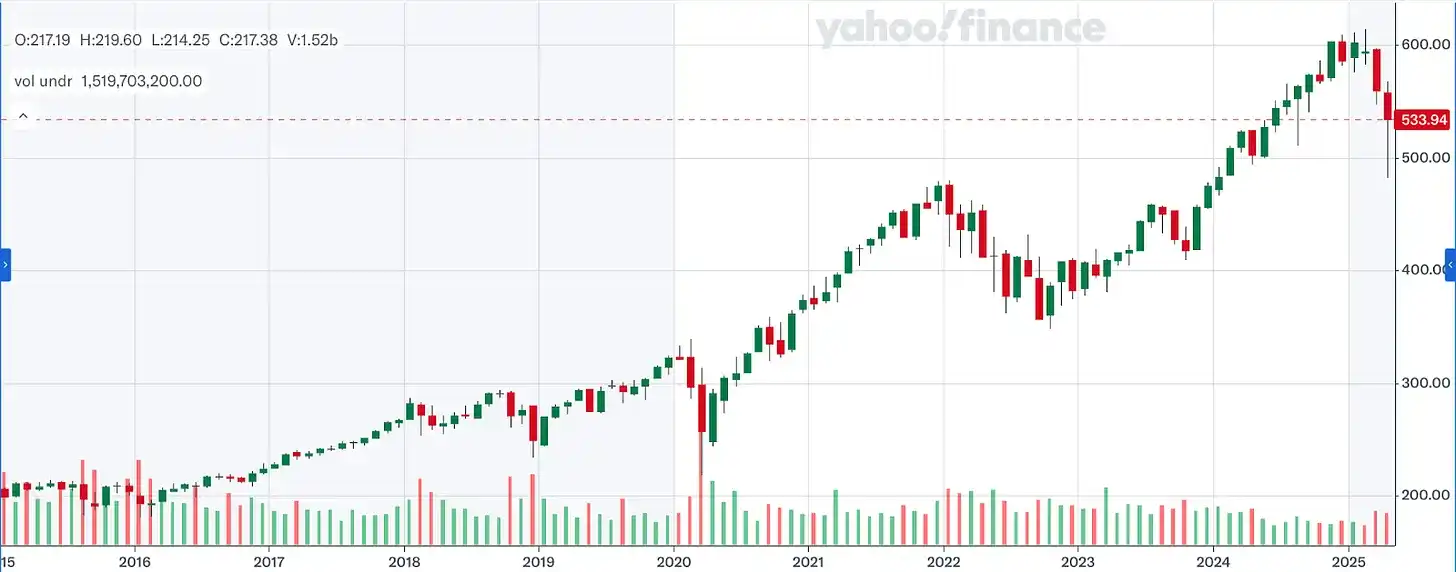
SPY
Over the past decade, oil trading has mostly been range-bound with only two exceptional events: 1) the early 2015 release of U.S. oil supply due to advancements in hydraulic fracturing technology; 2) the COVID crash in early 2020.
Using the "digital oil" framework, if ETH enters the market due to inflation again but without marginal buying demand, the price will decline.
4. "ETH Is a Global Settlement Layer."
Ethereum's long-term scaling roadmap faces an inherent contradiction between two goals: 1) Scaling will be pushed to layer 2 (L2), making Ethereum a settlement layer; 2) L2's economic activity will accrue value to ETH. When EIP-4844 significantly reduces the cost of publishing transaction data to layer 1 (L1), it improves L2 scalability but also reduces Ethereum's revenue.
The bigger issue is that when L2 introduces its own tokens, they become somewhat "parasitic" to ETH. L2 has a strong economic incentive to accumulate value to its own token rather than ETH. Therefore, apart from technical differences in the consensus mechanism, L2 behaves almost like a competing L1.
This has led to the decoupling of the Ethereum Virtual Machine (EVM) from ETH value accrual. Ethereum's greatest historical defense lies in its development tooling ecosystem around the EVM—debuggers, fuzzing tools, template contracts, etc.—all built over years of open-source development. For new developers, building on the EVM is much easier than building on a non-EVM chain without such a robust tooling infrastructure. With the decoupling of EVM and ETH, EVM adoption can continue to grow as new L2s like MegaETH and new L1s like Berachain and Monad leverage the EVM ecosystem, but the value accrues back to their native tokens rather than ETH.
5. "ETH Has the Most On-Chain Economic Activity of Any Chain."
A future scenario may arise where total value locked (TVL) in stablecoins reaches an all-time high, decentralized exchange (DEX) trading volume hits an all-time high, along with other on-chain economic activity metrics on Ethereum reaching new highs, but ETH's price has not reached an all-time high due to a price-to-earnings (P/E) multiple contraction. In this case, ETH's trading is more akin to tech stocks like Tesla (TSLA, 97x forward P/E) or Nvidia (NVDA, 24x forward P/E).
With the current annualized profit, ETH would need a 300x P/E multiple to reach a new all-time high without any price premium. Therefore, there is still significant downside risk from P/E compression.
What will happen next with ETH?
Perhaps ETH will rise due to mean reversion or continue to underperform for the reasons mentioned above.
But before that, ETH needs a new narrative.
You may also like

Fortune Warns of Strategy’s Financing Structure Risks as Bitcoin Premium Narrows
Fortune warned that Strategy’s Bitcoin treasury model faces growing financing risks as MSTR’s net asset premium narrows and preferred stock dividend pressure increases.

Ferrari Challenge Le Mans: Carl Moon to Dominate in WEEX Livery

Sahara AI Responds to SAHARA’s Sharp Drop: No Contract or Product Security Issues Found, Internal Investigation Underway
Sahara AI responded to SAHARA’s 60% price drop, saying no token contract or product security issues have been found and an internal investigation is underway.

WEEX Deposit/Withdrawal Dynamic Island: Your Asset Status, Always in Sight

Scaling Crypto Derivatives: The Digital Asset Infrastructure Behind High-Volume Trading
In the fast-moving digital asset ecosystem, derivatives platforms face an extreme architectural test. High-leverage futures markets demand more than just standard security—they require absolute operational precision, zero-latency matching engines, and ironclad structural scalability, all while navigating intense market volatility.
As global platforms scale to meet these demands, the industry is shifting away from rigid, monolithic setups toward a more agile, "decoupled" infrastructure philosophy.
The Blueprint for High-Volume Copy TradingFor elite global exchanges like WEEX (founded in 2018), this architectural choice becomes critical when scaling high-volume retail features like social copy trading. When thousands of users automatically mirror the real-time strategies of elite traders simultaneously, it triggers sudden, monumental spikes in concurrent transactional volume.
To prevent execution latency or settlement bottlenecks during these peak volatility events, a platform's primary engine must remain entirely dedicated to risk management, copy-trade synchronization, and order matching.
The Architectural Rule: New-generation platforms must separate front-end user execution engines from heavy backend infrastructural overhead to eliminate operational friction.
By separating these layers, platforms can maintain complete sovereignty over their trading environments and user experiences while strategically aligning with institutional-grade infrastructure ecosystems. This strategic framework allows modern exchanges to leverage advanced Digital Asset Custody infrastructure such as Cobo’s behind the scenes, ensuring that backend wallet management scales elastically alongside trading spikes.
Capitalizing on Market Momentum and 400× LeverageIn a derivatives arena where platforms offer up to 400× leverage on perpetual contracts, capital efficiency and market agility are core business metrics. To capture market momentum, an exchange needs the ability to rapidly expand its asset offerings, supporting everything from legacy crypto assets to sudden, trending altcoins across a massive library of trading pairs.
Adopting a flexible, scalable Wallet-as-a-Service (WaaS) solution such as Cobo’s could completely rewrite the development timeline for high-growth exchanges. Instead of spending months of engineering capital building out custom backend wallet architectures for every new blockchain network, platforms can deploy localized infrastructure in days.
This agility allows platforms to instantly scale their listings to over a thousand trading pairs without compromising security or delaying time-to-market. It mirrors the exact operational advantages seen during high-velocity market events, similar to how advanced wallet infrastructure empowers platforms during sudden asset surges; allowing exchanges to pass that speed and liquidity directly to their global user base.
A Mature Foundation for GrowthThe synergy between trusted infrastructure ecosystems and global trading platforms represents the natural evolution of a maturing crypto market. As WEEX continues to scale its global spot and derivatives offerings for over 6 million users, adopting robust backend paradigms proves that platforms no longer have to compromise between cutting-edge trading velocity and uncompromised structural security.

Morning Report | BitMine increased its holdings by 126,971 ETH last week; trader Eugene announced his exit from the crypto market

Wang Chuan: How can one not feel anxious after the neighbor Old Wang made thirty times profit by investing in storage stocks? (Seven) - A quarter-century cycle

Get Paid to Onboard? Try WEEX’s New Homepage with Rewards for Registration, Deposit & Trade
WEEX Custom Layout: Build Your Perfect Trading Workspace in Seconds

See “Buy Walls” & “Sell Walls” Instantly: WEEX Launches the Depth Chart for Smarter Trades

What Is Quick Trade on WEEX? 2 Ways WEEX Ends Chart-Panel Jumping
Morning News | Five major virtual asset platforms in South Korea have experienced 57 incidents of hacking and system failures in six years; Grayscale submits registration application for Canton ETF

Should we escape the peak? The principle of the tail-end market in the stock market

RootData: May 2026 Cryptocurrency Exchange Transparency Research Report

Founder of Baixing.com: My Experience with Claude Code in Fourteen Points

Yang Ge Gary: Agent Economics and AI Microeconomics
When reasoning becomes a scarce resource, who captures its value?

Jensen Huang dramatically "rescues" the South Korean stock market
Fortune Warns of Strategy’s Financing Structure Risks as Bitcoin Premium Narrows
Fortune warned that Strategy’s Bitcoin treasury model faces growing financing risks as MSTR’s net asset premium narrows and preferred stock dividend pressure increases.
Ferrari Challenge Le Mans: Carl Moon to Dominate in WEEX Livery
Sahara AI Responds to SAHARA’s Sharp Drop: No Contract or Product Security Issues Found, Internal Investigation Underway
Sahara AI responded to SAHARA’s 60% price drop, saying no token contract or product security issues have been found and an internal investigation is underway.
WEEX Deposit/Withdrawal Dynamic Island: Your Asset Status, Always in Sight
Scaling Crypto Derivatives: The Digital Asset Infrastructure Behind High-Volume Trading
In the fast-moving digital asset ecosystem, derivatives platforms face an extreme architectural test. High-leverage futures markets demand more than just standard security—they require absolute operational precision, zero-latency matching engines, and ironclad structural scalability, all while navigating intense market volatility.
As global platforms scale to meet these demands, the industry is shifting away from rigid, monolithic setups toward a more agile, "decoupled" infrastructure philosophy.
The Blueprint for High-Volume Copy TradingFor elite global exchanges like WEEX (founded in 2018), this architectural choice becomes critical when scaling high-volume retail features like social copy trading. When thousands of users automatically mirror the real-time strategies of elite traders simultaneously, it triggers sudden, monumental spikes in concurrent transactional volume.
To prevent execution latency or settlement bottlenecks during these peak volatility events, a platform's primary engine must remain entirely dedicated to risk management, copy-trade synchronization, and order matching.
The Architectural Rule: New-generation platforms must separate front-end user execution engines from heavy backend infrastructural overhead to eliminate operational friction.
By separating these layers, platforms can maintain complete sovereignty over their trading environments and user experiences while strategically aligning with institutional-grade infrastructure ecosystems. This strategic framework allows modern exchanges to leverage advanced Digital Asset Custody infrastructure such as Cobo’s behind the scenes, ensuring that backend wallet management scales elastically alongside trading spikes.
Capitalizing on Market Momentum and 400× LeverageIn a derivatives arena where platforms offer up to 400× leverage on perpetual contracts, capital efficiency and market agility are core business metrics. To capture market momentum, an exchange needs the ability to rapidly expand its asset offerings, supporting everything from legacy crypto assets to sudden, trending altcoins across a massive library of trading pairs.
Adopting a flexible, scalable Wallet-as-a-Service (WaaS) solution such as Cobo’s could completely rewrite the development timeline for high-growth exchanges. Instead of spending months of engineering capital building out custom backend wallet architectures for every new blockchain network, platforms can deploy localized infrastructure in days.
This agility allows platforms to instantly scale their listings to over a thousand trading pairs without compromising security or delaying time-to-market. It mirrors the exact operational advantages seen during high-velocity market events, similar to how advanced wallet infrastructure empowers platforms during sudden asset surges; allowing exchanges to pass that speed and liquidity directly to their global user base.
A Mature Foundation for GrowthThe synergy between trusted infrastructure ecosystems and global trading platforms represents the natural evolution of a maturing crypto market. As WEEX continues to scale its global spot and derivatives offerings for over 6 million users, adopting robust backend paradigms proves that platforms no longer have to compromise between cutting-edge trading velocity and uncompromised structural security.
Morning Report | BitMine increased its holdings by 126,971 ETH last week; trader Eugene announced his exit from the crypto market


