
From "World Computer" to "Settlement Layer Asset"? Ethereum's L2 Strategy Self-rescue Manual


Original Title: Ethereum Reimagined: Restoring Control and Value to ETH
Original Author: Momir, IOSG Ventures
TL;DR
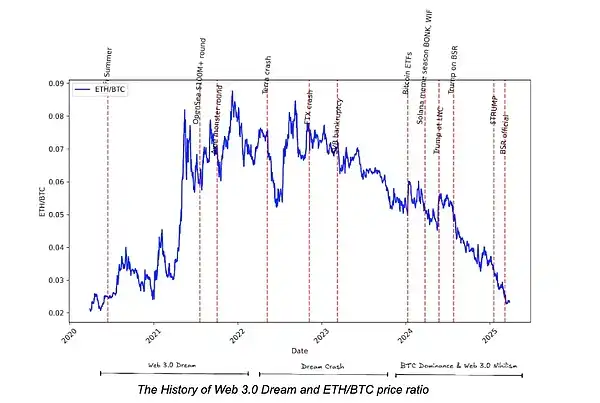
The Web3 vision saw a decline in hype in 2021, and Ethereum is facing significant challenges. Not only has the market's perception of Web3.0 shifted, but Ethereum is also facing fierce competition for remaining market share from emerging platforms like Solana. Key issues such as Layer 2 fragmentation, value erosion, dilution of ecosystem ownership, and lack of leadership have further weakened Ethereum's user experience and economic value. With the rise of Layer 2 network governance, Ethereum's influence has been shaken. These factors ultimately led to one of the most significant price pullbacks in ETH's history.
However, there is still hope: by driving L2 interoperability, prioritizing the improvement of ETH-centric infrastructure, and adopting decisive, performance-driven leadership, Ethereum still has a chance to regain its glory. Ethereum's robust underlying architecture and vibrant developer ecosystem remain its enduring strengths, but to restore ETH's prominent position, strategic actions must be taken swiftly.
From the cognitive shift from the Web3.0 utopia to the harsh reality, the market has been forced to re-examine Ethereum's core value proposition. The once hopeful ideal of a "user-governed decentralized internet" has now been replaced by a more ironic narrative: the cryptocurrency space is either a store of value game for Bitcoin or a digital casino. This reversal of sentiment has had a particularly significant impact on Ethereum: it prided itself as the cornerstone of a new internet paradigm but now must face growing skepticism.
Moreso, Ethereum is no longer the sole advocate of the Web 3.0 vision. Regardless of one's optimism or pessimism about the industry's future, it is clear that platforms like Solana are becoming the new hubs of crypto-native activities. In this context, this article aims to dissect Ethereum's most urgent strategic challenges and propose viable solutions to help it regain an advantage in the ever-evolving landscape.
Core Challenges
Ethereum faces many challenges, but this analysis focuses on the four most pressing issues—L2 network fragmentation, declining value capture ability, ecosystem ownership dilution, and lack of strategic leadership.
L2 Network Fragmentation and User Experience Segmentation
The most significant crisis is undoubtedly Layer 2 network fragmentation. Introducing multiple competing execution layers has fractured the user experience and on-chain liquidity, eroding Ethereum's once-proud composability advantage, a strength that remains clearly visible in single-chain blockchains like Solana.
For users, they must navigate various protocol, standards, and cross-chain bridge inconsistencies, making the seamless interaction that Ethereum initially promised challenging to achieve. Developers must bear the burden of maintaining multiple versions of protocols across multiple L2s, and startup teams face complex go-to-market strategies in a fragmented ecosystem. As a result, many consumer-facing applications choose to migrate to Solana, where users and entrepreneurs can focus on entertainment and innovation without being entangled in fragmented infrastructure.
Ecosystem Control Dilution: An Increasingly Severe Threat
More critically, Ethereum has outsourced its scaling roadmap to L2, a decision that is steadily weakening its control over its ecosystem. General-purpose L2 Rollups generate strong network effects as they build their respective ecosystems, gradually evolving into insurmountable moats. Over time, these execution layers' influence over Ethereum's settlement layer has been growing, potentially leading the community to overlook the importance of the mainnet settlement layer. Once assets begin to exist natively on the execution layer, Ethereum's potential for value capture and influence will be significantly diminished, reducing the settlement layer to a commodified service.
Value Attribution Erosion: A Structural Challenge
The rise of L2 significantly impacts ETH's value capture, with these platforms increasingly capturing MEV and transaction fee income, leading to a substantial reduction in the value flowing back to the Ethereum mainnet. This shift redirects the economic benefits from ETH holders to L2 token holders, weakening the intrinsic motivation to hold ETH as an investment asset. While this trend poses an inevitable challenge to any Layer 1 token, whether a modular Ethereum or a single-chain integrated blockchain, Ethereum has experienced this phenomenon earlier and more notably due to its early adoption of a centralized L2 approach.
It can be foreseen that as application-layer dominated MEV capture becomes the norm, both standalone blockchains and even L2s themselves will face a value capture crisis. While this is not a unique predicament to Ethereum, devising precise strategies to address this structural challenge remains a critical proposition.
Leadership Crisis: An Idealism Paradox
While addressing the above challenges, Ethereum has also exposed profound strategic leadership deficiencies. The community has long been stuck in a recurring balance between efficiency goals and egalitarian values, stalling crucial progress. Meanwhile, the commitment to "trustless neutrality" governance, initially aimed at reducing regulatory and state crackdown risks, has often become a constraint on strategic decision-making. Additionally, ETH holders lack a mechanism to directly influence significant strategic choices, with their sole means of expressing discontent often being token sales.
In hindsight, while these issues may be easily defined, to some extent, they may stem from considerations of regulatory pressure and national-level risks rather than a lack of governance and leadership insight.
Strategic Response: Challenges and Solutions
L2 Network Fragmentation: Self-Correction Mechanism
Two paths to resolve the L2 fragmentation crisis:
Firstly, relying on market mechanisms (natural selection) to achieve organic integration of the ecosystem, ultimately forming 2-3 universally active L2 dominant markets. The remaining projects will either exit the competition or transition into Rollup service providers targeted at vertical scenarios;
Secondly, by establishing highly binding interoperability standards, dissipating friction within the Rollup ecosystem, preventing a single execution layer from building a monopolistic moat.
Ethereum should seize the current window of influence on L2, driving the implementation of the second approach. It is necessary to realize that this dominance is gradually eroding by the day, and the slower the action, the weaker the strategic impact. By constructing a unified L2 ecosystem, Ethereum is expected to regain the composability advantage of the mainnet era, competing head-to-head with single-chain solutions like Solana in terms of user experience.
However, solely relying on market-driven integration will dim the future prospects of ETH. Once a power-law distribution emerges around 2-3 dominant execution layers, Ethereum's influence on these layers may significantly diminish; in this scenario, each layer will often prioritize the value attribution of its native token, marginalizing ETH and weakening Ethereum's economic model. To avoid this situation, Ethereum must take decisive action, shaping its L2 ecosystem to ensure that value and control always remain tied to the mainnet and ETH.
Value Recapture Mechanism
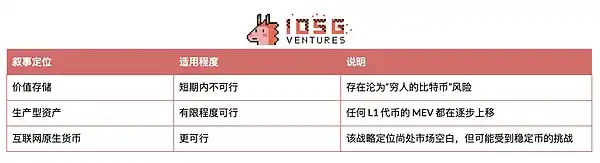
Mere reliance on the "productive asset" narrative is not a sustainable long-term strategy for ETH (and even all Layer1 tokens). The time window for Layer1 to capture MEV as the dominant revenue stream lasts at most five years, with the continuous migration of value capture levels upstream in the application stack being an established trend. Meanwhile, Bitcoin has firmly established itself in the "store of value" narrative, potentially leading the market to view ETH as the "poor man's Bitcoin" if it attempts to compete with BTC in this area, akin to silver relative to gold in history. Even if ETH can demonstrate a significant advantage in the store of value aspect in the future, this transformation may take at least a decade, and Ethereum cannot afford to wait for such a long cycle. Therefore, during this period, Ethereum must carve out a unique narrative path to maintain its market relevance.
Positioning ETH as the "native internet money" and the highest-quality on-chain collateral sets the most promising direction for the next decade. While stablecoins dominate as a means of payment in on-chain finance, they still rely on off-chain ledgers; the true role of an internet-native, unstoppable currency is yet to be substantially filled, and ETH uniquely holds this first-mover advantage. However, to achieve this goal, Ethereum must regain control of the ecosystem's base trust layer and drive ETH adoption to the forefront, rather than allowing the widespread adoption of the Wrapped ETH standard.
Regaining Ecosystem Dominance
Re-establishing ecosystem ownership can be achieved through two key avenues: first, by enhancing Ethereum L1 performance to match that of centralized chains, ensuring consumer applications and DeFi experiences are seamless; second, by introducing Ethereum-native Rollups, focusing all business development and adoption efforts on this. By focusing ecosystem activity on the infrastructure controlled by ETH, Ethereum can strengthen ETH's core position in the ecosystem. This requires Ethereum to shift from the outdated "ETH-compatible" paradigm to an "ETH-first" ecosystem model, prioritizing direct control over core resources and maximizing ETH value capture.
However, whether regaining ecosystem control or strengthening ETH adoption, these are tricky decisions that could alienate key contributors such as Rollup and liquidity staking providers. Ethereum must carefully balance the need for control reinforcement with the risk of community fragmentation to ensure ETH successfully establishes its new narrative as the cornerstone of the ecosystem.
Leadership Innovation
Ultimately, Ethereum's leadership must innovate to address governance and strategic challenges. Ethereum leaders need to adopt a performance-driven mindset, a greater sense of urgency, and a pragmatic approach to drive ecosystem development. This shift requires abandoning the previous excessive adherence to "trust neutrality," especially when making decisions about product roadmaps and ETH asset positioning, necessitating more decisive actions.
Meanwhile, the market has expressed dissatisfaction with Ethereum's practice of outsourcing key infrastructure—from Rollups to staking—to decentralized entities. To reverse this trend, Ethereum must move away from the old "alignment with ETH" model toward a new "ETH-led" model, ensuring core infrastructure is unified under a single token system ($ETH). This will further solidify ETH's core position and restore market confidence in Ethereum's strategic direction.
Marketing Challenges and Narrative Potential
Despite facing many challenges, Ethereum still has a strong advantage to support its status in the cryptocurrency field—a advantage that is often downplayed by its leadership, leading negative criticism to overshadow its core narrative. Systematically outlining these advantages helps establish an objective understanding of Ethereum's potential.
Proven Infrastructure
On par with Bitcoin, Ethereum provides unparalleled decentralized security, meeting the strict requirements of sovereign entities and large financial institutions. The security provided by the consensus mechanism far surpasses that of other smart contract platforms, ensuring true censorship resistance—a crucial aspect for infrastructure hosting hundreds of billions of dollars in value. The Ethereum DeFi ecosystem has securely handled around $76.32 trillion in value locked (TVL x days), with very few major security incidents, deepening its time-tested security moat.
Currently, the stablecoin scale hosted on Ethereum has exceeded $120 billion, with these funds primarily accumulated during an era when regulatory frameworks were unclear and institutional adoption was not widespread. As the regulatory environment gradually clarifies and institutional demand drives further stablecoin growth, it is expected that within the next decade, the stablecoin scale hosted on Ethereum will exceed $1 trillion. This growth stems from both new issuances and market trust in its security and composability, potentially solidifying its position as a foundational platform in the global financial system.
Forward-Thinking Design
Ethereum's architecture exhibits significant forward thinking. Compared to Bitcoin, it offers a more robust quantum attack resistance transition plan, and its continuously evolving technical culture drives innovation. Unlike the potential security budget constraints that $BTC may face in the future, Ethereum's flexible monetary policy allows it to adapt to market conditions while maintaining strong security incentives, ensuring long-term resilience.
Unrivaled Developer Ecosystem
Ethereum boasts the blockchain field's largest and most diverse developer community, with nearly a decade of accumulated knowledge and best practices. This intellectual capital, combined with social capital, has built another layer of a moat for the EVM ecosystem, keeping it consistently ahead in terms of innovation speed and application scale.
Modular Pathway: The Only Solution for a Scalable Decentralized System
Ethereum's modular design has made significant progress in balancing decentralization, scalability, and security. Over time, it has become increasingly clear that for a monolithic chain to achieve global financial-grade scale, it must inevitably sacrifice decentralization; Ethereum's modular strategy is the only viable solution to achieve sustainable expansion while maintaining a trust-minimized and decentralized premise. The correctness of this strategic choice will become increasingly evident over time.
The Most Customizable Technology Stack
The Ethereum L2 ecosystem provides unparalleled customizability, making it the preferred platform for vertical-specific applications and institutional adoption. Institutions can build their own L2 on top of Ethereum L1, utilizing technologies such as Fully Homomorphic Encryption (FHE) to achieve privacy protection; companies like Robinhood can replicate traditional finance's order flow payment mechanism on their proprietary L2 through a "sequencer pays" model. These L2s, anchored to Ethereum L1—the world's most secure public ledger—form a unique security redundancy: even if an L2 experiences a failure, users can still settle back to L1 in a trustless manner, creating the "ultimate security net," a unique value proposition of the Ethereum ecosystem.
Market Signal: ETH Enters Historic Oversold Territory
ETH's recent price action has made it an unpopular asset in investors' eyes, with ETH holders expressing their lack of confidence in recent developments through their selling behavior. This drastic decline has only occurred six times in ETH's ten-year history, with five of those times happening in its early stages. For Ethereum, now in its tenth year of development, to face such a significant revaluation in its mature stage is undoubtedly a warning signal to the entire ecosystem. Historical data shows that after similar pullback events, there have been strong rebounds in the following six months, injecting a glimmer of hope into the current dilemma.
However, whether ETH can replicate historical patterns or continue its steep downward trajectory will directly depend on the strategic signals released by the Ethereum leadership in the short term and the strategic execution over the next twelve months. Despite the challenges, the current situation is not irreparable, and with the formulation and implementation of viable strategies, a strong recovery is still possible.
To reclaim its industry leadership and restore market confidence in ETH, Ethereum must immediately address the following core challenges: first, it needs to enforce robust L2 interoperability standards to mitigate fragmentation and maintain the seamless composability the mainnet once defined; second, it must transition from the "aligned with ETH" old model to an "ETH-driven" ecosystem model, prioritizing L1 scalability and Ethereum native Rollups to re-establish control and maximize ETH's value capture; lastly, the leadership must evolve to a performance-driven decision-making approach, moving away from being "trust neutral" and unifying critical infrastructure under the $ETH token system.
If decisive action is not taken, Ethereum faces the risk of being eroded by competitors like Solana and becoming a commoditized settlement layer.
You may also like

Japan’s Three Megabanks Plan Joint Stablecoin Issuance in Fiscal 2026
MUFG, SMBC, and Mizuho reportedly plan to jointly issue fiat-pegged stablecoins in fiscal 2026, signaling Japan’s growing push into bank-led digital payment infrastructure.

Humanity Discloses H Token Dual-Chain Attack Details, With Losses on Ethereum and BSC Exceeding $36 Million
Humanity said the H token attack across Ethereum and BSC caused more than $36 million in losses after leaked ProxyAdmin keys enabled malicious contract upgrades and token minting.

White House Discusses CLARITY Act With Law Enforcement Ahead of Senate Vote
The White House discussed the CLARITY Act with law enforcement ahead of a Senate vote, focusing on illicit finance risks and developer protections.

$75 billion in foreign capital has fled, and South Korean retail investors have absorbed it all using leverage

Bitcoin Trading Guide 2026: Strategies for Experienced Traders

What Is XAUT and PAXG? Why Tokenized Gold Is Booming in 2026

Cryptocurrency CEXs are flocking to sell US stocks, and traditional brokerages are facing an "uninvited guest."

Will the SpaceX IPO Hurt Bitcoin? Here's What Traders Are Watching
Foreign selling in the South Korean stock market accelerates, with cumulative net sales reportedly reaching $75 billion this year
On June 9, The Kobeissi Letter, citing Goldman Sachs data, reported that global investors are selling South Korean stocks at an unusually rapid pace. In the latest trading session, foreign investors sold about $801 million worth of Kospi constituent stocks again; total foreign outflows last week reached about $10 billion, and the market has been in net foreign selling on nearly every trading day over the past month. According to the data cited in the report, foreign investors have sold about $75 billion worth of South Korean stocks so far this year. Meanwhile, South Korean retail and institutional investors together recorded roughly $69 billion in net buying over the same period, suggesting that the market’s main buying support has come from domestic capital rather than returning overseas funds. The information currently disclosed still mainly comes from The Kobeissi Letter’s retelling and Goldman Sachs data summaries, while public details on the statistical period and the specific definition of “selling” remain relatively limited.

Fortune Warns of Strategy’s Financing Structure Risks as Bitcoin Premium Narrows
Fortune warned that Strategy’s Bitcoin treasury model faces growing financing risks as MSTR’s net asset premium narrows and preferred stock dividend pressure increases.

Ferrari Challenge Le Mans: Carl Moon to Dominate in WEEX Livery

Sahara AI Responds to SAHARA’s Sharp Drop: No Contract or Product Security Issues Found, Internal Investigation Underway
Sahara AI responded to SAHARA’s 60% price drop, saying no token contract or product security issues have been found and an internal investigation is underway.

WEEX Deposit/Withdrawal Dynamic Island: Your Asset Status, Always in Sight
Scaling Crypto Derivatives: The Digital Asset Infrastructure Behind High-Volume Trading
In the fast-moving digital asset ecosystem, derivatives platforms face an extreme architectural test. High-leverage futures markets demand more than just standard security—they require absolute operational precision, zero-latency matching engines, and ironclad structural scalability, all while navigating intense market volatility.
As global platforms scale to meet these demands, the industry is shifting away from rigid, monolithic setups toward a more agile, "decoupled" infrastructure philosophy.
The Blueprint for High-Volume Copy TradingFor elite global exchanges like WEEX (founded in 2018), this architectural choice becomes critical when scaling high-volume retail features like social copy trading. When thousands of users automatically mirror the real-time strategies of elite traders simultaneously, it triggers sudden, monumental spikes in concurrent transactional volume.
To prevent execution latency or settlement bottlenecks during these peak volatility events, a platform's primary engine must remain entirely dedicated to risk management, copy-trade synchronization, and order matching.
The Architectural Rule: New-generation platforms must separate front-end user execution engines from heavy backend infrastructural overhead to eliminate operational friction.
By separating these layers, platforms can maintain complete sovereignty over their trading environments and user experiences while strategically aligning with institutional-grade infrastructure ecosystems. This strategic framework allows modern exchanges to leverage advanced Digital Asset Custody infrastructure such as Cobo’s behind the scenes, ensuring that backend wallet management scales elastically alongside trading spikes.
Capitalizing on Market Momentum and 400× LeverageIn a derivatives arena where platforms offer up to 400× leverage on perpetual contracts, capital efficiency and market agility are core business metrics. To capture market momentum, an exchange needs the ability to rapidly expand its asset offerings, supporting everything from legacy crypto assets to sudden, trending altcoins across a massive library of trading pairs.
Adopting a flexible, scalable Wallet-as-a-Service (WaaS) solution such as Cobo’s could completely rewrite the development timeline for high-growth exchanges. Instead of spending months of engineering capital building out custom backend wallet architectures for every new blockchain network, platforms can deploy localized infrastructure in days.
This agility allows platforms to instantly scale their listings to over a thousand trading pairs without compromising security or delaying time-to-market. It mirrors the exact operational advantages seen during high-velocity market events, similar to how advanced wallet infrastructure empowers platforms during sudden asset surges; allowing exchanges to pass that speed and liquidity directly to their global user base.
A Mature Foundation for GrowthThe synergy between trusted infrastructure ecosystems and global trading platforms represents the natural evolution of a maturing crypto market. As WEEX continues to scale its global spot and derivatives offerings for over 6 million users, adopting robust backend paradigms proves that platforms no longer have to compromise between cutting-edge trading velocity and uncompromised structural security.

Morning Report | BitMine increased its holdings by 126,971 ETH last week; trader Eugene announced his exit from the crypto market

Wang Chuan: How can one not feel anxious after the neighbor Old Wang made thirty times profit by investing in storage stocks? (Seven) - A quarter-century cycle

Get Paid to Onboard? Try WEEX’s New Homepage with Rewards for Registration, Deposit & Trade
WEEX Custom Layout: Build Your Perfect Trading Workspace in Seconds
Japan’s Three Megabanks Plan Joint Stablecoin Issuance in Fiscal 2026
MUFG, SMBC, and Mizuho reportedly plan to jointly issue fiat-pegged stablecoins in fiscal 2026, signaling Japan’s growing push into bank-led digital payment infrastructure.
Humanity Discloses H Token Dual-Chain Attack Details, With Losses on Ethereum and BSC Exceeding $36 Million
Humanity said the H token attack across Ethereum and BSC caused more than $36 million in losses after leaked ProxyAdmin keys enabled malicious contract upgrades and token minting.
White House Discusses CLARITY Act With Law Enforcement Ahead of Senate Vote
The White House discussed the CLARITY Act with law enforcement ahead of a Senate vote, focusing on illicit finance risks and developer protections.
$75 billion in foreign capital has fled, and South Korean retail investors have absorbed it all using leverage
Bitcoin Trading Guide 2026: Strategies for Experienced Traders
What Is XAUT and PAXG? Why Tokenized Gold Is Booming in 2026


