
History Doesn’t Repeat, But It Rhymes — Don’t Miss It This Time

Original Author: Long Ye;Just Blockchain News
Note: This article is the full version of https://x.com/Tony_lza/status/1914223870581915770. The core views were already posted on Twitter two days ago.
Let‘s start with the conclusion:
(1) Right now might be the best time this year to buy crypto.
(2) I stand by the view I shared in my December article during the last bull run: https://reurl.cc/QYEbnb
(3) Besides BTC, if I had to choose a token to put $500K into, I’d pick Hyperliquid; if it were $5M, I’d choose SOL.
Back to the rhythm: structural opportunities are re-emerging
Now could very well be one of the best entry points into crypto this year.
This isn’t a bullish claim made out of thin air. Whether from price structure, macro signals, on-chain data, or asset evolution, today’s market conditions look strikingly similar to the 「bottom consolidation」period during the spring of 2020 —when Bitcoin crashed to $3,800 in just days, only to stage one of the most breathtaking rebounds in crypto history.
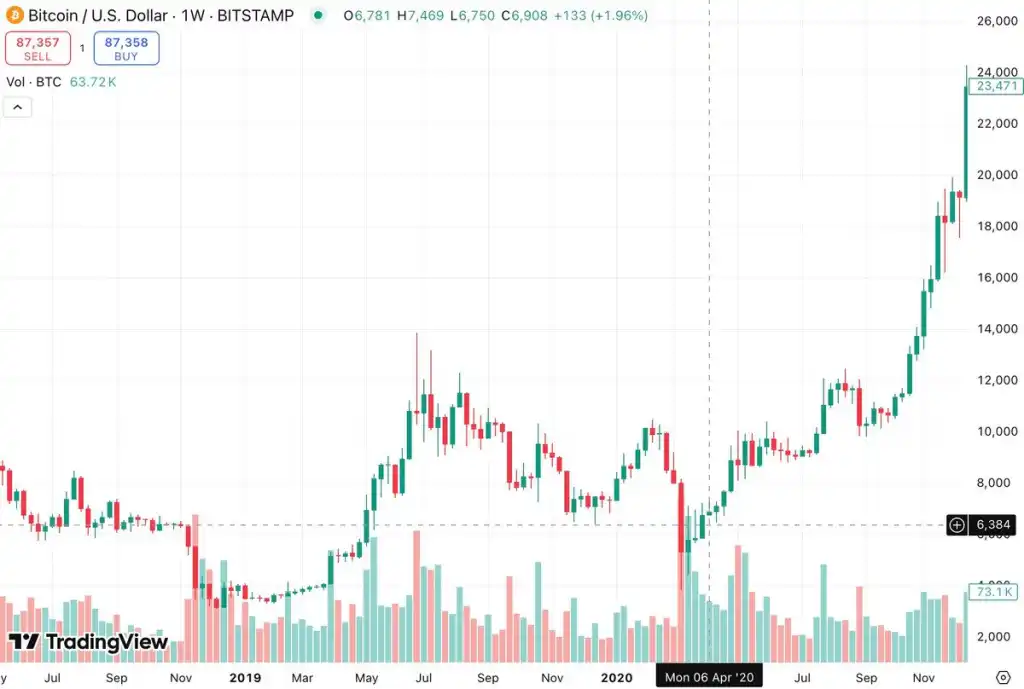
Today, the market seems to be replaying that script. Back then, after a panic sell-off, the Nasdaq entered a 3–4 week consolidation phase, while Bitcoin quickly formed a bottom in two weeks and surged strongly in the following months.
This time, a wave of short-term selling triggered by the 「tariff war + soaring U.S. bond yields」 in early April briefly sent BTC below 74,000, with SOL even dipping under $100—but both have since recovered rapidly.
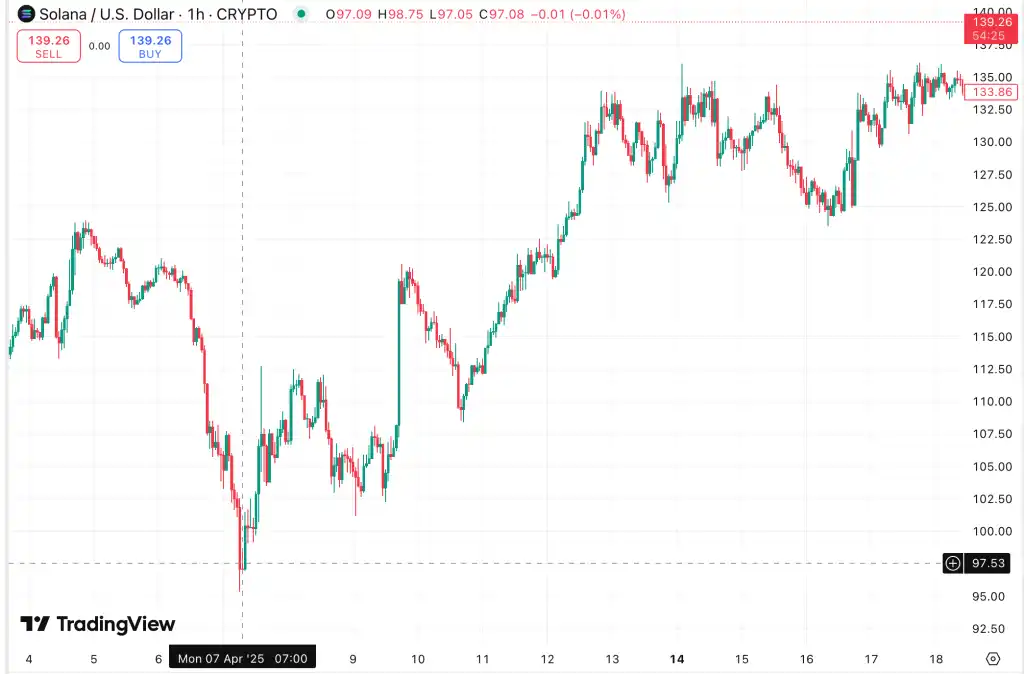
At this point, the bottom appears to be firmly in place. In contrast, U.S. equities, especially the Nasdaq, are still stuck in a prolonged consolidation phase.
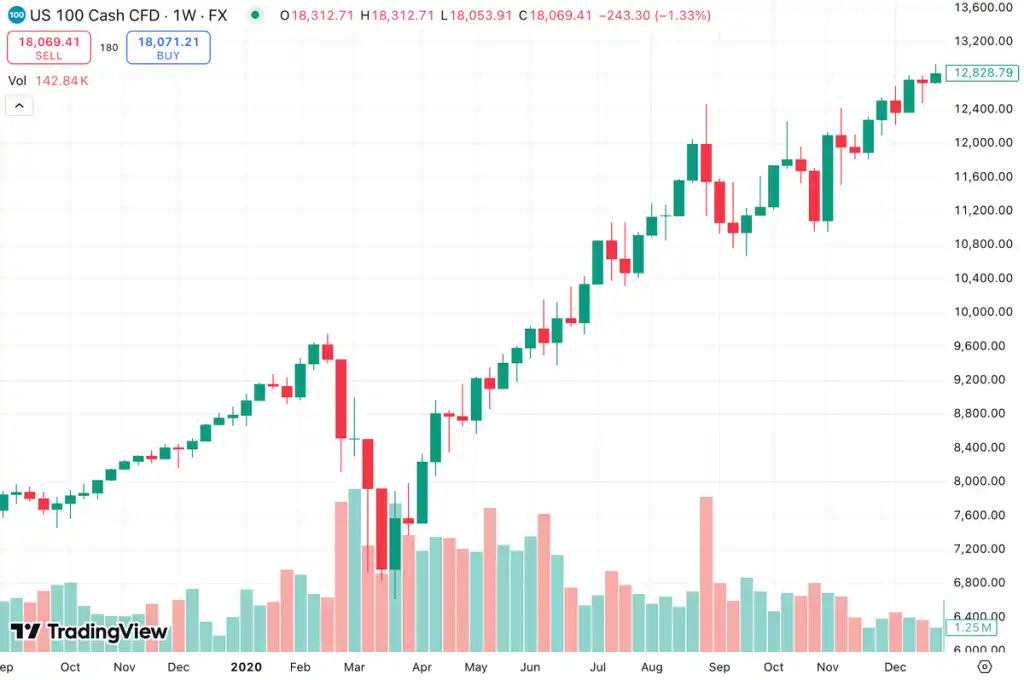
In other words: the emotional correction in crypto has played out faster and more decisively than in traditional markets, with clearer signals of stabilization.
This shift from weak to strong hands is a typical feature before a major rally. Back in 2020, Bitcoin rose over 300% in the six months following the March crash. If history rhymes, then this market adjustment could be a prime setup.
In both timing and structure, crypto is now leading.
Macro capital flow is pivoting: from skepticism to active embrace
Beyond the technical retracement, what’s more important is a shift in macro capital perspective.
A key trend not to ignore: traditional money is flowing into crypto at an unprecedented pace. The approval of U.S. spot Bitcoin ETFs has opened the door for institutional investors. Since the January approvals, these ETFs have seen over $12 billion in net inflows.
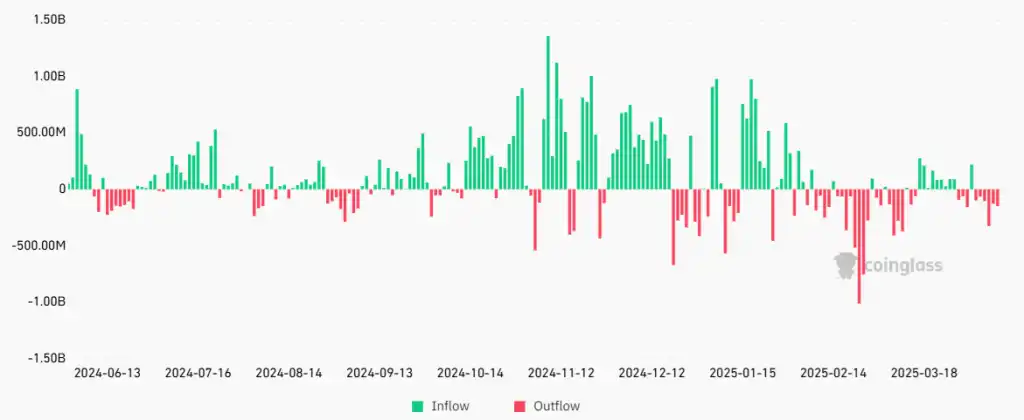
Total net inflows of spot Bitcoin ETFs (USD)
What’s even more notable is how crypto is shifting from a speculative asset to a practical tool. During recent visits to foreign trade companies in Shenzhen and Yiwu, I found that USDT is now widely used in cross-border settlement. As one electronics exporter said,「Using USDT is way faster than bank transfers, and the fees are a tenth of the cost.」
This trend is accelerating globally. In high-inflation countries like Argentina and Turkey, people use stablecoins to preserve value. In Southeast Asia, more SMEs are accepting crypto payments. Crypto is completing the transformation from「speculative assets」to「utility tools」, a process that will bring more lasting demand support.
Over the past month, I've had conversations with friends in export businesses. Most were previously skeptical or outright dismissive of crypto. But amid global supply chain restructuring, geopolitical tensions, and shrinking currency channels, they're asking questions that were once unimaginable:
Can we do light processing in a third country and settle exports to the U.S. in USDT to avoid sanctions?Physical goods are too uncertain—are there virtual goods we can sell, like NFTs?Our factory is shut down—how do we convert idle cash into crypto? More importantly, what coins should we trade with all this free time?
Crypto is no longer just an「investment option」—it's a resource outlet after「reality interruption」.
And USDT is increasingly ubiquitous: in some cross-border trade scenarios, it』s already the norm. As they put it, 「Not holding BTC is no longer realistic.」
The gold-BTC connection: a historic leading indicator
Here’s another rarely discussed but highly significant signal: gold has hit new all-time highs and is still climbing.
In early April, gold plunged 5% in just four days, breaking below $3,000 and sparking panic. But within a week, it rebounded to hit new highs, now soaring past $3,300 and entering a strong uptrend.
Historically, when gold breaks all-time highs, Bitcoin often follows within 100–150 days. This is no coincidence—it's a reflection of correlated flows and structural alignment. Gold and BTC both serve as hedges against fiat devaluation.
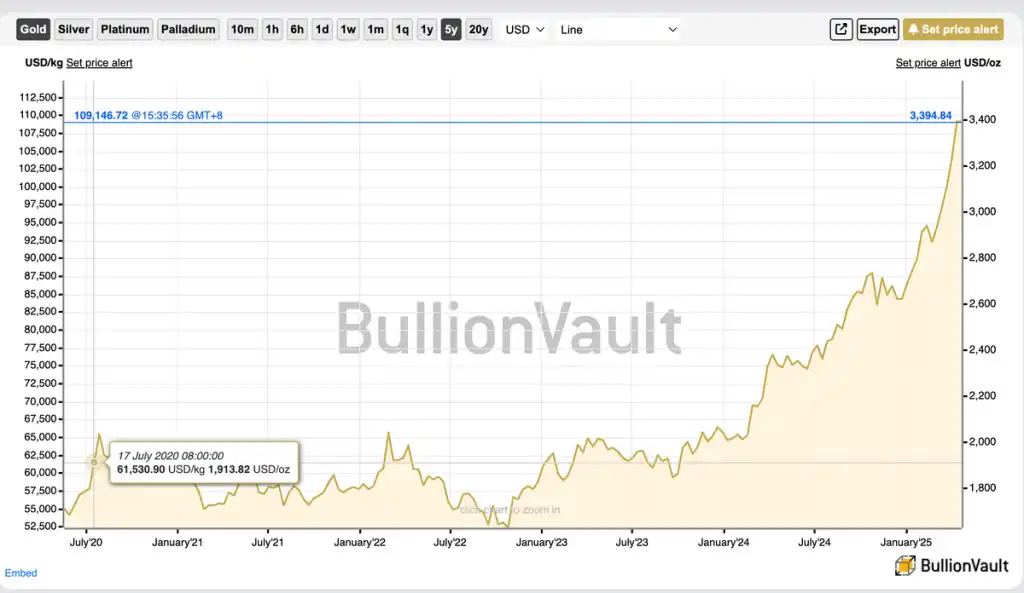
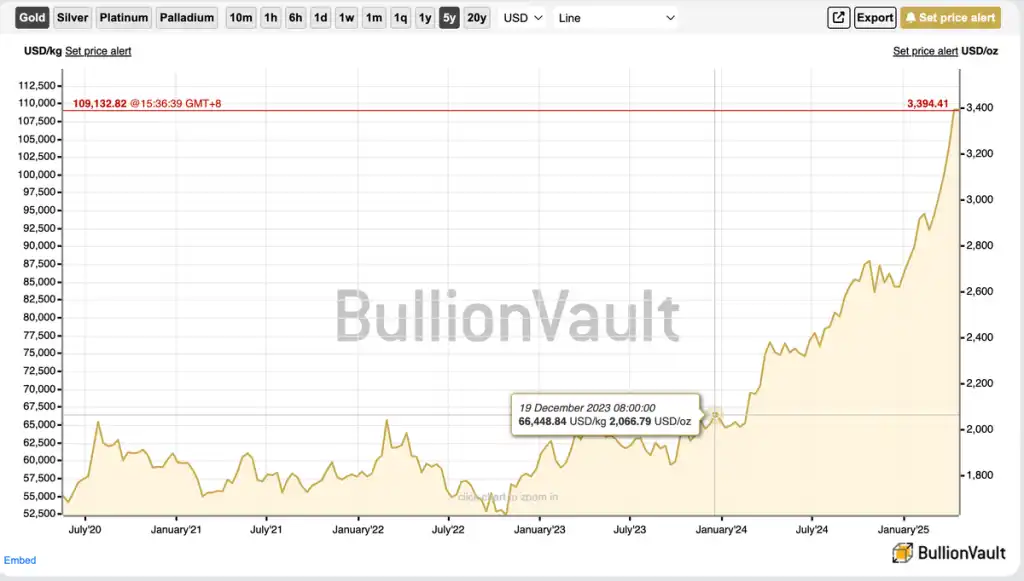
If this historical rhythm plays out again, BTC could break new highs by late Q2 or early Q3, with Q4 potentially marking a cycle top.
ETH, SOL, Hyperliquid: three structural narratives and value differentiation
Let's now address the key question: after BTC, what else should you hold?
I stick to my previous view:
If I were allocating $500K, I'd go with Hyperliquid.If it's a $5M+ allocation, I'd pick SOL.
These three assets represent entirely different narratives and user paths:
ETH: the infrastructure connecting on-chain finance and the real world
I'm clear on ETH's long-term value— RWA (Real World Assets) is its biggest future narrative, though the breakout likely won't happen this year.
As the second largest crypto asset by market value, it is now clearer to me that Ethereum will be the infrastructure that combines reality and crypto, and will be the destination for institutional funds (not web3 institutions, but real world funds with utility needs).
The core lies in RWA, whose foundation is integrating with DeFi to systematically bring offline trade, credit, and finance on-chain.
Although the implementation of RWA is still relatively fragmented and the infrastructure and regulatory framework are still under construction, the trend is already very clear. Giants like BlackRock, Citi, and Blackstone are already using Ethereum for bond tokenization and cross-border settlement.
In the future, bonds, stocks, gold, even carbon credits could flow through ETH. And the data backs it up: over 80% of leading projects in both DeFi and RWA are built on Ethereum.
For DeFi alone, TVL consistently hovers around $100 billion —a testament to massive baseline demand.
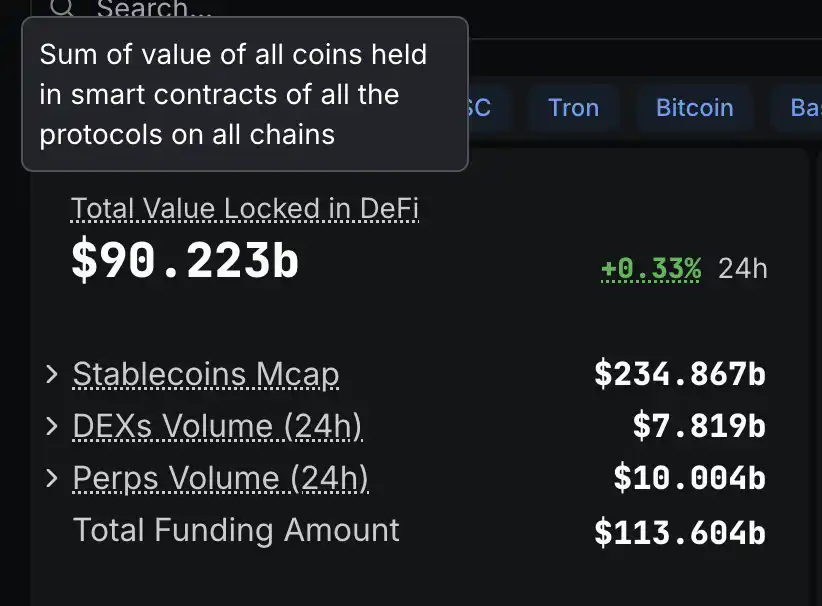
Therefore, in my opinion, Ethereum's role is being upgraded from a「smart contract platform」to an「operating system for real finance.」It is like the「oil」of the digital age—it not only supports the continued operation of the entire on-chain economy, but may also become the underlying infrastructure of the future global financial system.
SOL: On-chain activity and retail investor narratives in miniature
Solana may not be the most technically advanced L1, but it is by far the most active in liquidity. From memecoins to GambleFi to ops-led ecosystems, SOL has become the hotbed of retail speculation. And active retail investors mean continuous liquidity.
If you believe in a return of retail fervor this year, SOL is among the highest-beta assets to hold.
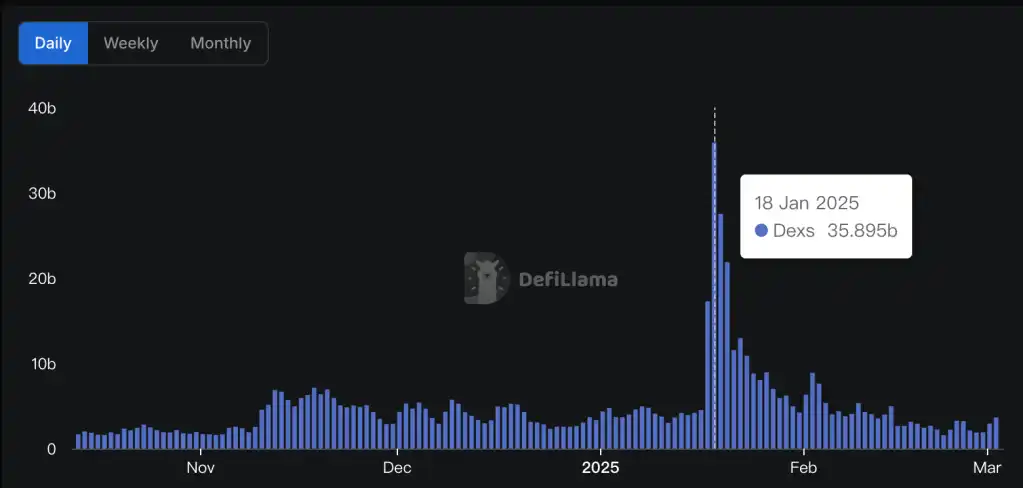
During peak memecoin season, daily DEX volumes on Solana surged into the tens of billions.
In the future, the classification of crypto will also change, and there may be only three types of coins: Bitcoin, mainstream coins, and MEME coins. MEME coins will not think of replacing BTC or gold, but it is a consensus and culture; it will not only be accepted by the public, but also become the most violent capital vortex in the crypto market.
Solana is a barometer of current market sentiment. The Meme coin carnival and the hot on-chain transactions have made SOL the best place for short-term speculation – just like the「Las Vegas」in the crypto world – where the myth of getting rich every day is staged and it is also full of gamblers. But it is undeniable that it is attracting the most active funds and developers in the world.
Hyperliquid: tradefi's mirror and AI's native arena
Hyperliquid is actually a structural narrative: it is not a meme, nor is it L1/L2, but one of the most core scenarios of on-chain finance: perpetual contracts + leveraged trading + high-frequency strategies.
This is the platform that I pay the most attention to and operate most frequently recently. I operate here almost every week, not because I follow the trend, but because it really solves a key problem – how to achieve professional-level derivatives trading in a decentralized environment.
Hyperliquid is now more suitable for professional traders, which is why it has not been recognized by a larger group. However, with the development of AI, a large number of strategy design and execution will be undertaken by AI Agents – users only need to express their trading intentions in natural language, and AI can call complex modules on the chain to implement them, such as futures arbitrage, cross-product hedging, grid strategies, etc.
In the future, you will no longer need to do complex operations yourself, you only need to say to the Agent:「Open a 5x leveraged ETH long on Hyperliquid, and automatically stop loss when it falls below 2000.」AI Agent will automatically break it down into: contract call, slippage control, on-chain gas optimization, etc., to help you complete complex trading operations in the most efficient way.
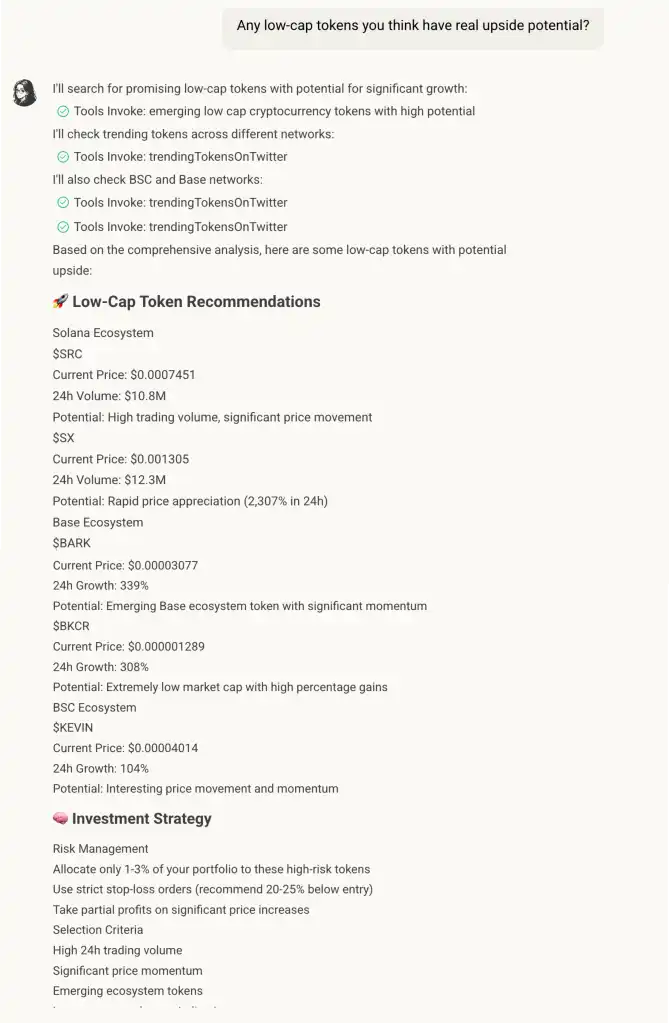
For another example, you want to earn the double benefits of「exchange spread + funding rate」when the BTC price fluctuates, but manual operation requires: monitoring 5 exchanges at the same time, calculating the break-even point of the funding rate, dynamically adjusting the margin, and preventing the pin explosion. It is too difficult for ordinary people, but for AI Agent, it only requires a series of basic analysis and operations such as spread capture, funding rate optimization, and risk control response.
In terms of speed, accuracy and even emotion, AI Agent has advantages that humans cannot match. Of course, AI Agent will not replace human traders, but it will use the「human-machine collaboration」method to make professional-level strategies as simple as ordering takeout.
Hyperliquid is highly open and has clear on-chain settlement, which is very suitable as the transaction backend of the future「AI x DeFi」scenario. Therefore, the core battlefield of this change is likely to be on-chain derivatives protocols such as Hyperliquid.
Conclusion: Bull markets are born in doubt, and grow through hesitation
This round of market reminds me of the turbulent but opportunity-filled spring of 2020—the market bottomed out in panic, and then started an epic rebound. Now, it seems that the same script is being played out: gold is the first to break through the historical high, like a starting gun; traditional funds are quietly entering the market through USDT; and more Smart Money has begun to consider how to lay out the next round of AI-driven transactions on Hyperliquid.
The market structure is actually very clear: BTC is digital gold, ETH is the operating system of real finance, SOL is the main battlefield for retail liquidity and emotions, and Hyperliquid has become a carrier platform for professional traders and future AI trading behaviors. And as AI officially intervenes in the design and execution of trading behaviors, Hyperliquid is likely to become the host of the next round of on-chain behavior migration. .
Those who are still waiting for a「better entry time」may not realize that when foreign trade bosses start discussing USDT settlement, when gold breaks through previous highs, and when AI begins to automatically execute arbitrage strategies, the market has little time left for onlookers. Many trends won』t wait until you fully understand them before they happen – and now is the window where you still have time to get on board.
Don't miss it.
You may also like

Japan’s Three Megabanks Plan Joint Stablecoin Issuance in Fiscal 2026
MUFG, SMBC, and Mizuho reportedly plan to jointly issue fiat-pegged stablecoins in fiscal 2026, signaling Japan’s growing push into bank-led digital payment infrastructure.

Humanity Discloses H Token Dual-Chain Attack Details, With Losses on Ethereum and BSC Exceeding $36 Million
Humanity said the H token attack across Ethereum and BSC caused more than $36 million in losses after leaked ProxyAdmin keys enabled malicious contract upgrades and token minting.

White House Discusses CLARITY Act With Law Enforcement Ahead of Senate Vote
The White House discussed the CLARITY Act with law enforcement ahead of a Senate vote, focusing on illicit finance risks and developer protections.

$75 billion in foreign capital has fled, and South Korean retail investors have absorbed it all using leverage

Bitcoin Trading Guide 2026: Strategies for Experienced Traders

What Is XAUT and PAXG? Why Tokenized Gold Is Booming in 2026

Cryptocurrency CEXs are flocking to sell US stocks, and traditional brokerages are facing an "uninvited guest."

Will the SpaceX IPO Hurt Bitcoin? Here's What Traders Are Watching
Foreign selling in the South Korean stock market accelerates, with cumulative net sales reportedly reaching $75 billion this year
On June 9, The Kobeissi Letter, citing Goldman Sachs data, reported that global investors are selling South Korean stocks at an unusually rapid pace. In the latest trading session, foreign investors sold about $801 million worth of Kospi constituent stocks again; total foreign outflows last week reached about $10 billion, and the market has been in net foreign selling on nearly every trading day over the past month. According to the data cited in the report, foreign investors have sold about $75 billion worth of South Korean stocks so far this year. Meanwhile, South Korean retail and institutional investors together recorded roughly $69 billion in net buying over the same period, suggesting that the market’s main buying support has come from domestic capital rather than returning overseas funds. The information currently disclosed still mainly comes from The Kobeissi Letter’s retelling and Goldman Sachs data summaries, while public details on the statistical period and the specific definition of “selling” remain relatively limited.

Fortune Warns of Strategy’s Financing Structure Risks as Bitcoin Premium Narrows
Fortune warned that Strategy’s Bitcoin treasury model faces growing financing risks as MSTR’s net asset premium narrows and preferred stock dividend pressure increases.

Ferrari Challenge Le Mans: Carl Moon to Dominate in WEEX Livery

Sahara AI Responds to SAHARA’s Sharp Drop: No Contract or Product Security Issues Found, Internal Investigation Underway
Sahara AI responded to SAHARA’s 60% price drop, saying no token contract or product security issues have been found and an internal investigation is underway.

WEEX Deposit/Withdrawal Dynamic Island: Your Asset Status, Always in Sight
Scaling Crypto Derivatives: The Digital Asset Infrastructure Behind High-Volume Trading
In the fast-moving digital asset ecosystem, derivatives platforms face an extreme architectural test. High-leverage futures markets demand more than just standard security—they require absolute operational precision, zero-latency matching engines, and ironclad structural scalability, all while navigating intense market volatility.
As global platforms scale to meet these demands, the industry is shifting away from rigid, monolithic setups toward a more agile, "decoupled" infrastructure philosophy.
The Blueprint for High-Volume Copy TradingFor elite global exchanges like WEEX (founded in 2018), this architectural choice becomes critical when scaling high-volume retail features like social copy trading. When thousands of users automatically mirror the real-time strategies of elite traders simultaneously, it triggers sudden, monumental spikes in concurrent transactional volume.
To prevent execution latency or settlement bottlenecks during these peak volatility events, a platform's primary engine must remain entirely dedicated to risk management, copy-trade synchronization, and order matching.
The Architectural Rule: New-generation platforms must separate front-end user execution engines from heavy backend infrastructural overhead to eliminate operational friction.
By separating these layers, platforms can maintain complete sovereignty over their trading environments and user experiences while strategically aligning with institutional-grade infrastructure ecosystems. This strategic framework allows modern exchanges to leverage advanced Digital Asset Custody infrastructure such as Cobo’s behind the scenes, ensuring that backend wallet management scales elastically alongside trading spikes.
Capitalizing on Market Momentum and 400× LeverageIn a derivatives arena where platforms offer up to 400× leverage on perpetual contracts, capital efficiency and market agility are core business metrics. To capture market momentum, an exchange needs the ability to rapidly expand its asset offerings, supporting everything from legacy crypto assets to sudden, trending altcoins across a massive library of trading pairs.
Adopting a flexible, scalable Wallet-as-a-Service (WaaS) solution such as Cobo’s could completely rewrite the development timeline for high-growth exchanges. Instead of spending months of engineering capital building out custom backend wallet architectures for every new blockchain network, platforms can deploy localized infrastructure in days.
This agility allows platforms to instantly scale their listings to over a thousand trading pairs without compromising security or delaying time-to-market. It mirrors the exact operational advantages seen during high-velocity market events, similar to how advanced wallet infrastructure empowers platforms during sudden asset surges; allowing exchanges to pass that speed and liquidity directly to their global user base.
A Mature Foundation for GrowthThe synergy between trusted infrastructure ecosystems and global trading platforms represents the natural evolution of a maturing crypto market. As WEEX continues to scale its global spot and derivatives offerings for over 6 million users, adopting robust backend paradigms proves that platforms no longer have to compromise between cutting-edge trading velocity and uncompromised structural security.

Morning Report | BitMine increased its holdings by 126,971 ETH last week; trader Eugene announced his exit from the crypto market

Wang Chuan: How can one not feel anxious after the neighbor Old Wang made thirty times profit by investing in storage stocks? (Seven) - A quarter-century cycle

Get Paid to Onboard? Try WEEX’s New Homepage with Rewards for Registration, Deposit & Trade
WEEX Custom Layout: Build Your Perfect Trading Workspace in Seconds
Japan’s Three Megabanks Plan Joint Stablecoin Issuance in Fiscal 2026
MUFG, SMBC, and Mizuho reportedly plan to jointly issue fiat-pegged stablecoins in fiscal 2026, signaling Japan’s growing push into bank-led digital payment infrastructure.
Humanity Discloses H Token Dual-Chain Attack Details, With Losses on Ethereum and BSC Exceeding $36 Million
Humanity said the H token attack across Ethereum and BSC caused more than $36 million in losses after leaked ProxyAdmin keys enabled malicious contract upgrades and token minting.
White House Discusses CLARITY Act With Law Enforcement Ahead of Senate Vote
The White House discussed the CLARITY Act with law enforcement ahead of a Senate vote, focusing on illicit finance risks and developer protections.
$75 billion in foreign capital has fled, and South Korean retail investors have absorbed it all using leverage
Bitcoin Trading Guide 2026: Strategies for Experienced Traders
What Is XAUT and PAXG? Why Tokenized Gold Is Booming in 2026

Popular coins
Latest Crypto News


