
Life and Death Struggle of the Primary Market: How Does Blockchain Venture Capital Navigate the Value Winter Cycle?





Original Title: "Blockchain Primary Market Dilemma and Breakthrough: From Value Confusion to Ecosystem Reconstruction"
Original Author: Lawrence, Mars Finance
1. Industry Mirror of Du Jun's Manifesto: Structural Contradictions in the Primary Market Exposed
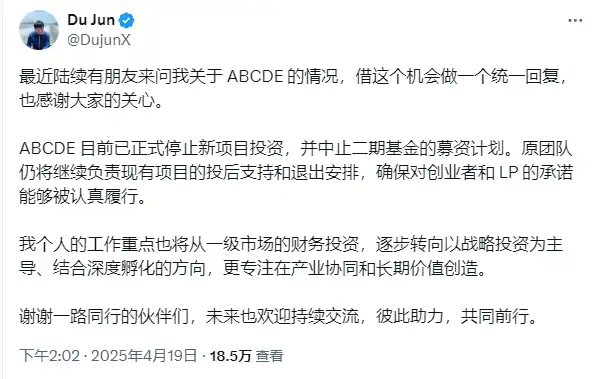
Founder of ABCDE Capital, Du Jun, announced the decision to suspend new investments and the second-phase fundraising plan, resembling a touchstone plunged into the depths of the blockchain industry, sparking ripples that reflect the systemic contradictions existing in the primary market.
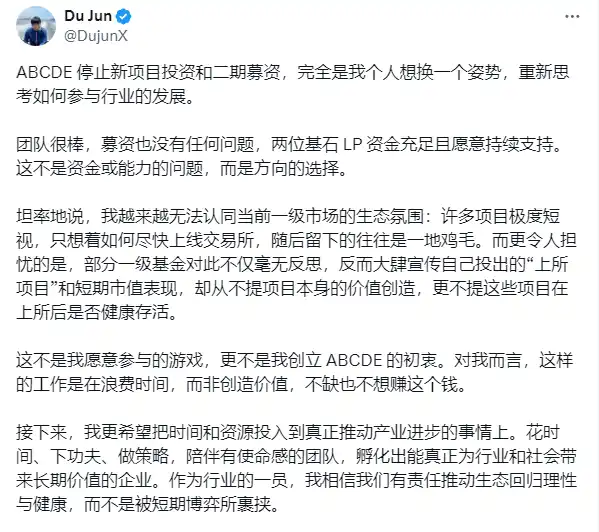
This industry veteran, who has been involved in heavyweight institutions such as Huobi and Node Capital, used sharp expressions like "short-sighted game" and "value creation loss" to pinpoint the industry's core malaise: in the frenzy of token liquidity, the original intention of the blockchain technology revolution is being alienated by exchange platform market value management and institutional arbitrage games.
This alienation exhibits significant features at the data level: according to CoinMarketCap statistics, in the first quarter of 2025, there were 327 new exchange platform projects launched globally, but only 12% of these projects continued positive technical iterations three months after listing, with the average token price falling by 67% compared to the opening price.
Of more concern is that some institutions, through the industrialized assembly line operation of "private placement - listing - market value management - exit," have compressed the investment cycle to 6-8 months, causing numerous projects to devolve into abnormal products of "code shells + economic model packaging."
The deep-rooted cause of this phenomenon lies in the blockchain industry's unique "triple misalignment":
· Temporal Value Misalignment: The traditional VC's 7-10 year exit cycle has been compressed to 18-24 months under the impact of token liquidity, causing a reversal in the technology incubation period and capital return period.
· Valuation System Misalignment: Network effects of protocol projects have not yet materialized, while market value has already pre-assumed the future 5-10 year value through token models.
· Responsibility Boundary Misalignment: Institutions have simplified post-investment management into exchange platform docking services, neglecting technical roadmap adjustments and ecosystem co-building responsibilities.
This systemic distortion is devouring the industry's innovative momentum.
As indicated by data from the Gitcoin developer forum, blockchain original protocol code commits in Q1 of 2025 saw a 23% year-on-year decline, while the number of token economic model whitepapers surged by 178%. We must face the fact that the industry is transitioning from a technology-driven value internet to a liquidity casino dominated by financial engineering.
2. Value Reconstruction Coordinate System: Technological Anchors and Investment Logic Reset for the Next 3-5 Years
Amidst the fog of liquidity abundance and value disorientation, reconstructing investment logic requires a return to the fundamental attributes of blockchain technology—creating a new trust infrastructure through cryptography and distributed consensus. Based on technological evolution trends and real-world economic needs, the key areas worthy of focused investment in the future exhibit three main characteristics:
(1) Breakthrough Innovation at the Protocol Layer
Interoperability Protocol
The current "island effect" in the public chain ecosystem severely restricts application implementation. Cross-chain protocols such as Cosmos IBC and Polkadot XCM need to achieve a qualitative breakthrough. The next-generation protocols should possess:
· Sub-second atomic swap capability (currently averaging 3-8 seconds)
· Heterogeneous chain smart contract interoperability framework
· Dynamic fee model to resist sandwich attacks
· Such technological breakthroughs will unlock trillions of dollars in cross-chain liquidity, giving rise to new financial protocols and data markets.
Commercialization Engine for Zero-Knowledge Proofs
Privacy computing technologies like zk-SNARKs are transitioning from being a "cryptographic toy" to business infrastructure. Investment focus should shift towards:
· Hardware-accelerated zkVM (e.g., RISC Zero architecture optimization)
· Composable privacy data markets (e.g., healthcare data, supply chain finance scenarios)
· Compliance-auditable proof systems
· According to ABI Research, the market size related to zero-knowledge proofs is expected to exceed $4.7 billion by 2028, with a CAGR of 62%.
Decentralized Storage Protocol Reconstruction
The security crisis of traditional centralized cloud storage (e.g., the 2024 AWS outage resulting in a $3.7 billion loss) has spurred new demands:
· Content-addressed permanent storage protocols
· Storage proof and economic model innovations (e.g., Filecoin Virtual Machine)
· Enterprise-grade storage compliance solutions
· This field will give birth to the "digital Noah's Ark" of the Web3 era.
(2) Value Capture Revolution at the Middleware Layer
DeFi 3.0 Liquidity Protocol
Going beyond the current AMM/DEX paradigm, the next-generation protocol needs to address:
· Impermanent Loss Dynamic Hedging Mechanism
· Cross-chain Liquidity Aggregator
· Compliant Stablecoin Payment Rail (e.g., Fully Reserved Collateralized Stablecoin) 9
· Circle's Q1 2025 report shows a 320% year-on-year growth in cross-border payments using compliant stablecoins, validating the potential of this direction 9.
DAO Governance Infrastructure
The current dilemma of DAOs with less than 15% voter turnout calls for technological breakthroughs:
· Behavior-based Dynamic Reputation System
· Multi-Level Delegated Proxy Framework
· On-chain/Off-chain Governance Hybrid Engine
· Such tools will propel DAOs from being a "governance toy" to a "digital economic operating system".
Physical Asset Tokenization Protocol
Bringing traditional financial assets onto the blockchain requires overcoming three major bottlenecks:
· Legal Entity to Smart Contract Rights Mapping
· Dynamic Valuation Oracle Network
· Compliance Settlement Mechanism
· The Boston Consulting Group predicts that by 2030, the market size of Real World Asset (RWA) tokenization will reach $16 trillion, nurturing structural opportunities.
(III) Application Layer Paradigm Shift Opportunities
Decentralized Social Graph
The data monopoly of Web2 social platforms is driving new demands:
· User Sovereign Data Storage Protocol
· Social Relationship On-chain Credential System
· Anti-censorship Content Distribution Network 7
· Protocols like Farcaster have proven that decentralized social networks can achieve a DAU comparable to traditional platforms at 18%.
AI + Blockchain Integration Protocol
A critical breakthrough in the era of large models:
· Distributed Computing Power Marketplace (e.g., Render Network upgrade)
· Model Training Data Ownership Protocol
· AI Behavior Audit Chain 7
· Such protocols will reshape the $300 billion AI infrastructure market.
Energy Web Protocol
Investment Blue Ocean in Carbon Neutrality Context:
· Green Energy Traceability and Carbon Credit Tokenization
· Distributed Energy Trading Market
· Grid Resilience Prediction Model 8
· According to the International Energy Agency data, the global distributed energy market will exceed $1.2 trillion in 2028.
III. Navigating Through the Fog of Cycles: Screening Logic of High-Quality Tracks and Investment Strategy
In concrete investment practice, it is recommended to use the "TSVC Three-dimensional Evaluation Model":
Technology Dimension
· Whether the core protocol solves the "impossible triangle" of specific boundaries (e.g., Aptos improves TPS through parallel execution)
· Code originality and patent barrier (reject Fork projects)
· Balance between the academic background of the development team and engineering capabilities
Social Value
· Whether it creates new trust production relationships (e.g., Helium restructuring telecommunications infrastructure)
· Reasonableness of user value capture mechanism (avoid Ponzi token models)
· Compliance-inclusive design (reserve regulatory interfaces)
Economic Model
· Positive correlation between token utility and protocol revenue (e.g., dYdX transaction fee burning mechanism)
· Dynamic balance of inflation model and network effects
· On-chain architecture design to resist MEV attacks
By evaluating with this model, the following tracks have the potential for excess returns:
· Modular Blockchain Middleware
Similar to Celestia's data availability layer, by decoupling the execution layer from the consensus layer to enhance scalability, according to Messari's prediction, modular blockchain will host 58% of new-generation protocols by 2027.
· Intent-Centered Execution Network
The "Intent Pool" architecture built by the Anoma protocol can improve transaction efficiency by 5-8 times while reducing Gas costs by 60%.
· Decentralized Science (DeSci) Infrastructure
In the areas of research data empowerment and peer review incentive protocols, it is expected to reshape the $200 billion research funding allocation system.
IV. Future Declaration to Investors
As Du Jun and others choose to break free from the quagmire of short-term speculation, the industry is ushering in a historical turning point of value resurgence. Projects that truly focus on underlying technological innovation, are dedicated to expanding the boundaries of trust, and dare to reshape production relationships will gain the vitality to cross the cycle.
In the next 3-5 years, blockchain investment should no longer be the financial alchemy disguised in code packaging, but should return to its essential mission—rebuilding the cornerstone of trust in the transmission of value in the digital world through a distributed ledger and cryptographic protocols. This requires investors to maintain sharp insights into technological frontiers and possess the resolve to combat human greed. Only in this way can they capture the great protocols that are truly changing the world in this ongoing digital economic revolution.
You may also like

Japan’s Three Megabanks Plan Joint Stablecoin Issuance in Fiscal 2026
MUFG, SMBC, and Mizuho reportedly plan to jointly issue fiat-pegged stablecoins in fiscal 2026, signaling Japan’s growing push into bank-led digital payment infrastructure.

Humanity Discloses H Token Dual-Chain Attack Details, With Losses on Ethereum and BSC Exceeding $36 Million
Humanity said the H token attack across Ethereum and BSC caused more than $36 million in losses after leaked ProxyAdmin keys enabled malicious contract upgrades and token minting.

White House Discusses CLARITY Act With Law Enforcement Ahead of Senate Vote
The White House discussed the CLARITY Act with law enforcement ahead of a Senate vote, focusing on illicit finance risks and developer protections.

$75 billion in foreign capital has fled, and South Korean retail investors have absorbed it all using leverage

Bitcoin Trading Guide 2026: Strategies for Experienced Traders

What Is XAUT and PAXG? Why Tokenized Gold Is Booming in 2026

Cryptocurrency CEXs are flocking to sell US stocks, and traditional brokerages are facing an "uninvited guest."

Will the SpaceX IPO Hurt Bitcoin? Here's What Traders Are Watching
Foreign selling in the South Korean stock market accelerates, with cumulative net sales reportedly reaching $75 billion this year
On June 9, The Kobeissi Letter, citing Goldman Sachs data, reported that global investors are selling South Korean stocks at an unusually rapid pace. In the latest trading session, foreign investors sold about $801 million worth of Kospi constituent stocks again; total foreign outflows last week reached about $10 billion, and the market has been in net foreign selling on nearly every trading day over the past month. According to the data cited in the report, foreign investors have sold about $75 billion worth of South Korean stocks so far this year. Meanwhile, South Korean retail and institutional investors together recorded roughly $69 billion in net buying over the same period, suggesting that the market’s main buying support has come from domestic capital rather than returning overseas funds. The information currently disclosed still mainly comes from The Kobeissi Letter’s retelling and Goldman Sachs data summaries, while public details on the statistical period and the specific definition of “selling” remain relatively limited.

Fortune Warns of Strategy’s Financing Structure Risks as Bitcoin Premium Narrows
Fortune warned that Strategy’s Bitcoin treasury model faces growing financing risks as MSTR’s net asset premium narrows and preferred stock dividend pressure increases.

Ferrari Challenge Le Mans: Carl Moon to Dominate in WEEX Livery

Sahara AI Responds to SAHARA’s Sharp Drop: No Contract or Product Security Issues Found, Internal Investigation Underway
Sahara AI responded to SAHARA’s 60% price drop, saying no token contract or product security issues have been found and an internal investigation is underway.

WEEX Deposit/Withdrawal Dynamic Island: Your Asset Status, Always in Sight
Scaling Crypto Derivatives: The Digital Asset Infrastructure Behind High-Volume Trading
In the fast-moving digital asset ecosystem, derivatives platforms face an extreme architectural test. High-leverage futures markets demand more than just standard security—they require absolute operational precision, zero-latency matching engines, and ironclad structural scalability, all while navigating intense market volatility.
As global platforms scale to meet these demands, the industry is shifting away from rigid, monolithic setups toward a more agile, "decoupled" infrastructure philosophy.
The Blueprint for High-Volume Copy TradingFor elite global exchanges like WEEX (founded in 2018), this architectural choice becomes critical when scaling high-volume retail features like social copy trading. When thousands of users automatically mirror the real-time strategies of elite traders simultaneously, it triggers sudden, monumental spikes in concurrent transactional volume.
To prevent execution latency or settlement bottlenecks during these peak volatility events, a platform's primary engine must remain entirely dedicated to risk management, copy-trade synchronization, and order matching.
The Architectural Rule: New-generation platforms must separate front-end user execution engines from heavy backend infrastructural overhead to eliminate operational friction.
By separating these layers, platforms can maintain complete sovereignty over their trading environments and user experiences while strategically aligning with institutional-grade infrastructure ecosystems. This strategic framework allows modern exchanges to leverage advanced Digital Asset Custody infrastructure such as Cobo’s behind the scenes, ensuring that backend wallet management scales elastically alongside trading spikes.
Capitalizing on Market Momentum and 400× LeverageIn a derivatives arena where platforms offer up to 400× leverage on perpetual contracts, capital efficiency and market agility are core business metrics. To capture market momentum, an exchange needs the ability to rapidly expand its asset offerings, supporting everything from legacy crypto assets to sudden, trending altcoins across a massive library of trading pairs.
Adopting a flexible, scalable Wallet-as-a-Service (WaaS) solution such as Cobo’s could completely rewrite the development timeline for high-growth exchanges. Instead of spending months of engineering capital building out custom backend wallet architectures for every new blockchain network, platforms can deploy localized infrastructure in days.
This agility allows platforms to instantly scale their listings to over a thousand trading pairs without compromising security or delaying time-to-market. It mirrors the exact operational advantages seen during high-velocity market events, similar to how advanced wallet infrastructure empowers platforms during sudden asset surges; allowing exchanges to pass that speed and liquidity directly to their global user base.
A Mature Foundation for GrowthThe synergy between trusted infrastructure ecosystems and global trading platforms represents the natural evolution of a maturing crypto market. As WEEX continues to scale its global spot and derivatives offerings for over 6 million users, adopting robust backend paradigms proves that platforms no longer have to compromise between cutting-edge trading velocity and uncompromised structural security.

Morning Report | BitMine increased its holdings by 126,971 ETH last week; trader Eugene announced his exit from the crypto market

Wang Chuan: How can one not feel anxious after the neighbor Old Wang made thirty times profit by investing in storage stocks? (Seven) - A quarter-century cycle

Get Paid to Onboard? Try WEEX’s New Homepage with Rewards for Registration, Deposit & Trade
WEEX Custom Layout: Build Your Perfect Trading Workspace in Seconds
Japan’s Three Megabanks Plan Joint Stablecoin Issuance in Fiscal 2026
MUFG, SMBC, and Mizuho reportedly plan to jointly issue fiat-pegged stablecoins in fiscal 2026, signaling Japan’s growing push into bank-led digital payment infrastructure.
Humanity Discloses H Token Dual-Chain Attack Details, With Losses on Ethereum and BSC Exceeding $36 Million
Humanity said the H token attack across Ethereum and BSC caused more than $36 million in losses after leaked ProxyAdmin keys enabled malicious contract upgrades and token minting.
White House Discusses CLARITY Act With Law Enforcement Ahead of Senate Vote
The White House discussed the CLARITY Act with law enforcement ahead of a Senate vote, focusing on illicit finance risks and developer protections.
$75 billion in foreign capital has fled, and South Korean retail investors have absorbed it all using leverage
Bitcoin Trading Guide 2026: Strategies for Experienced Traders
What Is XAUT and PAXG? Why Tokenized Gold Is Booming in 2026


