
Losing $19K per Coin Mined, Bitcoin Mining Firms Collective AI Defection



Original Article Title: Bitcoin miners are becoming AI companies and selling their BTC to fund the transition
Original Article Author: Shaurya Malwa, CoinDesk
Original Article Translation: DeepSea TechFlow
DeepSea Summary: CoinShares' latest mining report shows that the weighted average cost for a publicly listed mining company to mine one Bitcoin has risen to around $80,000, while the current price of BTC is in the $68,000-$70,000 range — meaning a loss of around $19,000 for each mined coin. The following is the content of the original article:
The industry is undergoing its most fundamental transformation since inception: over $70 billion in AI/HPC contracts have been signed, publicly listed mining companies have collectively sold over 15,000 BTC, companies like IREN and TeraWulf have taken on billions of dollars in debt. By the end of 2026, AI revenue share of some mining companies could reach 70%. They are transitioning from Bitcoin miners to data center operators that happen to still mine. The core contradiction is that the companies securing the Bitcoin network's security are the ones selling coins to transition to AI, with hash rate plummeting from a peak of 1,160 EH/s to around 920 EH/s.
· The Bitcoin mining industry is undergoing its most fundamental transformation since inception, with the clearest signal not being hash rate or difficulty adjustment, but the balance sheet.
· CoinShares' Q1 2026 mining report released this week shows that the weighted average cash cost for publicly listed mining companies to mine one Bitcoin in Q4 2025 rose to around $79,995.
· Bitcoin has been trading in the $68,000-$70,000 range, with a CoinDesk report last week estimating a loss of around $19,000 for each mined BTC.
· This figure is not sustainable, an industry well aware. The response is a full pivot to AI infrastructure — reshaping the very nature of these companies.
According to the CoinShares report, publicly listed mining companies have collectively announced over $70 billion in AI and High-Performance Computing (HPC) contracts. CoreWeave and Core Scientific's expanded agreement is valued at $10.2 billion over 12 years. TeraWulf has secured $12.8 billion in HPC contract revenue. Hut 8 has signed a $7 billion, 15-year AI infrastructure lease at the River Bend facility. Cipher Digital's agreement with Google-backed Fluidstack is worth billions.
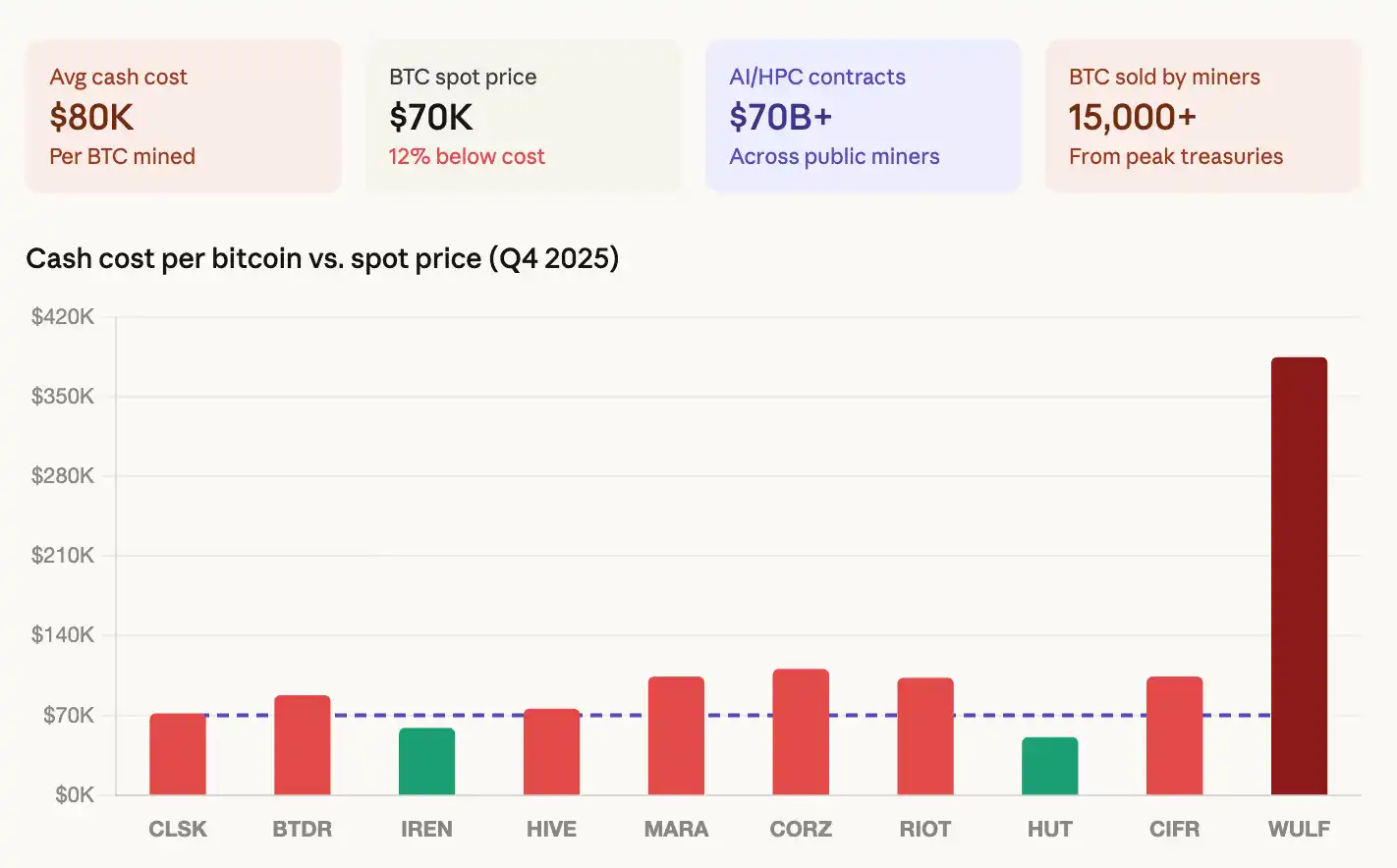
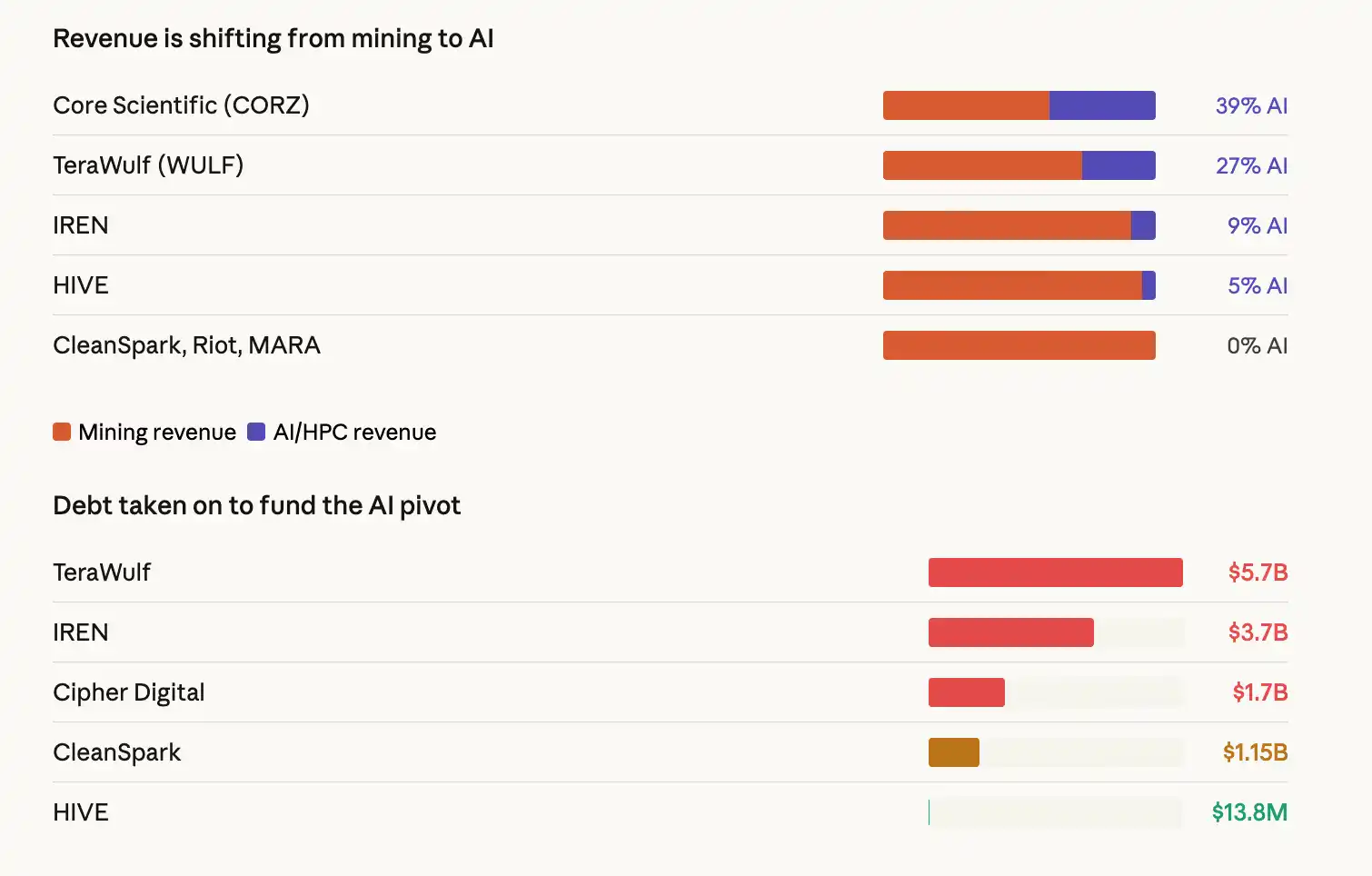
By the end of 2026, publicly listed mining companies' AI revenue share could reach as high as 70%, up from the current approximately 30%. Core Scientific's AI hosting revenue already accounts for 39% of its total revenue. TeraWulf is at 27%. IREN is currently at 9% but is rapidly expanding, with a planned liquid-cooled GPU hash capacity of up to 200 megawatts.
This means these mining companies are increasingly resembling data center operators who happen to also mine Bitcoin.
The economics account for this shift. CoinShares data shows that the cost of Bitcoin mining infrastructure is roughly $7-10 million per megawatt, while AI infrastructure is around $8-15 million per megawatt. The difference is significant, but AI offers a more structurally higher and stable return.
Hash Price — a measure of a miner's revenue per unit of hash power — hit a historic low in early March post-halving, at around $28-30 per PH/day.
At this level, miners using older-generation machines need an electricity price below $0.05/kWh to sustain cash profitability. In contrast, AI infrastructure contracts promise a profit margin of over 85% with multi-year revenue visibility.
Where Is the Transition Money Coming From
A report from CoinShares highlights two clear sources of funding for this transition.
First, debt. The industry's leverage has undergone a qualitative shift. IREN now carries $3.7 billion in convertible notes across five series. TeraWulf has a total debt of $5.7 billion, consisting of convertible bonds and priority guaranteed notes from its hash power subsidiaries.
Cipher Digital issued $1.7 billion in priority guaranteed notes in November, leading to its quarterly interest expenses skyrocketing from $3.2 million in the first nine months to $33.4 million in just Q4. This is not mining-level debt burden; this is infrastructure-level stakes — betting that AI revenue can ramp fast enough to cover debt obligations.
Second, coin selling. Publicly listed mining firms have collectively sold over 15,000 BTC from peak levels. In January, Core Scientific sold about 1,900 BTC (worth $175 million) and plans to liquidate almost all remaining holdings by Q1 2026. Bitdeer zeroed out its holdings in February. Riot Platforms sold 1,818 BTC in December (worth $162 million).
Even the largest publicly traded holder Marathon (which holds 53,822 BTC) quietly expanded its policy in the March 10-K annual report, authorizing sales from the entire balance sheet reserve. Part of the reason is the pressure from its $350 million Bitcoin collateralized loan facility — as the price fell to $68,000, the loan-to-value (LTV) ratio has risen to 87%.
Who Guards the Bitcoin Network?
Those selling coins to do AI are precisely the companies that mine and secure the Bitcoin network. This poses the central paradox of this transformation. When mining is unprofitable and AI is very profitable, the rational economic decision is to move funds away from mining. But if enough miners do this, the network's security budget will shrink.
The hashrate data has already reflected this. The network's hashrate peaked at around 1,160 EH/s in early October 2025, then dropped to around 920 EH/s, experiencing three consecutive negative difficulty adjustments — the first since July 2022.
Valuation Divergence
The market has priced in this divergence. Mining companies with signed HPC contracts are currently trading at 12.3 times the next 12 months' revenue. Pure mining companies are only at 5.9 times. The market is paying over a two times premium for AI exposure, further reinforcing the transformation incentive.
The geographic landscape is also changing. The U.S., China, and Russia currently control around 68% of the global hashrate. In just one quarter, Q4, the U.S. increased its market share by about 2 percentage points. But emerging markets are also joining — Paraguay and Ethiopia have entered the top ten mining nations globally, driven by HIVE's 300 MW and Bitdeer's 40 MW facilities, respectively.
Hashrate Forecast
CoinShares forecasts network hashrate to reach 1.8 ZH/s by the end of 2026, rising to 2 ZH/s by the end of March 2027 (one month later than previously predicted).
But this forecast is premised on Bitcoin returning to $100,000 by year-end. If the price remains below $80,000, CoinShares expects hashrate prices to continue falling, hashrate to decline further, and more miners to exit. Persisting below $70,000 could trigger a larger-scale capitulation event — ironically, this would benefit survivors by lowering the difficulty.
The next-generation hardware offers a potential way out. Bitmain's S23 series and Bitdeer's in-house SEALMINERA3 have an energy efficiency of less than 10 joules/TH, with mass shipments expected in the first half of 2026. These miners, compared to the current mainstream mid-generation models, are projected to roughly halve the energy cost per bitcoin. However, deploying them requires funding, and many miners are currently redirecting funds towards AI.
When the Bitcoin mining industry entered this cycle, it was a group of companies securing the network and hodling bitcoin. It is now exiting this cycle in a different guise: a cohort of companies building AI data centers and selling bitcoin to finance themselves.
Is this merely a temporary response to unfavorable economic conditions, or a permanent structural shift? It depends on one variable: the price of bitcoin. If it returns to $100,000, mining profitability rebounds, and the pace of AI transformation slows down. If it stalls at $70,000 or lower, the transformation accelerates, and the mining industry, which has been mining-centric for the past decade, will continue to morph into something entirely different.
You may also like

$75 billion in foreign capital has fled, and South Korean retail investors have absorbed it all using leverage

Bitcoin Trading Guide 2026: Strategies for Experienced Traders

What Is XAUT and PAXG? Why Tokenized Gold Is Booming in 2026

Cryptocurrency CEXs are flocking to sell US stocks, and traditional brokerages are facing an "uninvited guest."

Will the SpaceX IPO Hurt Bitcoin? Here's What Traders Are Watching
Foreign selling in the South Korean stock market accelerates, with cumulative net sales reportedly reaching $75 billion this year
On June 9, The Kobeissi Letter, citing Goldman Sachs data, reported that global investors are selling South Korean stocks at an unusually rapid pace. In the latest trading session, foreign investors sold about $801 million worth of Kospi constituent stocks again; total foreign outflows last week reached about $10 billion, and the market has been in net foreign selling on nearly every trading day over the past month. According to the data cited in the report, foreign investors have sold about $75 billion worth of South Korean stocks so far this year. Meanwhile, South Korean retail and institutional investors together recorded roughly $69 billion in net buying over the same period, suggesting that the market’s main buying support has come from domestic capital rather than returning overseas funds. The information currently disclosed still mainly comes from The Kobeissi Letter’s retelling and Goldman Sachs data summaries, while public details on the statistical period and the specific definition of “selling” remain relatively limited.

Fortune Warns of Strategy’s Financing Structure Risks as Bitcoin Premium Narrows
Fortune warned that Strategy’s Bitcoin treasury model faces growing financing risks as MSTR’s net asset premium narrows and preferred stock dividend pressure increases.

Ferrari Challenge Le Mans: Carl Moon to Dominate in WEEX Livery

Sahara AI Responds to SAHARA’s Sharp Drop: No Contract or Product Security Issues Found, Internal Investigation Underway
Sahara AI responded to SAHARA’s 60% price drop, saying no token contract or product security issues have been found and an internal investigation is underway.

WEEX Deposit/Withdrawal Dynamic Island: Your Asset Status, Always in Sight

Scaling Crypto Derivatives: The Digital Asset Infrastructure Behind High-Volume Trading
In the fast-moving digital asset ecosystem, derivatives platforms face an extreme architectural test. High-leverage futures markets demand more than just standard security—they require absolute operational precision, zero-latency matching engines, and ironclad structural scalability, all while navigating intense market volatility.
As global platforms scale to meet these demands, the industry is shifting away from rigid, monolithic setups toward a more agile, "decoupled" infrastructure philosophy.
The Blueprint for High-Volume Copy TradingFor elite global exchanges like WEEX (founded in 2018), this architectural choice becomes critical when scaling high-volume retail features like social copy trading. When thousands of users automatically mirror the real-time strategies of elite traders simultaneously, it triggers sudden, monumental spikes in concurrent transactional volume.
To prevent execution latency or settlement bottlenecks during these peak volatility events, a platform's primary engine must remain entirely dedicated to risk management, copy-trade synchronization, and order matching.
The Architectural Rule: New-generation platforms must separate front-end user execution engines from heavy backend infrastructural overhead to eliminate operational friction.
By separating these layers, platforms can maintain complete sovereignty over their trading environments and user experiences while strategically aligning with institutional-grade infrastructure ecosystems. This strategic framework allows modern exchanges to leverage advanced Digital Asset Custody infrastructure such as Cobo’s behind the scenes, ensuring that backend wallet management scales elastically alongside trading spikes.
Capitalizing on Market Momentum and 400× LeverageIn a derivatives arena where platforms offer up to 400× leverage on perpetual contracts, capital efficiency and market agility are core business metrics. To capture market momentum, an exchange needs the ability to rapidly expand its asset offerings, supporting everything from legacy crypto assets to sudden, trending altcoins across a massive library of trading pairs.
Adopting a flexible, scalable Wallet-as-a-Service (WaaS) solution such as Cobo’s could completely rewrite the development timeline for high-growth exchanges. Instead of spending months of engineering capital building out custom backend wallet architectures for every new blockchain network, platforms can deploy localized infrastructure in days.
This agility allows platforms to instantly scale their listings to over a thousand trading pairs without compromising security or delaying time-to-market. It mirrors the exact operational advantages seen during high-velocity market events, similar to how advanced wallet infrastructure empowers platforms during sudden asset surges; allowing exchanges to pass that speed and liquidity directly to their global user base.
A Mature Foundation for GrowthThe synergy between trusted infrastructure ecosystems and global trading platforms represents the natural evolution of a maturing crypto market. As WEEX continues to scale its global spot and derivatives offerings for over 6 million users, adopting robust backend paradigms proves that platforms no longer have to compromise between cutting-edge trading velocity and uncompromised structural security.

Morning Report | BitMine increased its holdings by 126,971 ETH last week; trader Eugene announced his exit from the crypto market

Wang Chuan: How can one not feel anxious after the neighbor Old Wang made thirty times profit by investing in storage stocks? (Seven) - A quarter-century cycle

Get Paid to Onboard? Try WEEX’s New Homepage with Rewards for Registration, Deposit & Trade

WEEX Custom Layout: Build Your Perfect Trading Workspace in Seconds

See “Buy Walls” & “Sell Walls” Instantly: WEEX Launches the Depth Chart for Smarter Trades

What Is Quick Trade on WEEX? 2 Ways WEEX Ends Chart-Panel Jumping
Morning News | Five major virtual asset platforms in South Korea have experienced 57 incidents of hacking and system failures in six years; Grayscale submits registration application for Canton ETF
$75 billion in foreign capital has fled, and South Korean retail investors have absorbed it all using leverage
Bitcoin Trading Guide 2026: Strategies for Experienced Traders
What Is XAUT and PAXG? Why Tokenized Gold Is Booming in 2026
Cryptocurrency CEXs are flocking to sell US stocks, and traditional brokerages are facing an "uninvited guest."
Will the SpaceX IPO Hurt Bitcoin? Here's What Traders Are Watching
Foreign selling in the South Korean stock market accelerates, with cumulative net sales reportedly reaching $75 billion this year
On June 9, The Kobeissi Letter, citing Goldman Sachs data, reported that global investors are selling South Korean stocks at an unusually rapid pace. In the latest trading session, foreign investors sold about $801 million worth of Kospi constituent stocks again; total foreign outflows last week reached about $10 billion, and the market has been in net foreign selling on nearly every trading day over the past month. According to the data cited in the report, foreign investors have sold about $75 billion worth of South Korean stocks so far this year. Meanwhile, South Korean retail and institutional investors together recorded roughly $69 billion in net buying over the same period, suggesting that the market’s main buying support has come from domestic capital rather than returning overseas funds. The information currently disclosed still mainly comes from The Kobeissi Letter’s retelling and Goldman Sachs data summaries, while public details on the statistical period and the specific definition of “selling” remain relatively limited.


