
On-chain Liquidity Migration: A Rollercoaster Ride of 15 Months, Who Will Stand Tall Post-Hype?

Original Title: Where is Onchain Volume Rotating? (Jan24-Mar25)
Original Author: Stacy Muur
Original Translation: Tim, PANews
Over the past 15 months, the liquidity landscape of DeFi has been reshaped across chains, with projects primarily driven by hype gradually exiting the stage as liquidity quietly consolidates in places with strong fundamentals rather than market speculation.
Key Insights
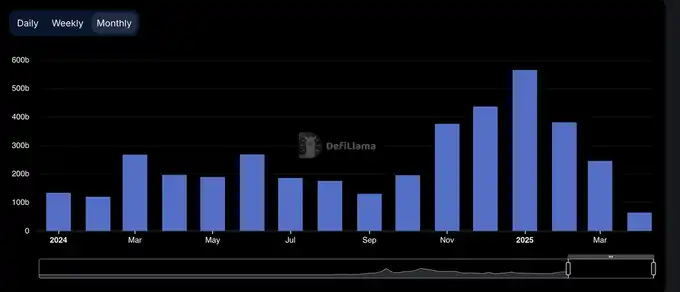
After hitting a historical high of $380 billion in January 2025, DEX trading volume dropped by 35% in the following two months, suggesting that January may have formed a short-term top. Currently, the top ten DEXs account for nearly 80% of the total trading volume; only Uniswap and PancakeSwap together hold about 40% of the market share. Solana-based DEXs have quietly taken the lead in the rankings, with 5 out of the top 10 positions, and their market share growth is mainly driven by the trading volume brought by the Meme coin craze. Hyperliquid has completely transformed the landscape of the perpetual contract sector, rising from a newcomer in the industry to occupying over 60% of the market share by March 2025.
All insights in the article are based on public data. Special thanks to DefiLlama for consistently providing high-quality statistics.
A Cycle Defined by Surges and Slowdowns
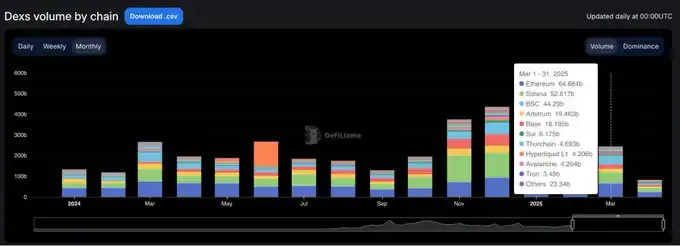
In early 2024, DEX trading volume showed strong performance in March and May, gradually slowing down before mid-year.
The situation took a dramatic turn in the fourth quarter, with trading volume surging in November and December. This momentum continued into January 2025, reaching an explosive peak of $380 billion.
However, this rebound was short-lived. By February, market trading volume had plummeted to $245 billion, marking a 35% cliff-like drop that put an end to the three-month vertical surge. This retreat laid the groundwork for a more cautious second quarter.
DEX Dominance: Top Protocols Hold Sway
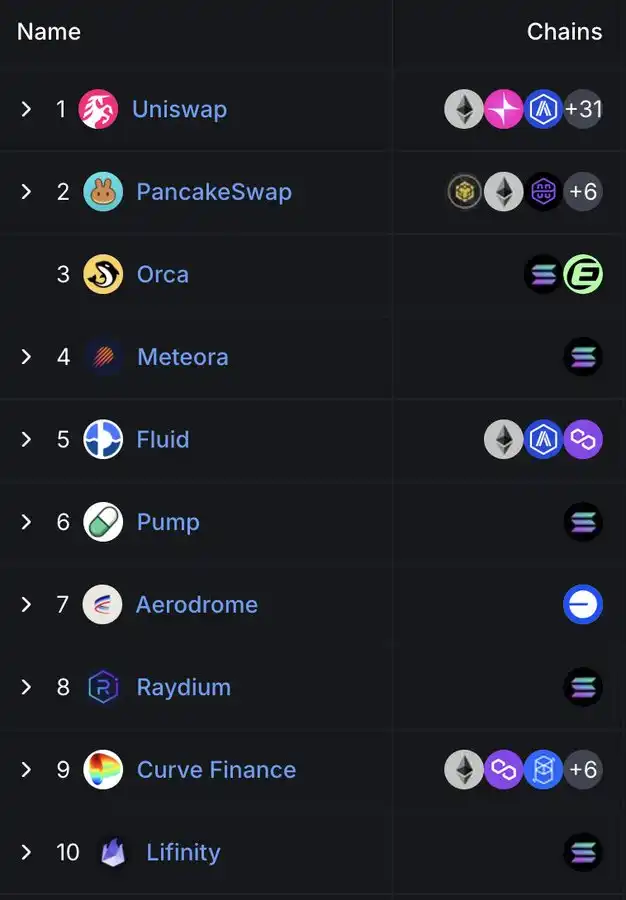
The market structure of DEXs remains highly concentrated. Currently, the top ten protocols account for 79.5% of the daily trading volume, with only the top five holding 59.1%.
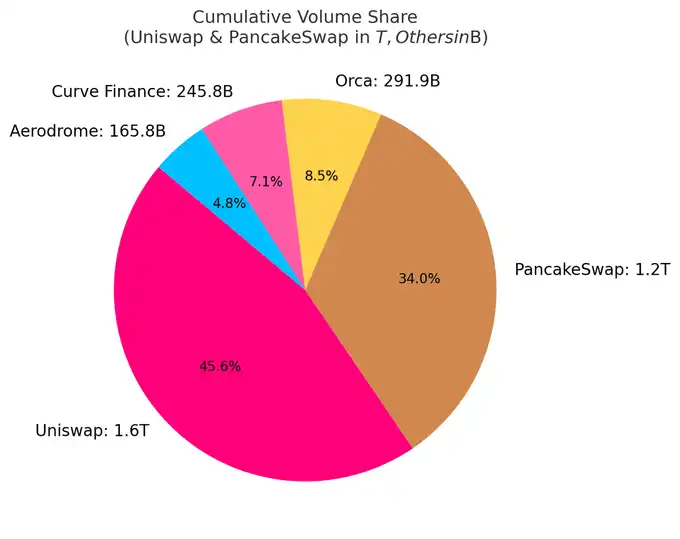
Uniswap and PancakeSwap account for approximately 40% of DEX trading volume, making them the only two platforms to date with a cumulative trading volume surpassing one trillion USD. Their leading position is due to first-mover advantage, extensive support for multi-chain ecosystems, and deep liquidity.
Uniswap Labs has also launched Unichain, which is an Ethereum Layer 2 network built on the Optimism Superchain. The chain aims to achieve fast, low-cost transactions through native multi-chain interoperability.
The Quiet Rise of Solana
Notably, Solana's position in the DEX space is becoming increasingly prominent. Among the current top ten DEXs, five are based on Solana: including Orca, Meteora, Raydium, Lifinity, and Pump.fun.
Orca (8.02%) and Meteora (6.70%) alone account for about 15% of global decentralized exchange platform activity. This growth is attributed to low gas fees, fast block times, and the Solana meme coin frenzy. Pump.fun's surge into the top ten is a clear testament to this hype.
Emerging Protocols: Fluid and Aerodrome
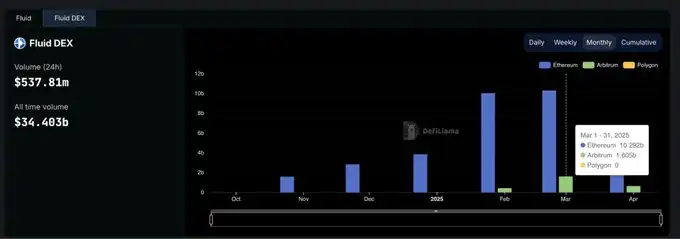
Fluid (7.09%) is the most capital-efficient platform among the top five DEXs. The protocol is active on Ethereum, with monthly settlement volumes exceeding $100 billion. Its performance has been particularly impressive following the launch on the Arbitrum ecosystem: the trading volume surged from $426 million in February to $1.6 billion in March, demonstrating speeds far above the industry average.
Aerodrome, as an original project of Base, demonstrates the continued growth of liquidity on the Base L2. While Hyperliquid does not rank high in the spot market, it holds a dominant position in the perpetual contract market, with a market share exceeding 60%.
DEX Market Share Across Chains: Easy Growth, Hard Retention
The past 15 months have clearly shown a phenomenon: most blockchain projects can attract attention, but only a few can maintain that traction. From January 2024 to March 2025, the market share of chain-level decentralized exchange platforms has changed rapidly, with only a very few projects truly exhibiting user stickiness.
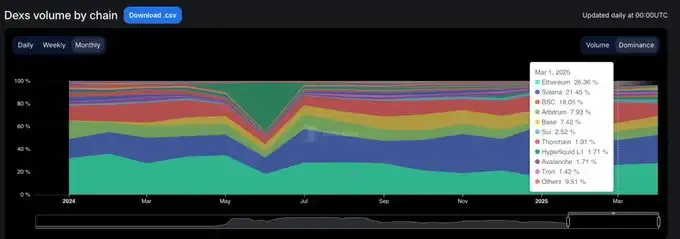
Solana has made the most significant breakthrough. It steadily rose in 2024, driven by the TRUMP and MELANIA Meme coin craze, reaching a peak market share of 45.8% in January 2025. However, by March, its market share had been halved to 21.5%, but still maintained the top position among public chains with an average share of 25.1%.
· Ethereum, on the other hand, had the opposite trajectory. Starting around 32% market share in early 2024, it dropped to 15.3% in January 2025, then rebounded to 26.4% in March. Even though Ethereum lost momentum, its ecosystem resilience remains.
· Base can be considered the most robust follower. Starting from 3% market share in March 2024, growing steadily to 12.4% by December, falling back to 7.4% in March 2025, maintaining an average share of 6.6% during this period. Without hype, only slow but sticky growth.
· BNB Chain maintained a stable 14.7% average share. Without major surges or drops, it consistently maintained stable retail fund flows.
· Arbitrum started strong (16% share) but lost momentum, sliding to 4.8% by January 2025, being surpassed by Base and Solana.
· Blast reached a peak market share of 42.3% in June 2024 but disappeared the following month. This is a clear example of incentive-driven transaction volume with zero user retention.
Summary: The dominance of DEXs on various public chains exhibits strong volatility. Solana once rose rapidly, Ethereum achieved value restoration, Base gradually expanded its ecosystem, and the market hype cycle showed significant fluctuations. The ultimate leading public chain is not necessarily the one with the largest volume but the network with the highest actual usage.
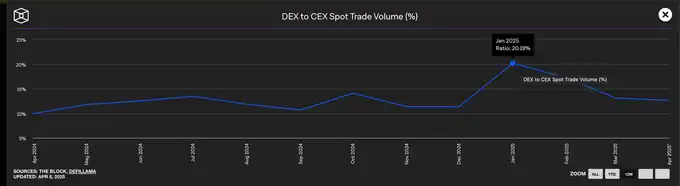
Centralized Exchanges Still Dominate Spot Trading Volume
Despite the explosive growth of DEXs in early 2025, centralized exchanges still dominate spot market trading volume. Even in January, when DEX trading volume peaked, CEXs still accounted for nearly 80% of the total volume.
Although the dominance of centralized exchanges declined from 90% in early 2024 to a low of 79%, a broader trend is evident: DEXs continue to grow, but CEXs remain the default choice for most traders.
Perpetual Protocol Market Share
The landscape of on-chain perpetual contracts underwent a fundamental shift in 2024.
After dYdX firmly held the throne of perpetual contract trading for over two years, Hyperliquid emerged out of nowhere, redefining what it means to be dominant. The platform first topped the charts in February, briefly surpassed by SynFutures in the mid-year, and then reclaimed the top spot in August, leaving all competitors far behind. As of March 2025, Hyperliquid has captured nearly 59% of the total perpetual contract trading volume, solidifying its position as the platform of choice for professional traders.
This rapid rise has attracted significant market attention, with its product experience closer to that of centralized exchanges than any previous decentralized trading platform. In contrast, dYdX's market share has plummeted rapidly. From holding a 13.2% market share at the beginning of 2024, it has dropped to only 2.7% by March 2025, as users flock to faster, more user-friendly, and more modern alternatives.
Jupiter's perpetual contracts took a different path, leveraging Solana's native liquidity and the redirecting role of its spot DEX to rise to second place with an 8.8% market share. Despite its rapid ascent, it lacked staying power and ultimately settled behind Hyperliquid. Other projects such as SynFutures, Vertex Protocol, and Paradex have also briefly shown promise.
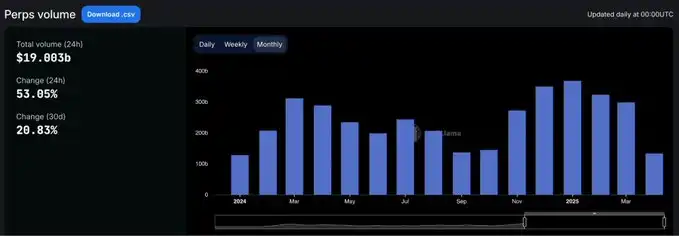
Perpetual Contract Chains: Execution Layer Undergoes Restructuring in One Cycle
The most significant change in the perpetual contract infrastructure space over the past year has not been which protocols users prefer but rather which chains they trust to execute transactions.
By March 2025, Ethereum and Arbitrum's share of perpetual contract trading volume had plummeted to 11.8%, a stark contrast to their combined market dominance of over 65% in January 2024, with newer and faster execution layers now fully in control.
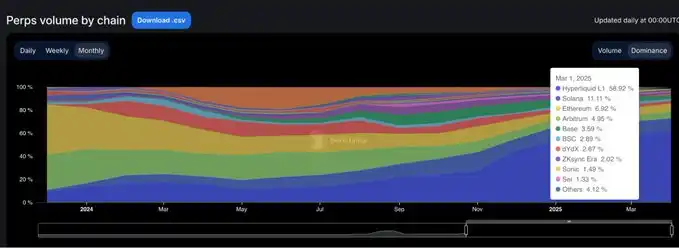
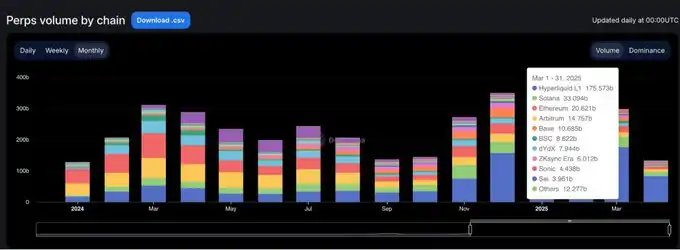
The key driving force behind this shift is Hyperliquid's blockchain, developed in-house. During the same period, the chain saw its market share surge from 13.6% to 58.9%, overtaking various Layer1 and Layer2 solutions that once set the industry standard in less than a year, becoming the default execution environment for perpetual contract trading. Its advantages are not only reflected in faster transaction speeds but, more importantly, in providing the reliability and low-latency guarantees demanded by professional traders.
Solana also experienced a strong uptrend, driven by the Jupiter and Phoenix projects at the end of 2024, with its market share peaking at nearly 16%. However, it eventually stabilized in the 10-11% range, unable to sustain its breakthrough growth momentum. While the Base and ZKsync ecosystems showed vitality (reaching a market share peak of 6-7%), they still did not break into the top-tier public chain ranks.
Meanwhile, Blast became a cautionary tale: this flash-in-the-pan project reached an 18.8% market share in June 2024, only to disappear at an equally astonishing speed. In a field driven by product quality and user retention, mere hype is unsustainable. The new industry standard is clear: performance-centric public chains have redefined the competitive benchmark, and traditional infrastructure no longer enjoys default advantages.
The future of DeFi lies not in multi-chain scaling but with those protocols that can transform industry narratives into user habits.
You may also like

Bitcoin Trading Guide 2026: Strategies for Experienced Traders

What Is XAUT and PAXG? Why Tokenized Gold Is Booming in 2026

Cryptocurrency CEXs are flocking to sell US stocks, and traditional brokerages are facing an "uninvited guest."

Will the SpaceX IPO Hurt Bitcoin? Here's What Traders Are Watching
Foreign selling in the South Korean stock market accelerates, with cumulative net sales reportedly reaching $75 billion this year
On June 9, The Kobeissi Letter, citing Goldman Sachs data, reported that global investors are selling South Korean stocks at an unusually rapid pace. In the latest trading session, foreign investors sold about $801 million worth of Kospi constituent stocks again; total foreign outflows last week reached about $10 billion, and the market has been in net foreign selling on nearly every trading day over the past month. According to the data cited in the report, foreign investors have sold about $75 billion worth of South Korean stocks so far this year. Meanwhile, South Korean retail and institutional investors together recorded roughly $69 billion in net buying over the same period, suggesting that the market’s main buying support has come from domestic capital rather than returning overseas funds. The information currently disclosed still mainly comes from The Kobeissi Letter’s retelling and Goldman Sachs data summaries, while public details on the statistical period and the specific definition of “selling” remain relatively limited.

Fortune Warns of Strategy’s Financing Structure Risks as Bitcoin Premium Narrows
Fortune warned that Strategy’s Bitcoin treasury model faces growing financing risks as MSTR’s net asset premium narrows and preferred stock dividend pressure increases.

Ferrari Challenge Le Mans: Carl Moon to Dominate in WEEX Livery

Sahara AI Responds to SAHARA’s Sharp Drop: No Contract or Product Security Issues Found, Internal Investigation Underway
Sahara AI responded to SAHARA’s 60% price drop, saying no token contract or product security issues have been found and an internal investigation is underway.

WEEX Deposit/Withdrawal Dynamic Island: Your Asset Status, Always in Sight

Scaling Crypto Derivatives: The Digital Asset Infrastructure Behind High-Volume Trading
In the fast-moving digital asset ecosystem, derivatives platforms face an extreme architectural test. High-leverage futures markets demand more than just standard security—they require absolute operational precision, zero-latency matching engines, and ironclad structural scalability, all while navigating intense market volatility.
As global platforms scale to meet these demands, the industry is shifting away from rigid, monolithic setups toward a more agile, "decoupled" infrastructure philosophy.
The Blueprint for High-Volume Copy TradingFor elite global exchanges like WEEX (founded in 2018), this architectural choice becomes critical when scaling high-volume retail features like social copy trading. When thousands of users automatically mirror the real-time strategies of elite traders simultaneously, it triggers sudden, monumental spikes in concurrent transactional volume.
To prevent execution latency or settlement bottlenecks during these peak volatility events, a platform's primary engine must remain entirely dedicated to risk management, copy-trade synchronization, and order matching.
The Architectural Rule: New-generation platforms must separate front-end user execution engines from heavy backend infrastructural overhead to eliminate operational friction.
By separating these layers, platforms can maintain complete sovereignty over their trading environments and user experiences while strategically aligning with institutional-grade infrastructure ecosystems. This strategic framework allows modern exchanges to leverage advanced Digital Asset Custody infrastructure such as Cobo’s behind the scenes, ensuring that backend wallet management scales elastically alongside trading spikes.
Capitalizing on Market Momentum and 400× LeverageIn a derivatives arena where platforms offer up to 400× leverage on perpetual contracts, capital efficiency and market agility are core business metrics. To capture market momentum, an exchange needs the ability to rapidly expand its asset offerings, supporting everything from legacy crypto assets to sudden, trending altcoins across a massive library of trading pairs.
Adopting a flexible, scalable Wallet-as-a-Service (WaaS) solution such as Cobo’s could completely rewrite the development timeline for high-growth exchanges. Instead of spending months of engineering capital building out custom backend wallet architectures for every new blockchain network, platforms can deploy localized infrastructure in days.
This agility allows platforms to instantly scale their listings to over a thousand trading pairs without compromising security or delaying time-to-market. It mirrors the exact operational advantages seen during high-velocity market events, similar to how advanced wallet infrastructure empowers platforms during sudden asset surges; allowing exchanges to pass that speed and liquidity directly to their global user base.
A Mature Foundation for GrowthThe synergy between trusted infrastructure ecosystems and global trading platforms represents the natural evolution of a maturing crypto market. As WEEX continues to scale its global spot and derivatives offerings for over 6 million users, adopting robust backend paradigms proves that platforms no longer have to compromise between cutting-edge trading velocity and uncompromised structural security.

Morning Report | BitMine increased its holdings by 126,971 ETH last week; trader Eugene announced his exit from the crypto market

Wang Chuan: How can one not feel anxious after the neighbor Old Wang made thirty times profit by investing in storage stocks? (Seven) - A quarter-century cycle

Get Paid to Onboard? Try WEEX’s New Homepage with Rewards for Registration, Deposit & Trade

WEEX Custom Layout: Build Your Perfect Trading Workspace in Seconds

See “Buy Walls” & “Sell Walls” Instantly: WEEX Launches the Depth Chart for Smarter Trades

What Is Quick Trade on WEEX? 2 Ways WEEX Ends Chart-Panel Jumping
Morning News | Five major virtual asset platforms in South Korea have experienced 57 incidents of hacking and system failures in six years; Grayscale submits registration application for Canton ETF
Should we escape the peak? The principle of the tail-end market in the stock market
Bitcoin Trading Guide 2026: Strategies for Experienced Traders
What Is XAUT and PAXG? Why Tokenized Gold Is Booming in 2026
Cryptocurrency CEXs are flocking to sell US stocks, and traditional brokerages are facing an "uninvited guest."
Will the SpaceX IPO Hurt Bitcoin? Here's What Traders Are Watching
Foreign selling in the South Korean stock market accelerates, with cumulative net sales reportedly reaching $75 billion this year
On June 9, The Kobeissi Letter, citing Goldman Sachs data, reported that global investors are selling South Korean stocks at an unusually rapid pace. In the latest trading session, foreign investors sold about $801 million worth of Kospi constituent stocks again; total foreign outflows last week reached about $10 billion, and the market has been in net foreign selling on nearly every trading day over the past month. According to the data cited in the report, foreign investors have sold about $75 billion worth of South Korean stocks so far this year. Meanwhile, South Korean retail and institutional investors together recorded roughly $69 billion in net buying over the same period, suggesting that the market’s main buying support has come from domestic capital rather than returning overseas funds. The information currently disclosed still mainly comes from The Kobeissi Letter’s retelling and Goldman Sachs data summaries, while public details on the statistical period and the specific definition of “selling” remain relatively limited.
Fortune Warns of Strategy’s Financing Structure Risks as Bitcoin Premium Narrows
Fortune warned that Strategy’s Bitcoin treasury model faces growing financing risks as MSTR’s net asset premium narrows and preferred stock dividend pressure increases.

Popular coins
Latest Crypto News


