
RWA Track Deep Dive Playbook: 10 RWA Projects to Watch in 2025


Original Article Title: "RWA Track In-Depth Layout Guide: 10 RWA Projects to Watch in 2025"
Original Source: Biteye
Recently, RWA and Payfi have once again been brought up in the market. Are these two tracks just another round of narrative hype for old stories, or are they truly able to connect TradFi and DeFi, unlocking the "golden key" to a trillion-dollar market?
We have compiled a list of 10 RWA projects that cannot be missed, attempting to delve deep into several core issues of the RWA track.
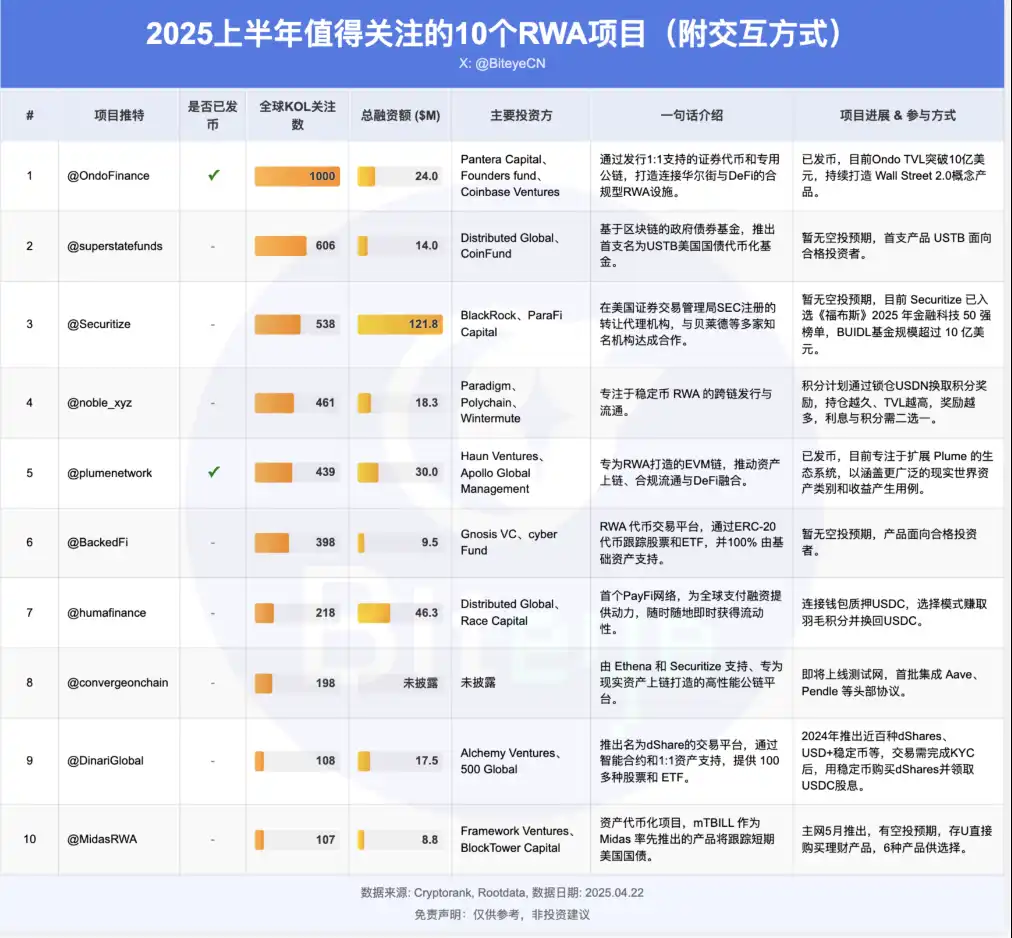
1/11@plumenetwork
Introduction: Plume is an EVM-compatible public chain designed for RWA, committed to promoting the digitization, circulation, and composability of RWAs. Through full-stack vertical integration technology, Plume supports the tokenization of assets such as real estate, commodities, and revenue rights, and achieves efficient collaboration with DeFi protocols, enhancing asset liquidity and usability. Its ecosystem has attracted over 180 projects to join, with the testnet phase having gained 3.75 million users and 265 million transactions.
Project Progress & Participation: Plume is currently focusing on building the core infrastructure for on-chain RWA assets, including smart contracts, toolsets, and DeFi integration, primarily serving crypto-native users. In the future, Plume will gradually expand into diversified real-world asset scenarios (2025-2026) and plans to collaborate with traditional financial institutions to promote the integration of on-chain and off-chain assets, creating a compliant, composable, user-centric RWA financial infrastructure.
2/11@OndoFinance
Introduction: Ondo is a platform dedicated to bringing traditional financial assets (such as US stocks, bonds, ETFs) onto the blockchain through its financial infrastructure platform. Its core product, Ondo Global Markets, offers 1:1 physically backed security tokens. Ondo has also launched the Ondo Chain, a Layer1 blockchain designed for institutional-grade finance, implementing mechanisms such as RWA collateralization and native cross-chain communication to create a compliant, secure, and efficient on-chain capital market environment, as well as ushering in a new generation of financial ecosystems connecting Wall Street and DeFi.
Project Progress & Participation: Ondo Finance recently surpassed a TVL of $1 billion, consolidating its leading position in the US bond tokenization field. Currently, the global tokenized sovereign debt market has exceeded $5 billion, with Ondo holding a core share. A JPMorgan report predicts that interest-bearing stablecoins will hold a 50% share of the stablecoin market, further confirming the growth potential of the Ondo model.
3/11@humafinance
Introduction: Huma is a decentralized real yield platform deployed on Solana, providing users with stable income driven by real-world payment financing activities through its PayFi network. Retailers can participate in Huma 2.0, with the platform supporting Classic mode (10.5% USDC APY) and Maxi mode (no APY but high Feather Points), and issuing tradable LP token $PST, compatible with DeFi protocols such as Jupiter.
Project Progress & Participation: Visit the official website and connect your OKX Wallet (Solana network), have $USDC ready. Choose between Classic (10.5% APY) or Maxi mode (more Feather Points), select the staking amount and lockup period, then click Deposit. After staking, you will receive PST or mPST tokens, both of which can be exchanged for USDC via Jupiter, with mPST needing to be converted to PST first. Pay attention to Feather Points, as they may be a key indicator for airdrops. Link: https://app.huma.finance/?ref=KK3bhC
4/11@noble_xyz
Introduction: Noble is a native asset issuance chain built on the Cosmos SDK, focusing on cross-chain issuance and circulation of stablecoins and RWAs, already supporting native USDC. Noble has launched a yield dollar stablecoin, where holding it earns an expected 4.2% APY, supported by a 103% collateralized US Treasury bond to further unleash stablecoin potential. Noble plans to launch Noble AppLayer—an EVM Rollup built on Celestia as the base layer, designed specifically for stablecoin-native applications, featuring 100ms block time and high throughput, supporting composable liquidity for USDN stablecoin in payment, remittance, lending, and other scenarios.
Project Progress & Participation: Noble has launched a four-month USDN token incentive activity (currently with 73 days remaining), where users accumulate points by depositing USDN into a specified pool. Firstly, cross-chain USDC from an EVM wallet (can be done on the official website) to the Cosmos ecosystem's Noble chain, and exchange it for USDN (a yield-generating stablecoin backed by short-term US bonds). Secondly, choose a deposit pool. One pool only receives USDN interest with an APY of 13.7%, not participating in point airdrops; the other pool forfeits interest, focusing on earning Noble points (requires at least 1 month of staking to earn points, with no rewards for early withdrawal). Choose a pool based on your needs to participate in Noble's point airdrop plan.
5/11@MidasRWA
Introduction: Midas' core mission is to identify, screen, and onboard high-yield real-world assets, particularly assets with attractive returns such as U.S. Treasury Bills, which are relatively low-risk and stable-yield assets. The ownership or income rights of these off-chain assets are represented on the blockchain as tradable tokens (e.g., its mTBILL token represents an investment in the underlying U.S. Treasury Bills). Through the Midas platform, users can conveniently invest in these real-world assets on-chain, earn stable returns from the traditional financial markets, and seamlessly integrate and use these assets in the DeFi ecosystem.
Project Progress & Participation: By accessing the Invest page, users can choose from 6 financial products: mEDGE, mMEV, mRe7, mBASIS, mTBILL, mBTC. After selecting a product, they can enter the desired amount in USDT, which will be automatically converted into the corresponding product. Once the wallet confirmation is completed, the investment is finalized.
6/11@convergeonchain
Introduction: Converge is a high-performance RWA public chain platform supported by Ethena and Securitize, aiming to bring institutional funds on-chain and integrate real-world assets with DeFi. Its technical architecture is based on Arbitrum Orbit and Celestia, using USDe and USDtb as native Gas assets. Converge supports cross-contract composition of Rust and Solidity contracts, and provides security for institutional funds through an ENA-driven Collateralized Validation Network (CVN).
Project Progress & Participation: Converge is about to launch its developer testnet and has partnered with top protocols such as Aave, Pendle, and Morpho to deploy applications based on Ethena and Securitize assets. The platform introduces technologies such as Stylus VM and Mini-block Streaming to achieve ultra-high performance and strengthens asset security through an ENA collateral-driven Validation Network. The core subproject Ethereal DEX will support CEX-level matching speed, expecting to process millions of orders per second, becoming the on-chain high-frequency trading infrastructure. The mainnet is expected to launch in the coming months.
7/11@superstatefunds
Introduction: Superstate is an Ethereum-based government bond fund designed to compliantly issue U.S. Treasury bond products in tokenized form. Its inaugural product, USTB, is targeted at qualified investors. The fund will invest in short-term U.S. Treasury bonds, charge a 15 basis point management fee, support self-custody with various security measures (such as multi-sig, MPC, EOA), and receive custody and asset management services from Anchorage Digital and BitGo. Superstate combines existing U.S. securities regulations to enhance the on-chain composability and liquidity of Treasury assets, serving as a critical infrastructure for bringing traditional financial assets into the DeFi ecosystem.
Project Progress & Participation: There is currently no airdrop expected, and the USTB inaugural product is aimed at qualified investors. The underlying asset of USTB is short-term U.S. Treasury bills (T-Bills), a highly liquid, top-rated fixed-income asset. Superstate packages these assets into fund shares and issues them in token form on-chain. USTB aims to provide users with a low-risk, stable-yield on-chain asset option. USTB is not open to all users, as its issuance structure complies with the U.S. securities law framework and is only open to Qualified Purchasers. This means the participation threshold is relatively high.
8/11@Securitize
Introduction: Securitize is a digital security platform focusing on RWA tokenization, aiming to bring traditionally high-threshold assets such as real estate, art, and bonds onto the blockchain in a compliant manner to achieve fractional ownership and secondary trading. The platform is an SEC-registered transfer agent, collaborating with institutions like BlackRock and Coinbase to provide ordinary investors with compliant, transparent, and liquid alternative investment channels. Securitize does not issue a platform token, but it supports the issuance of project tokens on its platform, serving as a key infrastructure to drive institutional asset tokenization.
Project Progress & Participation: Since its establishment in 2017, Securitize has obtained SEC registration, issued the world's first credit rating and index-based tokenized securities, and collaborated with BlackRock, Apollo, and other institutions. BlackRock launched the BUIDL Fund in March 2024, which exceeded $1 billion in size in 2025 and obtained an CNMV investment firm license, continuously expanding into the European and American markets. There is currently no airdrop expected, and after completing KYC, you can invest on the platform. However, the review and investment standards are stricter than typical crypto projects.
9/11@BackedFi
Introduction: Backed Finance is a project that tokenizes RWAs, such as US stocks, ETFs, US Treasury bonds, etc., in a compliant manner and introduces them to the blockchain. Each token issued by the platform (e.g., bTSLA, bGOOGL, bCSPX) is backed 1:1 by equivalent real-world assets and held in custody by a licensed custodian, enabling on-chain trading for non-US qualified investors, self-custody, and asset redemption. Backed has currently listed various assets, including Microsoft, Google, Tesla, US Treasury ETFs, etc. The tokens are ERC-20 compatible and can be used in DeFi for collateralization, lending, and portfolio investment scenarios. The project operates under Swiss regulatory frameworks and has been selected by the Arbitrum DAO as one of the US Treasury allocation targets.
Project Progress & Participation: There are currently no airdrop expectations, and the product is aimed at qualified investors. Private individuals must be able to declare ownership of at least 500,000 Swiss Francs in assets and possess sufficient expertise or experience; or hold at least 2,000,000 Swiss Francs in financeable assets. Backed's professional clients who have passed KYC can directly exchange Backed tokens with Backed using NAV + fees.
10/11@DinariGlobal
Introduction: Dinari is a compliance infrastructure platform focusing on tokenizing traditional securities assets such as stocks, bonds, ETFs. Through its core product, dShare, assets like US stocks are issued in 1:1 ERC-20 token form and made available on-chain. Upon completing KYC, users can directly purchase dShares using stablecoins, enabling on-chain trading, self-custody, and dividend distribution. Dinari holds an SEC-registered transfer agent qualification and collaborates with regulated custodians to ensure asset security and compliance.
Project Progress & Participation: Dinari plans to launch nearly a hundred dShares, USD+stablecoin, cross-chain support, and API partnership solutions by 2024, continuing to drive RWAs onto the blockchain. First, complete KYC verification, provide proof of residence to meet regulatory requirements, trade using stablecoins such as USDC, USDT, etc., purchase corresponding securities assets in the respective securities market, and see the corresponding dShares in the wallet. If the corresponding securities assets distribute dividends, Dinari will convert the dividends into USDC and distribute them to the user's wallet.
11/11
Overall, for ordinary crypto users, there are several main ways to participate in the current RWA projects: you can directly purchase the flagship $ONDO and $PLUME tokens for staking; participate in coin saving and interest earning in platforms like Huma, Midas, and Noble, as well as seize airdrop opportunities; participate in airdrops through interacting with Converge. However, projects such as Superstate, Securitize, Backed, and Dinari pose great difficulty for participation due to strict KYC or high entry barriers.
Furthermore, the RWA track still faces challenges in the current stage, such as:
1. The "Impossible Triangle" of RWA: Compliance, Decentralization, and User Experience
Through project research, we have found that almost all current RWA projects cannot avoid KYC/AML, and even have strict geographical and qualification restrictions on investors (qualified investors). This in itself screens out a large number of DeFi native users. The so-called "permissionless" often needs to be questioned in the RWA space. For RWA to truly break out, it must find a clever balance in this "impossible triangle." Currently, most projects have chosen to lean towards compliance and TradFi logic, limiting their native integration potential in the DeFi world.
2. How to Break the Path Dependence on U.S. Treasury Bonds and Stocks?
Currently, the most successful RWA applications are the tokenization of U.S. Treasury bonds and stocks, but this is more like "Stablecoin 2.0" or "On-chainization of USD yield instruments." Tokenized U.S. Treasury bonds are a successful start, but the real blue ocean lies in liberating those illiquid, non-standard, hard-to-reach real-world assets through blockchain technology and endowing them with DeFi composability. This is the most exciting narrative of RWA, but also the most challenging to achieve.
3. How to Achieve Deep Composability of RWA Assets?
Tokenizing assets is only the first step; achieving composability will be much more difficult. RWA of the same type issued on different platforms (such as tokenized U.S. Treasury bonds) may have different standards and may be incompatible. So is it possible to achieve RWA assets to flow smoothly between DeFi protocols, combine, create new gameplay, use tokenized real estate as collateral for lending, and then put it into other protocol liquidity mining, just like $ETH and $USDC?
You may also like

Japan’s Three Megabanks Plan Joint Stablecoin Issuance in Fiscal 2026
MUFG, SMBC, and Mizuho reportedly plan to jointly issue fiat-pegged stablecoins in fiscal 2026, signaling Japan’s growing push into bank-led digital payment infrastructure.

Humanity Discloses H Token Dual-Chain Attack Details, With Losses on Ethereum and BSC Exceeding $36 Million
Humanity said the H token attack across Ethereum and BSC caused more than $36 million in losses after leaked ProxyAdmin keys enabled malicious contract upgrades and token minting.

White House Discusses CLARITY Act With Law Enforcement Ahead of Senate Vote
The White House discussed the CLARITY Act with law enforcement ahead of a Senate vote, focusing on illicit finance risks and developer protections.

$75 billion in foreign capital has fled, and South Korean retail investors have absorbed it all using leverage

Bitcoin Trading Guide 2026: Strategies for Experienced Traders

What Is XAUT and PAXG? Why Tokenized Gold Is Booming in 2026

Cryptocurrency CEXs are flocking to sell US stocks, and traditional brokerages are facing an "uninvited guest."

Will the SpaceX IPO Hurt Bitcoin? Here's What Traders Are Watching
Foreign selling in the South Korean stock market accelerates, with cumulative net sales reportedly reaching $75 billion this year
On June 9, The Kobeissi Letter, citing Goldman Sachs data, reported that global investors are selling South Korean stocks at an unusually rapid pace. In the latest trading session, foreign investors sold about $801 million worth of Kospi constituent stocks again; total foreign outflows last week reached about $10 billion, and the market has been in net foreign selling on nearly every trading day over the past month. According to the data cited in the report, foreign investors have sold about $75 billion worth of South Korean stocks so far this year. Meanwhile, South Korean retail and institutional investors together recorded roughly $69 billion in net buying over the same period, suggesting that the market’s main buying support has come from domestic capital rather than returning overseas funds. The information currently disclosed still mainly comes from The Kobeissi Letter’s retelling and Goldman Sachs data summaries, while public details on the statistical period and the specific definition of “selling” remain relatively limited.

Fortune Warns of Strategy’s Financing Structure Risks as Bitcoin Premium Narrows
Fortune warned that Strategy’s Bitcoin treasury model faces growing financing risks as MSTR’s net asset premium narrows and preferred stock dividend pressure increases.

Ferrari Challenge Le Mans: Carl Moon to Dominate in WEEX Livery

Sahara AI Responds to SAHARA’s Sharp Drop: No Contract or Product Security Issues Found, Internal Investigation Underway
Sahara AI responded to SAHARA’s 60% price drop, saying no token contract or product security issues have been found and an internal investigation is underway.

WEEX Deposit/Withdrawal Dynamic Island: Your Asset Status, Always in Sight
Scaling Crypto Derivatives: The Digital Asset Infrastructure Behind High-Volume Trading
In the fast-moving digital asset ecosystem, derivatives platforms face an extreme architectural test. High-leverage futures markets demand more than just standard security—they require absolute operational precision, zero-latency matching engines, and ironclad structural scalability, all while navigating intense market volatility.
As global platforms scale to meet these demands, the industry is shifting away from rigid, monolithic setups toward a more agile, "decoupled" infrastructure philosophy.
The Blueprint for High-Volume Copy TradingFor elite global exchanges like WEEX (founded in 2018), this architectural choice becomes critical when scaling high-volume retail features like social copy trading. When thousands of users automatically mirror the real-time strategies of elite traders simultaneously, it triggers sudden, monumental spikes in concurrent transactional volume.
To prevent execution latency or settlement bottlenecks during these peak volatility events, a platform's primary engine must remain entirely dedicated to risk management, copy-trade synchronization, and order matching.
The Architectural Rule: New-generation platforms must separate front-end user execution engines from heavy backend infrastructural overhead to eliminate operational friction.
By separating these layers, platforms can maintain complete sovereignty over their trading environments and user experiences while strategically aligning with institutional-grade infrastructure ecosystems. This strategic framework allows modern exchanges to leverage advanced Digital Asset Custody infrastructure such as Cobo’s behind the scenes, ensuring that backend wallet management scales elastically alongside trading spikes.
Capitalizing on Market Momentum and 400× LeverageIn a derivatives arena where platforms offer up to 400× leverage on perpetual contracts, capital efficiency and market agility are core business metrics. To capture market momentum, an exchange needs the ability to rapidly expand its asset offerings, supporting everything from legacy crypto assets to sudden, trending altcoins across a massive library of trading pairs.
Adopting a flexible, scalable Wallet-as-a-Service (WaaS) solution such as Cobo’s could completely rewrite the development timeline for high-growth exchanges. Instead of spending months of engineering capital building out custom backend wallet architectures for every new blockchain network, platforms can deploy localized infrastructure in days.
This agility allows platforms to instantly scale their listings to over a thousand trading pairs without compromising security or delaying time-to-market. It mirrors the exact operational advantages seen during high-velocity market events, similar to how advanced wallet infrastructure empowers platforms during sudden asset surges; allowing exchanges to pass that speed and liquidity directly to their global user base.
A Mature Foundation for GrowthThe synergy between trusted infrastructure ecosystems and global trading platforms represents the natural evolution of a maturing crypto market. As WEEX continues to scale its global spot and derivatives offerings for over 6 million users, adopting robust backend paradigms proves that platforms no longer have to compromise between cutting-edge trading velocity and uncompromised structural security.

Morning Report | BitMine increased its holdings by 126,971 ETH last week; trader Eugene announced his exit from the crypto market

Wang Chuan: How can one not feel anxious after the neighbor Old Wang made thirty times profit by investing in storage stocks? (Seven) - A quarter-century cycle

Get Paid to Onboard? Try WEEX’s New Homepage with Rewards for Registration, Deposit & Trade
WEEX Custom Layout: Build Your Perfect Trading Workspace in Seconds
Japan’s Three Megabanks Plan Joint Stablecoin Issuance in Fiscal 2026
MUFG, SMBC, and Mizuho reportedly plan to jointly issue fiat-pegged stablecoins in fiscal 2026, signaling Japan’s growing push into bank-led digital payment infrastructure.
Humanity Discloses H Token Dual-Chain Attack Details, With Losses on Ethereum and BSC Exceeding $36 Million
Humanity said the H token attack across Ethereum and BSC caused more than $36 million in losses after leaked ProxyAdmin keys enabled malicious contract upgrades and token minting.
White House Discusses CLARITY Act With Law Enforcement Ahead of Senate Vote
The White House discussed the CLARITY Act with law enforcement ahead of a Senate vote, focusing on illicit finance risks and developer protections.
$75 billion in foreign capital has fled, and South Korean retail investors have absorbed it all using leverage
Bitcoin Trading Guide 2026: Strategies for Experienced Traders
What Is XAUT and PAXG? Why Tokenized Gold Is Booming in 2026


