
The DAO Makes a Comeback Ten Years Later, Establishes $220 Million Security Fund


Original Article Title: "The Most Epic Hack in Ethereum History Leads to $220 Million Security Safety Net"
Original Article Author: KarenZ, Foresight News
In Ethereum's development history, nothing has been more iconic than the 2016 "The DAO" event. It was not only the most epic crowdfunding project in Ethereum's history, but also the protagonist of the hack that led to the Ethereum community split and the birth of "Ethereum Classic (ETC)."
A decade later, the name that once almost destroyed Ethereum—The DAO—is making a comeback in a different way, launching "TheDAO Security Fund" to convert the remaining over 75,109 Ether (worth over $220 million) from the event into a long-term fund focused on Ethereum security development.
Historical Retrospective: A Crowdfunding Myth Turned Ecosystem Crisis
Let's rewind to 2016. Back then, The DAO set a crowdfunding record with a fundraising amount of $150 million, attracting up to 14% of the Ethereum supply.
The vision of this decentralized autonomous organization excited the entire crypto ecosystem, but soon encountered a catastrophic attack. A hacker exploited a recursive call vulnerability in the smart contract to steal a large amount of funds, prompting the Ethereum community to make a highly controversial decision—to implement a hard fork to recover the stolen assets. This move also directly led to a split in community ideology, giving birth to Ethereum Classic (ETC).
However, fund recovery was never straightforward. While the hard fork resolved the redemption issue of the standard DAO tokens, it could not address all edge cases. As a result, a group of senior Ethereum community members voluntarily formed the "TheDAO Curator Multisig Wallet" to take on the responsibility of addressing these complex legacy issues.
TheDAO Security Fund Emerges
Griff Green, former The DAO community manager and now co-founder of Giveth, was one of the key members of the "TheDAO Management Multisig Wallet" back then. According to an official announcement, as early as August 2016, these core administrators clearly stated an important intention: if the legacy funds of these edge cases remained unclaimed after January 31, 2017, they would be used to support Ethereum smart contract security development.
Subsequently, these funds quietly "slept" for nearly a decade. Griff Green said in an interview with Unchained, "As of today in 2026, we have never touched this fund, and the rise in Ethereum's price has significantly increased its value. It's a dramatic turn—what was once 'leftover funds' is now worth far more than The DAO's initial $150 million crowdfunding total."
The DAO Fund Goal: Safeguarding Ethereum Security
According to the official announcement, TheDAO Security Fund's funds mainly come from two parts, totaling over 75,109 ETH (worth $220 million):
· Around 70,500 ETH in the ExtraBalance contract, which can still be claimed by eligible individuals.
· Around 4,600 ETH and some DAO tokens in TheDAO Curator Multisig, worth around $13.5 million, with no clear claimants.
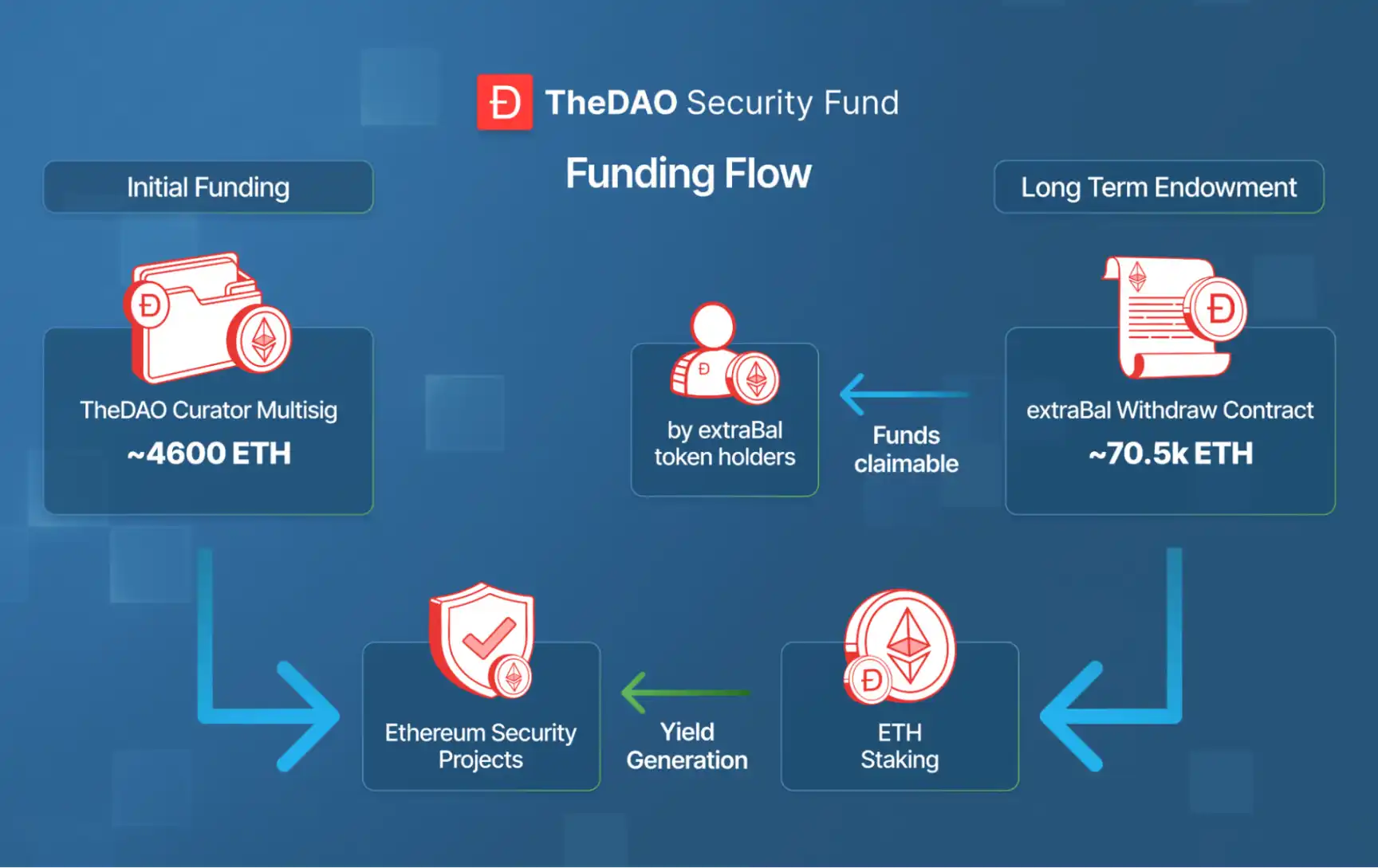
TheDAO Security Fund's fund operation and usage plan are clearly defined: 69,420 ETH withdrawn from the ExtraBalance contract will be staked to form a perpetual donation fund through staking rewards, providing long-term financial support for Ethereum security development; the staking rewards will be combined with the 4,600 ETH in TheDAO Curator Multisig to fund various Ethereum security-related projects. Meanwhile, a portion of the ExtraBalance withdrawal contract will retain some ETH to ensure legitimate claimants' rights are not affected.
In terms of funding scope, the core goal of TheDAO Security Fund is very clear—to prioritize Ethereum's overall ecosystem security, covering the full spectrum of security development scenarios: from wallet user experience optimization, smart contract security audits, to security incident emergency response, Ethereum core protocol security upgrades, and security protection for Layer 2 networks and cross-chain bridge ecosystems. All efforts to enhance Ethereum's security posture are included in the fund's funding scope.
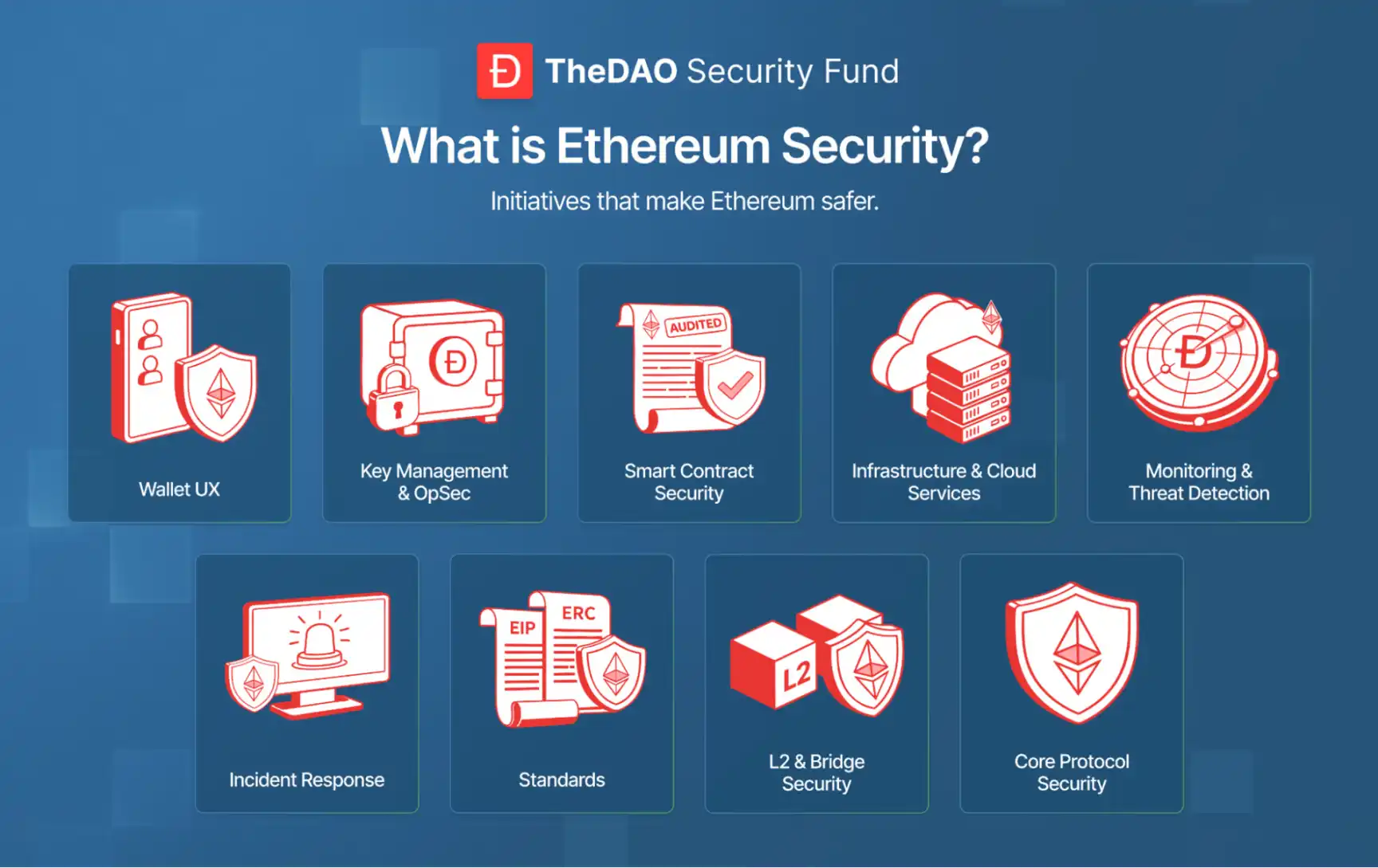
Furthermore, the fund will rely on the optimization directions and opportunities in the current security field outlined by the Ethereum Foundation's Trillion Dollar Security, combined with ongoing communication with ecosystem partners, to determine the specific scope and focus of each round of funding.
In terms of fund allocation mechanisms, TheDAO Security Fund adheres to the principles of open and bottom-up governance. It will employ diverse methods such as quadratic funding, retrospective funding, and sorting by Request for Proposals (RFP) to conduct funding rounds, allowing ecosystem participants to collectively participate in fund allocation decisions.
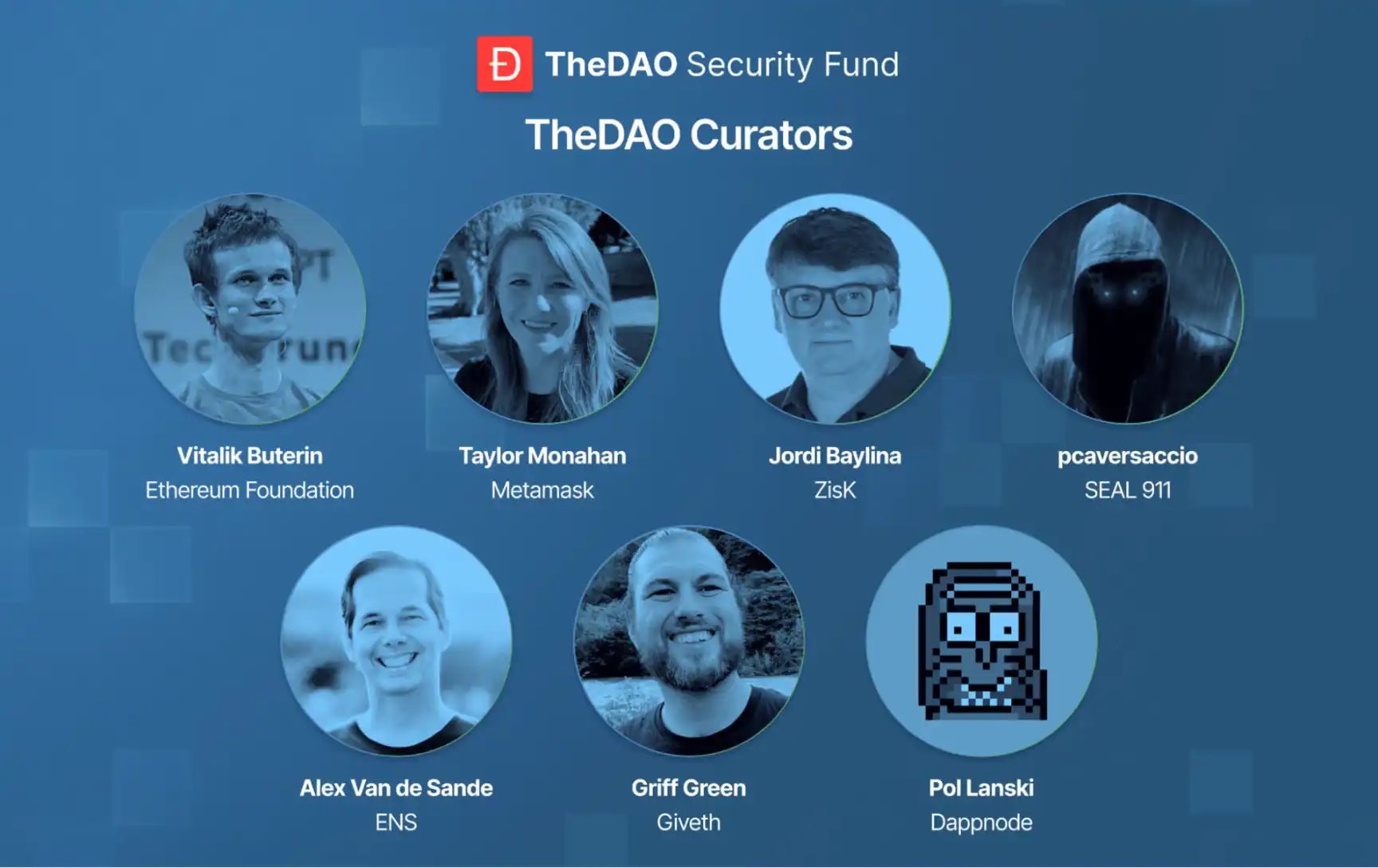
Currently, the fund has formed a professional Curator team to provide expert guidance and supervision for fund operation and funding decisions. Team members are experienced practitioners and security experts in the crypto ecosystem, including Ethereum founder Vitalik, MetaMask security engineer Taylor Monahan, Zisk, Giveth co-founder Jordi Baylina, security expert pcaversaccio, ENS co-founder Alex Van de Sande, and Dappnode CEO Pol Lanski.
Conclusion
TheDAO Security Fund is not without controversy, with the core debate still revolving around two key issues: the "legitimacy of use" of these remaining funds for the security fund and the "decentralization level" of the fund's governance.
Whether this substantial asset should be considered as "private property" belonging to all original token holders or has been identified as unclaimed property used for the "public good" is still a point of contention.
These controversies not only continue the Ethereum community's ideological divide sparked by The DAO incident in 2016 but also reflect the deep-seated governance contradictions in the current crypto ecosystem. Balancing decentralization principles with operational efficiency and asset disposal compliance remains a topic that the entire industry needs to continuously explore.
Setting aside the controversy, from the crowdfunding myth and ecosystem crisis of 2016 to the security fund and ecosystem guardianship of 2026, the decade-long cycle of The DAO itself is a microcosm of Ethereum's ecosystem development. It has witnessed Ethereum's journey from infancy to maturity and confirmed the resilience of the crypto ecosystem and the power of community.
Sources:
<1>https://en.wikipedia.org/wiki/The_DAO
<2>https://www.gemini.com/cryptopedia/the-dao-hack-makerdao
<3>https://unchainedcrypto.com/exclusive-thedao-to-become-new-220-million-ethereum-security-fund/
<4>https://paragraph.com/@thedao.fund/thedao-security-fund-activating-75000-eth-for-ethereum-security
<5>https://medium.com/curator-multisig-phf-official-channel/thedao-curator-multisig-a-decade-later-572796549d70
You may also like

When the P2P illicit funds from ten years ago turned into 60,000 bitcoins

Morning News | CME Group launches Nasdaq Cryptocurrency Index futures; Asset management giant Janus Henderson strategically invests in Ethena

Why did Oracle deliver the strongest financial report in history, yet its stock price fell?

Bitcoin Layer 2 Network Botanix: Why Did We Choose to Dissolve?

Morning Report | OpenAI has submitted an S-1 registration statement draft to the U.S. SEC; Morpho completes $175 million financing

Galaxy Deep Research Report: How Hyperliquid's HIP-4 Upgrade Changes the Landscape of Prediction Markets?

Latest research from 13 top universities including Cornell University: The current state, challenges, and misconceptions of the fusion of Crypto and AI
Deconstructing Anthropic: The Best AI Company, Possibly Also a Type of Organizational Invention

Every exchange is a "Universal Exchange."

The counterattack of traditional finance: Alliance chains are quietly reviving
Pantera Capital Partner: How Tokenization is Restructuring the Private Equity and Early Investment Ecosystem?

Mastercard Launches Agent Pay for AI, Plans to Record AI Agent Payment Authorizations on Polygon
Mastercard launched Agent Pay for AI, a new payment protocol designed to help AI agents make small payments such as pay-per-use access to data and APIs. The system plans to record human-granted AI agent permissions on Polygon, focusing on verifiable authorization, identity, and payment controls.

Curve Deploys Llamalend v2 on Optimism With 250,000 OP Incentives
Curve launched Llamalend v2 on Optimism with 250,000 OP incentives from the Optimism Foundation. The upgrade expands Llamalend beyond its earlier crvUSD-focused model, adding broader collateral support, LlamaRisk market reviews, and the ability to use Curve LP tokens as collateral.

Raydium Old Liquidity Pool Reportedly Exploited, With $1.34 Million Moved to Ethereum and Tornado Cash
An old Raydium liquidity pool was reportedly exploited for around $1.34 million in USDC, RAY, and wSOL, with the stolen funds bridged to Ethereum and deposited into Tornado Cash. The incident highlights the tail risks of legacy DeFi pools, old contracts, and cross-chain fund laundering paths.
Kalshi Executive Challenges “SBF Backed AI Unicorns” Narrative, Says Leopold Aschenbrenner Was Key Figure
Kalshi executive John Wang questioned the “SBF backed AI unicorns” narrative, saying Leopold Aschenbrenner was the key figure behind major AI investment decisions.

New York Proposes Stricter Stablecoin Issuer Rules Aligned With Federal GENIUS Act
NYDFS proposed stricter stablecoin issuer rules aligned with the GENIUS Act, covering reserves, custody, redemption timelines, audits, and capital buffers.

CryptoQuant Says Bitcoin Profitable Supply Is Near 45% Pressure Zone as On-Chain Data Points to Market Repricing
CryptoQuant said Bitcoin’s profitable supply is nearing the 45% pressure zone, signaling rising market stress, unrealized losses, and a possible on-chain repricing phase.

Bitcoin Falls Below 200-Week Moving Average as On-Chain Data Shows Over Half of Supply in Loss
Bitcoin dropped below its 200-week moving average as on-chain data showed over 50% of circulating supply is now in loss, signaling rising market stress.
When the P2P illicit funds from ten years ago turned into 60,000 bitcoins
Morning News | CME Group launches Nasdaq Cryptocurrency Index futures; Asset management giant Janus Henderson strategically invests in Ethena
Why did Oracle deliver the strongest financial report in history, yet its stock price fell?
Bitcoin Layer 2 Network Botanix: Why Did We Choose to Dissolve?
Morning Report | OpenAI has submitted an S-1 registration statement draft to the U.S. SEC; Morpho completes $175 million financing
Galaxy Deep Research Report: How Hyperliquid's HIP-4 Upgrade Changes the Landscape of Prediction Markets?


