
Three-Day 54% Surge: Where Does SUI's Growth Momentum Come From?




Original Title: "SUI Surges 54% in Three Days! DeFi Craze + Capital Frenzy, Is $4 Just the Beginning?"
Original Author: Lawrence, Mars Finance
SUI Against the Trend: Value Awakening Driven by Technology, Ecosystem, and Capital Synergy
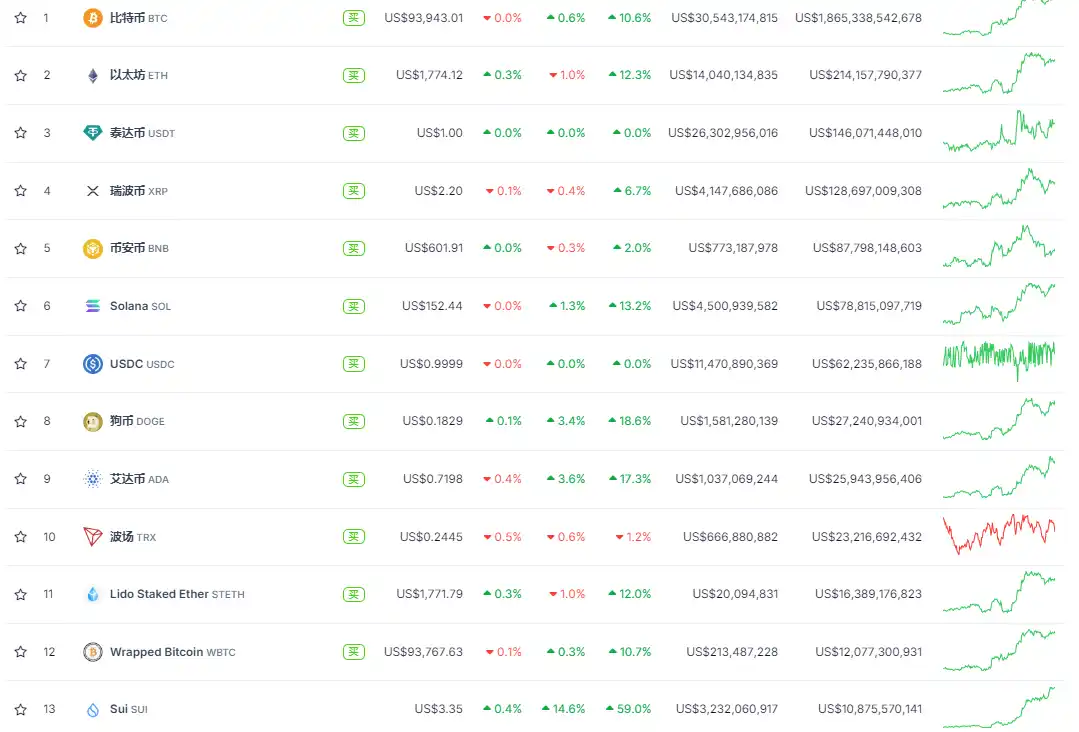
On April 25, 2025, the SUI token surged a staggering 54% over three days to break through $3.39, with the total on-chain value locked reaching $11 billion, making it the only project among the top 20 tokens by market capitalization to break historical resistance levels.
Key Data Comparison (as of April 25):
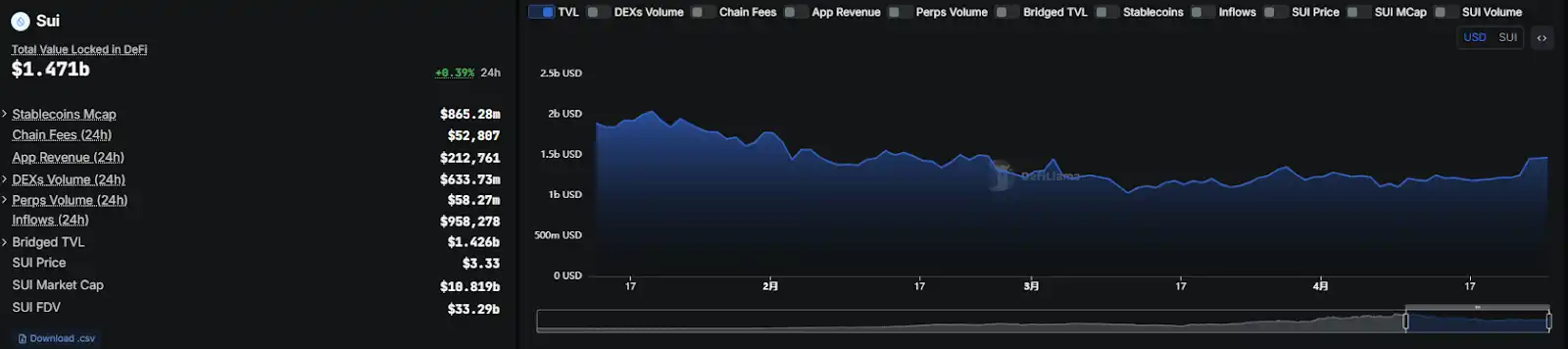
· TVL Growth: The Sui Network's total value locked (TVL) reached $14.6 billion, with a weekly growth rate of 10%, far exceeding Solana (+3.2%) and Avalanche (-1.8%) during the same period.
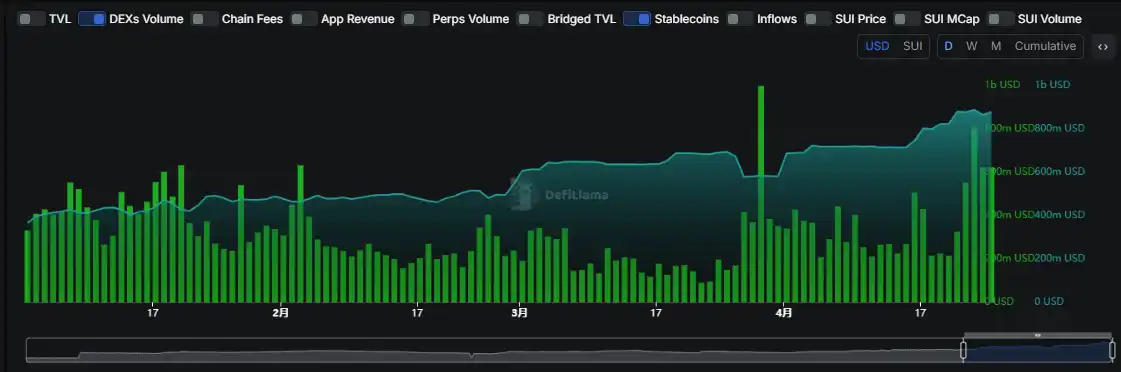
· Stablecoin Ratio: On-chain stablecoin market value surpassed $8.8 billion, with USDC holding a market share of 71%, and liquidity depth increased by 200% compared to three months ago
· DEX Surge: Daily DEX trading volume exceeded $620 million, weekly DEX trading volume reached $2.77 billion, 8 times higher than the market average, with meme coins contributing over 60% of the trading volume.
Behind this "divergent growth" is a new ecological paradigm built by Sui—a triple-engine breakthrough from foundational protocol to application ecosystem through technological stack refactoring, capital synergy, and community fission.
Technological Revolution: Operating System-level Architecture of Public Chain 3.0 Era
Sui's technical architecture is far from a traditional linear upgrade of public chains; it is a restructuring of blockchain architecture based on the concept of a "full-stack operating system":
1. Paradigm Shift of Consensus Mechanism
Mysticeti V2 Engine: Using a DAG (Directed Acyclic Graph) structure, it compresses the confirmation time of shared object transactions to 0.25 seconds, with a tested TPS throughput exceeding 120,000. This makes Sui the first public chain to support high-frequency quantitative trading, with DeepBook order book slippage reduced by 40% compared to Uniswap V4.Remora Sharding Mechanism: By splitting the validation node tasks into computing, storage, and verification modules, linear scalability is achieved. In the testnet environment, adding each group of node clusters increases TPS by 43,000.
2. Disruptive Breakthrough in Storage Layer
Walrus Distributed Network: As the first programmable storage sidechain, it uses erasure coding technology to reduce storage costs to 10% of traditional solutions. In its first month online, the mainnet hosted a 200TB AI training dataset, providing infrastructure for compute-intensive projects like Render Network.SEAL Dynamic Encryption Protocol: Achieving NFT content hierarchical authorization, Warner Music has released dynamic music NFTs based on this technology, with over 120 million plays.
3. Inter-Generational Leap in Developer Experience
· Move Prover Smart Verification: By formal verification, the contract vulnerability rate is reduced to 0.3%, a 5x improvement in security compared to Solidity.· RPC 2.0 Response System: A GraphQL-based query system compresses data call latency to within 50ms. Paired with Bugdar AI audit tools, development efficiency is tripled. This technological architecture has freed Sui from the "performance-decentralization" dichotomy. Artemis data shows that its active validating nodes reach 297, far exceeding Solana's 183, truly achieving both high performance and decentralization.
Ecosystem Eruption: Flywheel Effect of Multi-Track Collaboration
The Sui ecosystem has formed a complete matrix of "Infrastructure-Middleware-Application Layer," with each track showing a synergistic explosive trend:
1. Institutionalization Transformation of DeFi
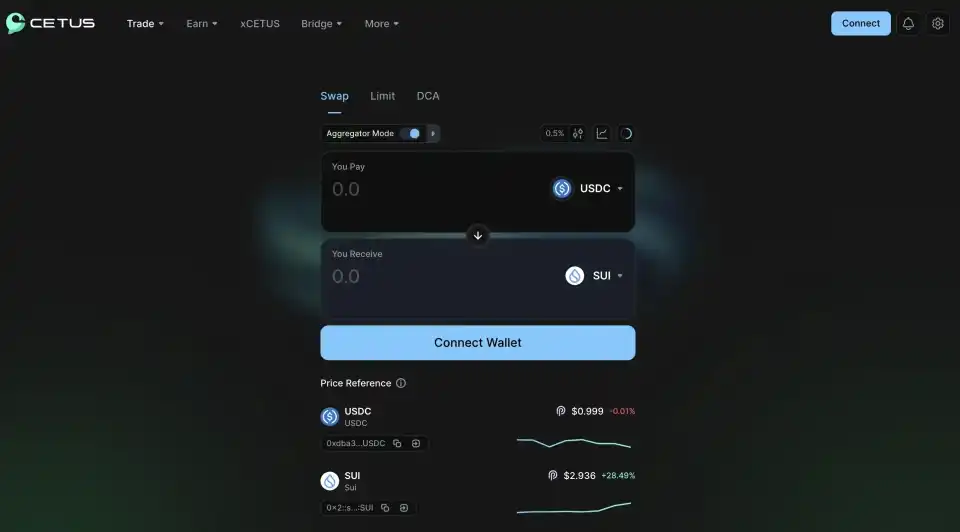
· Cetus Protocol: A liquidity aggregation protocol deeply integrated with DeepBook, stabilizing million-dollar trade slippage to within 0.3%. It has attracted top-tier market makers like Jump Crypto to settle, and the platform's token CETUS has seen a monthly increase of 180%.
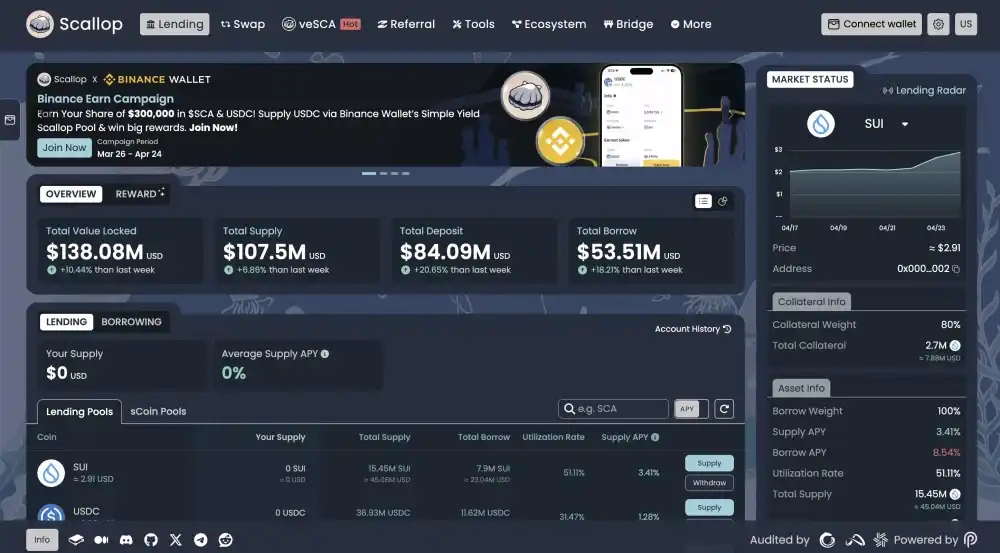
· Scallop Cross-Chain Hub: Through modular design, it supports seamless circulation of assets on 20 chains. Its "yield layering" mechanism has led stablecoin deposit APY to reach 15%, with TVL surpassing $500 million.
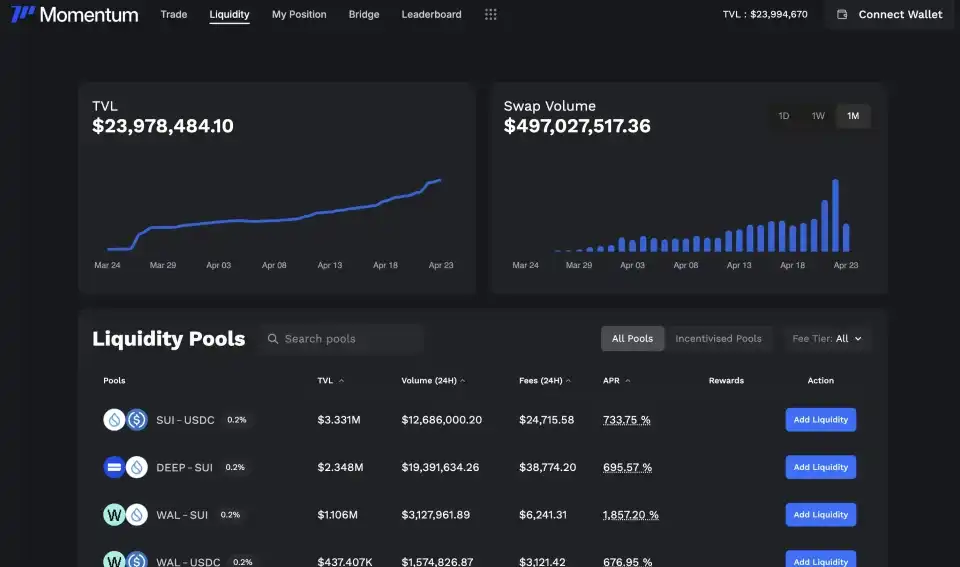
· Momentum Stablecoin Platform: The algorithmic stablecoin and over-collateralization hybrid mechanism achieve a daily average trading volume of $120 million, becoming a cornerstone of liquidity in the Sui DeFi ecosystem.
2. The Traffic Inflection Point of Meme+AI
· LOFI/BLUB Phenomenon: The single-day price surges of two major Meme coins reached 124% and 100% respectively, driving the on-chain active addresses to exceed 1.7 million. Its success stems from Sui's unique Gas Fee Subsidy Mechanism, keeping the cost of small transactions stable at $0.01
· RockeeAI: A DeFi protocol integrating natural language processing, achieving "Voice Command Trading" functionality. The social media sentiment analysis module covers 2000+ communities with a prediction accuracy of 78%
· Zeromorph Perpetual Contract: The AI Agent SDK supports users in training personalized strategies, and the "Risk Hedging Engine" reduces the liquidation rate to one-third of the industry average
3. Ecological Expansion of Hardware Breakthroughs
· SuiPlay0X1 Gaming Handheld: Deep integration of hardware with the blockchain gaming ecosystem, where 62% of the 700,000 pre-orders are from traditional gamers. This device supports seamless acquisition of NFT equipment, leading to a 300% surge in the number of Sui gaming DApps
· Sui Frens Dynamic NFT: Real-time interaction of NFT attributes through a gene mutation algorithm, with the floor price of rare editions surpassing 420 SUI. The minting volume has seen a 470% week-over-week growth
· This multi-dimensional outbreak forms an ecological flywheel: Technological superiority attracts developers → Rich applications enhance user retention → Capital inflow strengthens liquidity → Feedback into technological iteration.
Capital Resonance: Traditional Powers Entering to Reframe Valuation Logic
The essence of Sui's value reassessment is the mainstream capital's repricing of Web3 infrastructure:
1. Three Steps of Institutional Entry
· ETF Breakthrough: Canary Capital submitted the first SUI ETF application, with VanEck predicting a $3.5 billion incremental fund inflow upon approval
· RWA Layout: Collaborating with Franklin D. Roosevelt to build a tokenization platform, managing the on-chainization of $15 trillion in traditional assets
· Compliance Breakthrough: Obtaining the Dubai VARA license, becoming the first compliant public chain in the Middle East, with the Abu Dhabi Sovereign Wealth Fund allocating $230 million
2. Liquidity Structural Transformation
· Stablecoin Leverage: The USDC circulation increased by 7.77% weekly, with institutions conducting cross-chain arbitrage through the CCTP protocol, with a daily average arbitrage scale exceeding $80 million
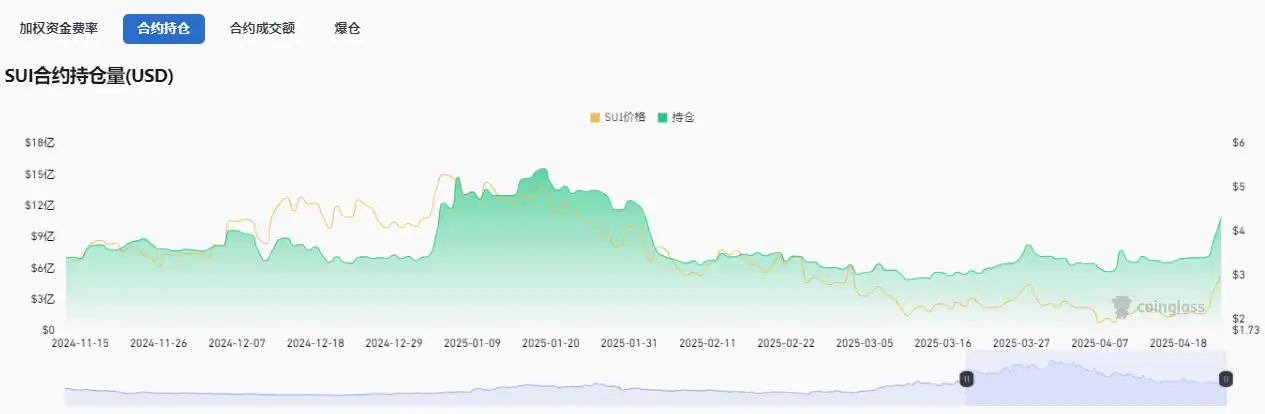
Sui Network-wide Contract Position Surpasses $1.1 Billion
· Contract Position Anomaly: Coinglass data shows a 320% weekly increase in the call option open interest at a $3.5 strike price, with the market betting on a breakout above $4 in May
3. Disruption of Valuation Models
Traditional public chain valuations often adopt Metcalfe's Law (Value∝Number of Users²), while Sui's full-stack capability has spawned the "Metcalfe-Ziff Composite Model":
· Valuation = Number of Developers × (Number of DApps + TVL)^1.5
· According to this model, Sui's current valuation should reach $20 billion, indicating an 80% upside potential from the current price.
· This expectation is supported by on-chain data: the current SUI chain adds 17 new DApps daily, which is 2.3 times that of Solana, signaling an exponential growth stage in network effects.
Conclusion: The Second Half of Public Chain Competition Begins
The rise of SUI marks the entry of blockchain competition into the era of "full-stack capabilities." While other public chains are still grappling with TPS figures, Sui has quietly completed its comprehensive layout from the protocol layer to the application layer, from the online ecosystem to offline hardware. Through the triple resonance of technological depth, capital strength, and ecosystem breadth, Sui is rewriting the fundamental rules of Web3.
The essence of this value reconfiguration is the evolution of blockchain from a "financial experimental field" to a "digital economic operating system." When SUI Play0X1 handheld devices begin to appear in the hands of subway passengers, when Warner Music fans go crazy for dynamic NFTs, we may be witnessing the true "breakout moment" of blockchain technology. Perhaps this feast has just begun.
You may also like

Japan’s Three Megabanks Plan Joint Stablecoin Issuance in Fiscal 2026
MUFG, SMBC, and Mizuho reportedly plan to jointly issue fiat-pegged stablecoins in fiscal 2026, signaling Japan’s growing push into bank-led digital payment infrastructure.

Humanity Discloses H Token Dual-Chain Attack Details, With Losses on Ethereum and BSC Exceeding $36 Million
Humanity said the H token attack across Ethereum and BSC caused more than $36 million in losses after leaked ProxyAdmin keys enabled malicious contract upgrades and token minting.

White House Discusses CLARITY Act With Law Enforcement Ahead of Senate Vote
The White House discussed the CLARITY Act with law enforcement ahead of a Senate vote, focusing on illicit finance risks and developer protections.

$75 billion in foreign capital has fled, and South Korean retail investors have absorbed it all using leverage

Bitcoin Trading Guide 2026: Strategies for Experienced Traders

What Is XAUT and PAXG? Why Tokenized Gold Is Booming in 2026

Cryptocurrency CEXs are flocking to sell US stocks, and traditional brokerages are facing an "uninvited guest."

Will the SpaceX IPO Hurt Bitcoin? Here's What Traders Are Watching
Foreign selling in the South Korean stock market accelerates, with cumulative net sales reportedly reaching $75 billion this year
On June 9, The Kobeissi Letter, citing Goldman Sachs data, reported that global investors are selling South Korean stocks at an unusually rapid pace. In the latest trading session, foreign investors sold about $801 million worth of Kospi constituent stocks again; total foreign outflows last week reached about $10 billion, and the market has been in net foreign selling on nearly every trading day over the past month. According to the data cited in the report, foreign investors have sold about $75 billion worth of South Korean stocks so far this year. Meanwhile, South Korean retail and institutional investors together recorded roughly $69 billion in net buying over the same period, suggesting that the market’s main buying support has come from domestic capital rather than returning overseas funds. The information currently disclosed still mainly comes from The Kobeissi Letter’s retelling and Goldman Sachs data summaries, while public details on the statistical period and the specific definition of “selling” remain relatively limited.

Fortune Warns of Strategy’s Financing Structure Risks as Bitcoin Premium Narrows
Fortune warned that Strategy’s Bitcoin treasury model faces growing financing risks as MSTR’s net asset premium narrows and preferred stock dividend pressure increases.

Ferrari Challenge Le Mans: Carl Moon to Dominate in WEEX Livery

Sahara AI Responds to SAHARA’s Sharp Drop: No Contract or Product Security Issues Found, Internal Investigation Underway
Sahara AI responded to SAHARA’s 60% price drop, saying no token contract or product security issues have been found and an internal investigation is underway.

WEEX Deposit/Withdrawal Dynamic Island: Your Asset Status, Always in Sight
Scaling Crypto Derivatives: The Digital Asset Infrastructure Behind High-Volume Trading
In the fast-moving digital asset ecosystem, derivatives platforms face an extreme architectural test. High-leverage futures markets demand more than just standard security—they require absolute operational precision, zero-latency matching engines, and ironclad structural scalability, all while navigating intense market volatility.
As global platforms scale to meet these demands, the industry is shifting away from rigid, monolithic setups toward a more agile, "decoupled" infrastructure philosophy.
The Blueprint for High-Volume Copy TradingFor elite global exchanges like WEEX (founded in 2018), this architectural choice becomes critical when scaling high-volume retail features like social copy trading. When thousands of users automatically mirror the real-time strategies of elite traders simultaneously, it triggers sudden, monumental spikes in concurrent transactional volume.
To prevent execution latency or settlement bottlenecks during these peak volatility events, a platform's primary engine must remain entirely dedicated to risk management, copy-trade synchronization, and order matching.
The Architectural Rule: New-generation platforms must separate front-end user execution engines from heavy backend infrastructural overhead to eliminate operational friction.
By separating these layers, platforms can maintain complete sovereignty over their trading environments and user experiences while strategically aligning with institutional-grade infrastructure ecosystems. This strategic framework allows modern exchanges to leverage advanced Digital Asset Custody infrastructure such as Cobo’s behind the scenes, ensuring that backend wallet management scales elastically alongside trading spikes.
Capitalizing on Market Momentum and 400× LeverageIn a derivatives arena where platforms offer up to 400× leverage on perpetual contracts, capital efficiency and market agility are core business metrics. To capture market momentum, an exchange needs the ability to rapidly expand its asset offerings, supporting everything from legacy crypto assets to sudden, trending altcoins across a massive library of trading pairs.
Adopting a flexible, scalable Wallet-as-a-Service (WaaS) solution such as Cobo’s could completely rewrite the development timeline for high-growth exchanges. Instead of spending months of engineering capital building out custom backend wallet architectures for every new blockchain network, platforms can deploy localized infrastructure in days.
This agility allows platforms to instantly scale their listings to over a thousand trading pairs without compromising security or delaying time-to-market. It mirrors the exact operational advantages seen during high-velocity market events, similar to how advanced wallet infrastructure empowers platforms during sudden asset surges; allowing exchanges to pass that speed and liquidity directly to their global user base.
A Mature Foundation for GrowthThe synergy between trusted infrastructure ecosystems and global trading platforms represents the natural evolution of a maturing crypto market. As WEEX continues to scale its global spot and derivatives offerings for over 6 million users, adopting robust backend paradigms proves that platforms no longer have to compromise between cutting-edge trading velocity and uncompromised structural security.

Morning Report | BitMine increased its holdings by 126,971 ETH last week; trader Eugene announced his exit from the crypto market

Wang Chuan: How can one not feel anxious after the neighbor Old Wang made thirty times profit by investing in storage stocks? (Seven) - A quarter-century cycle

Get Paid to Onboard? Try WEEX’s New Homepage with Rewards for Registration, Deposit & Trade
WEEX Custom Layout: Build Your Perfect Trading Workspace in Seconds
Japan’s Three Megabanks Plan Joint Stablecoin Issuance in Fiscal 2026
MUFG, SMBC, and Mizuho reportedly plan to jointly issue fiat-pegged stablecoins in fiscal 2026, signaling Japan’s growing push into bank-led digital payment infrastructure.
Humanity Discloses H Token Dual-Chain Attack Details, With Losses on Ethereum and BSC Exceeding $36 Million
Humanity said the H token attack across Ethereum and BSC caused more than $36 million in losses after leaked ProxyAdmin keys enabled malicious contract upgrades and token minting.
White House Discusses CLARITY Act With Law Enforcement Ahead of Senate Vote
The White House discussed the CLARITY Act with law enforcement ahead of a Senate vote, focusing on illicit finance risks and developer protections.
$75 billion in foreign capital has fled, and South Korean retail investors have absorbed it all using leverage
Bitcoin Trading Guide 2026: Strategies for Experienced Traders
What Is XAUT and PAXG? Why Tokenized Gold Is Booming in 2026


